

8×8 Full Body Workout: Eight Sets of Pain for Infinite Gains

8×8 Full Body Workout: Eight Sets of Pain for Infinite Gains
The Old-School Training Method That Still Delivers Real Results
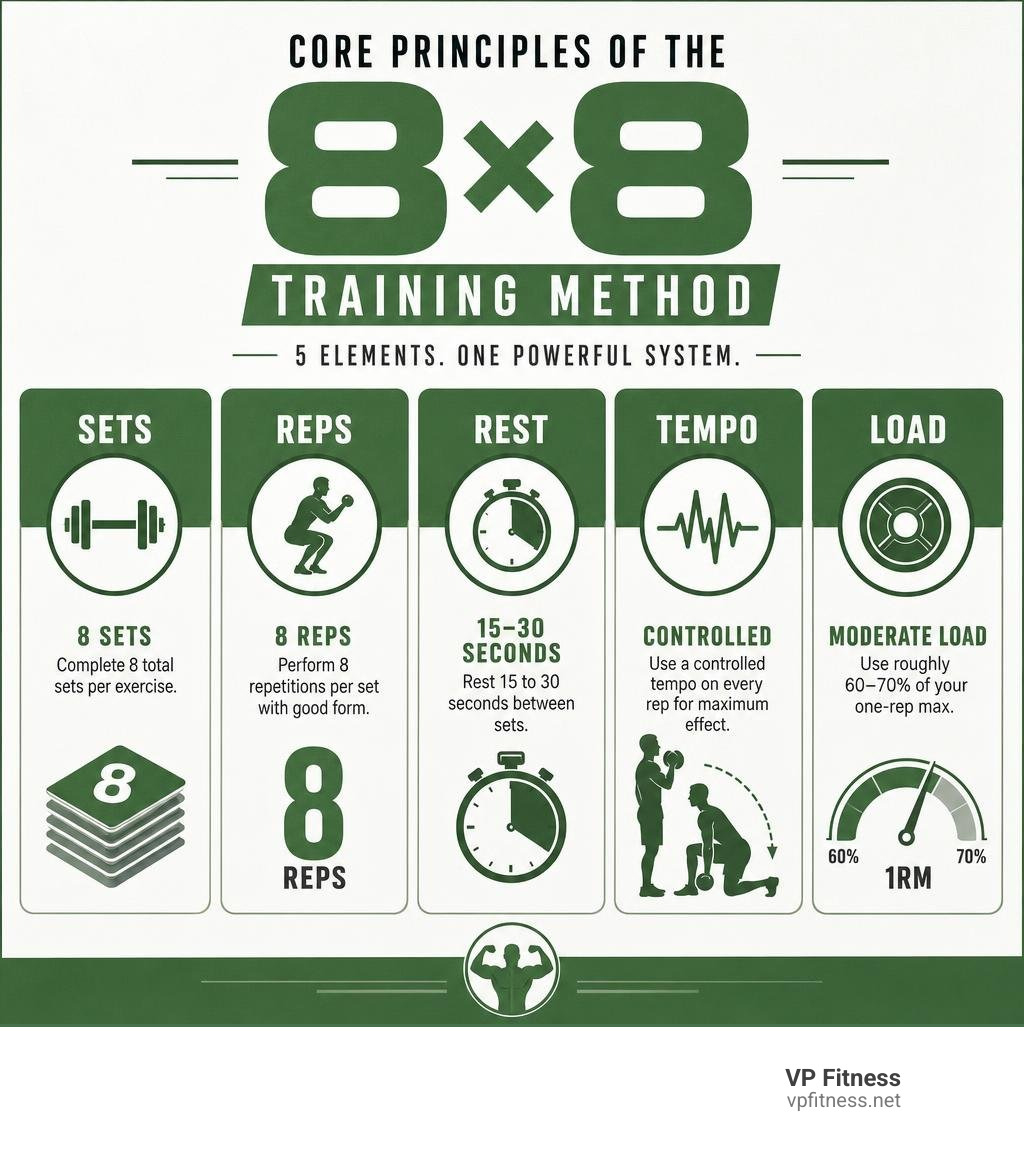
An 8×8 full body workout is a high-volume training protocol where you perform 8 sets of 8 reps for each exercise, with very short rest periods of 15 to 30 seconds between sets. Here’s the quick breakdown:
- What it is: 8 sets × 8 reps per exercise, with 30 seconds or less rest
- Who created it: Vince Gironda, bodybuilding coach and trainer to Hollywood celebrities in the 1960s
- How long it takes: Around 40 to 45 minutes for a full session
- Best for: Muscle growth, fat loss, and cardiovascular endurance
- Weight used: Roughly 60–70% of your one-rep max
- Who it suits: Intermediate to advanced trainees seeking a new challenge
If you’ve hit a wall with your current routine, the 8×8 method might be exactly the shock your body needs. It’s one of the oldest high-volume training systems in bodybuilding — and it’s still earning its reputation decades later.
Vince Gironda, known as the Iron Guru, called it “the honest workout.” Why? Because the short rest periods force you to use lighter weights than your ego wants. There’s nowhere to hide. The method strips away heavy loads and replaces them with density — more work packed into less time — creating intense metabolic stress that drives muscle growth and torches calories.
The results speak for themselves. Gironda’s clients included A-list names like Clint Eastwood, Carl Weathers, and Arnold Schwarzenegger. His training methods were unconventional for the era, but the physiques he built were hard to argue with.
I’m Joseph DePena, a master trainer with over a decade of experience designing high-volume programs — including the 8×8 full body workout — for clients at every fitness level. Whether you’re chasing size, definition, or just a brutally efficient session, this guide covers everything you need to put the 8×8 method to work.
Demystifying the 8×8 Full Body Workout Protocol
To understand why the 8×8 full body workout is so uniquely effective, we have to look past modern fitness fads and return to the golden era of bodybuilding. While contemporary gym culture often obsesses over lifting as heavy as possible for low reps, the 8×8 protocol relies on an entirely different mechanism of growth: training density.
The History and Philosophy of Vince Gironda
In the 1960s, Vince Gironda reigned supreme as the “Iron Guru” from his legendary gym in California. He was famous for his zero-nonsense attitude and his radical training philosophies. While other trainers of his era pushed for endless sets of heavy, low-rep lifts, Gironda prioritized aesthetic symmetry, physical conditioning, and muscle density. He famously banned cardio equipment from his gym, once even throwing a trainee out just for talking about running. To Vince, if you wanted cardiovascular conditioning, you simply needed to lift faster.
The absolute pinnacle of his training systems was the 8×8 protocol. He designed this method to rapidly reshape a lifter’s physique, calling it the “honest workout” because it instantly exposes any weaknesses in endurance, mental grit, and form. If you want to dive deep into his historical training logs, you can read the original Vince Gironda’s 8×8 Workout Plan. Gironda believed that physical cosmetic improvement was achieved not by moving massive weights with sloppy form, but by forcing the muscles to adapt to a massive volume of work in a highly compressed timeframe.
How 8×8 Differs from Traditional Training Protocols
Traditional hypertrophy training typically involves performing 3 to 4 sets of 8 to 12 reps, resting anywhere from 90 seconds to 3 minutes between sets. While this is great for building baseline strength, it allows your heart rate to drop and your muscles to fully recover before the next set.
The 8×8 method flips this formula on its head. Instead of prioritizing mechanical tension through heavy loads, 8×8 prioritizes training density—the amount of work you perform per minute.
By keeping your rest intervals strictly between 15 and 30 seconds, your muscle fibers never fully recover. Each subsequent set builds on the fatigue of the last, recruiting dormant muscle fibers and forcing your cardiorespiratory system to work at maximum capacity. This high-density approach is a complete departure from standard splits, which you can read more about in our Workout Splits Ultimate Guide.
Rather than spending two hours in the gym scrolling on your phone between heavy sets, an 8×8 routine delivers a brutal, highly efficient workout in under 45 minutes.
The Science and Benefits of High-Density Training
Though Vince Gironda designed the 8×8 method in the mid-20th century based on pure intuition and real-world results, modern exercise science has validated his approach. High-density training triggers unique physiological adaptations that traditional lifting simply cannot replicate.
Hypertrophy and Metabolic Stress
Muscle growth, or hypertrophy, is primarily driven by three factors: mechanical tension, muscle damage, and metabolic stress. While heavy powerlifting styles focus on mechanical tension, the 8×8 method is the undisputed king of metabolic stress.
By performing 64 reps per exercise with minimal rest, you trigger a massive accumulation of metabolic byproducts, such as hydrogen ions and lactate, within the target muscle. This lack of recovery time restricts oxygen-rich blood flow to the muscle temporarily, a phenomenon known as hypoxia.
When you finally finish your 8 sets, blood rushes back into the muscle, causing a massive “pump” or cellular swelling. This swelling triggers a cascade of anabolic signaling pathways, leading to sarcoplasmic hypertrophy—an increase in the volume of the non-contractile fluid within your muscle cells. If you want to learn more about the biological mechanisms of muscle building, check out our guide on How To Build Muscle.
Cardiovascular and Fat Loss Benefits
Because your heart rate remains elevated throughout the entire 40-minute session, an 8×8 workout double-hats as a highly effective cardiovascular workout. It is essentially a form of high-intensity resistance training (HIRT).
This relentless pace triggers a high rate of Excess Post-Exercise Oxygen Consumption (EPOC). This means your metabolism remains elevated for hours, sometimes even days, after your workout ends, as your body works to repair muscle tissue and replenish oxygen stores.
For those looking to shed body fat while preserving lean muscle mass, this combination is incredibly powerful. It allows you to build a defined, athletic physique without spending hours on a treadmill. For a deeper look at shaping your body, check out our Best Size Definition Workout Guide.
Rules of Engagement: How to Execute the 8×8 Protocol

The 8×8 method is simple on paper, but executing it correctly requires extreme discipline. If you bend the rules, you lose the unique metabolic benefits of the program. To get the most out of your training, you must adhere to these strict guidelines.
Mastering the 8×8 Full Body Workout Rest and Tempo
The absolute most important rule of the 8×8 protocol is the rest interval. You must keep your rest periods between 15 and 30 seconds. In fact, advanced bodybuilders under Vince Gironda’s guidance would sometimes take only 5 to 10 deep breaths (about 10 to 15 seconds) before starting their next set. Do not put the weights down, do not look at your phone, and do not chat with your training partner. Keep your hands on the bar or dumbbells and focus.
Equally important is your training tempo. We recommend a strict 2-0-2-0 tempo:
- 2 seconds for the eccentric (lowering) phase
- 0 seconds pause at the bottom
- 2 seconds for the concentric (lifting) phase
- 0 seconds pause at the top
This controlled, continuous movement keeps constant tension on the target muscle group. Avoid using momentum or exploding through the reps. By eliminating pauses, you maximize the burn and keep the mind-muscle connection locked in from the first rep to the sixty-fourth.
Weight Selection and Load Progression
Because the rest periods are so short, you cannot use your standard 8-rep maximum weight. If you do, you will likely hit absolute failure by set three or four.
Instead, you should reduce your normal 8-rep max by roughly 35% to 40%. This usually equates to about 60% to 70% of your one-rep max (1RM). Your first few sets should feel relatively easy, almost like a warm-up. However, as the cumulative fatigue sets in around set five, the weight will begin to feel incredibly heavy.
Your goal is to use the exact same weight across all 8 sets. Do not lower the weight if it gets too hard. If you cannot complete all 8 reps on your later sets, keep the weight the same and try to get as many reps as possible.
Only increase the weight in your next workout once you can successfully complete all 8 sets of 8 reps with perfect form and a strict 30-second rest. For more tips on managing load progression safely, refer to the Complete Guide to the Vince Gironda Workout 8×8 Method (2026).
Designing Your 8×8 Full Body Workout Routine

When structuring an 8×8 full body workout, exercise selection is critical. Because of the extreme metabolic demand, you cannot perform 8×8 on highly complex, dangerous lifts like 1RM deadlifts or Olympic cleans. Instead, we focus on stable, highly effective compound movements that target large muscle groups.
Selecting the Best Exercises for an 8×8 Full Body Workout
Compound movements are generally preferred over isolation exercises because they recruit more muscle mass, leading to a greater metabolic and hormonal response. However, because of the short rest intervals, exercises that require heavy core stabilization (like back squats or barbell overhead presses) can become dangerous as your lower back fatigues.
To solve this, we recommend using dumbbells or machines for certain movements. Dumbbells allow for a natural range of motion and reduce joint stress, which you can learn more about in our Dumbbell Workout Routine Guide.
Here are the five staple exercises we use for our ultimate 8×8 full-body routine:
- Dumbbell Front-Rack Squat (Quads, Glutes)
- Dumbbell Bench Press (Chest, Shoulders, Triceps)
- Chest-Supported Dumbbell Row (Upper Back, Lats, Biceps)
- Double Dumbbell Romanian Deadlift (Hamstrings, Glutes)
- Dumbbell Standing Shoulder Press (Shoulders, Triceps)
By utilizing these exercises, you can safely push your limits without risking injury to your lower back. For a comprehensive look at full-body training, check out our core resource on the Full Body Workout.
Sample 8-Week Progression and Routine Structure
To help you implement this, we have designed a structured 8-week progression. We will use an Every Minute On the Minute (EMOM) timing structure.
This means you start a set at the top of every minute, perform your 8 reps (which takes about 32 seconds at a 2-0-2-0 tempo), and then rest for the remainder of that minute (about 28 seconds). This naturally enforces the strict rest times.
The 40-Minute EMOM 8×8 Workout
Perform this workout 3 days per week (e.g., Monday, Wednesday, Friday), allowing at least 48 hours of rest between sessions.
- Minute 0–7 (8 Sets): Dumbbell Front-Rack Squat (8 reps per minute)
- Minute 8–15 (8 Sets): Dumbbell Bench Press (8 reps per minute)
- Minute 16–23 (8 Sets): Chest-Supported Dumbbell Row (8 reps per minute)
- Minute 24–31 (8 Sets): Double Dumbbell Romanian Deadlift (8 reps per minute)
- Minute 32–39 (8 Sets): Dumbbell Standing Shoulder Press (8 reps per minute)
If you are training at home or do not have access to heavy weights, you can adapt this protocol into a bodyweight circuit. To learn how to scale bodyweight movements progressively, check out the 8-Week Full Body Routine: No Equipment, No Gym, Real Progression.
To see how the 8×8 method stacks up against other high-volume programs, let’s compare it to German Volume Training (GVT):
| Feature | Vince Gironda’s 8×8 Method | German Volume Training (10×10) |
|---|---|---|
| Total Sets | 8 sets per exercise | 10 sets per exercise |
| Reps per Set | 8 reps | 10 reps |
| Rest Interval | 15–30 seconds | 60–90 seconds |
| Intensity (Load) | 60–70% of 1RM | 50–60% of 1RM |
| Primary Focus | Density, metabolic stress, fat loss | Absolute hypertrophy, volume |
| Time Efficiency | Extremely high (under 45 mins) | Moderate (60–75 mins) |
Potential Drawbacks, Recovery, and Nutrition
While the 8×8 full-body routine is incredibly effective, it is also highly demanding. To prevent injury and ensure continuous progress, you must manage your recovery and nutrition with the same discipline you bring to the gym floor.
Managing Fatigue and Avoiding Overtraining
The sheer volume of an 8×8 routine places a heavy tax on your central nervous system (CNS) and your joints. Connective tissue (tendons and ligaments) adapts to training stress much slower than muscle tissue. If you dive straight into an 8×8 routine without proper conditioning, you risk overuse injuries like tendinitis.
To avoid overtraining, we recommend running this program for a maximum of 8 weeks. After 8 weeks, your body will have adapted to the stimulus, and the risk of chronic fatigue increases.
Take a mandatory “deload” week where you reduce your training volume by half, or transition back to a traditional strength routine. To understand how to balance high-volume phases with recovery, read our guide on how Full Body Gains Maximize Muscle In Just 3 Days A Week.
Nutrition and Supplementation for High-Volume Training
You cannot recover from an 8×8 routine on a starvation diet. Because this program burns an immense number of calories both during and after the workout, you need to fuel your body properly.
- Caloric Intake: To maximize muscle growth, aim for a slight caloric surplus (around 200–300 calories above maintenance). If your goal is fat loss, keep a moderate caloric deficit but ensure your protein remains high.
- Protein: Consume 0.8 to 1.0 grams of high-quality protein per pound of body weight daily to support muscle repair.
- Hydration: The massive pumps generated by 8×8 require optimal cellular hydration. Drink plenty of water throughout the day, and consider adding electrolytes to your intra-workout water.
For a deeper dive into structuring your diet for high-volume training, you can explore the 8×8 Workout: Lean Muscle Gainz Workout.
Frequently Asked Questions about the 8×8 Method
Can beginners do an 8×8 workout?
Generally, we do not recommend a weighted 8×8 routine for absolute beginners. The short rest periods make it very difficult to maintain proper form as fatigue sets in, which can lead to injury.
However, beginners can easily scale the protocol by using bodyweight exercises. Performing a bodyweight circuit using the 8×8 structure is an excellent way to build cardiovascular endurance and joint stability. If you want to try a bodyweight version, take a look at The 8X8 Bodyweight Workout.
Is the 8×8 method good for strength gains?
If your primary goal is to increase your one-rep max on the bench press or squat, 8×8 is not the best tool. Strength training requires high mechanical tension (lifting weights above 85% of your 1RM) and long rest periods to allow the nervous system to fully recover.
The 8×8 method is designed strictly for cosmetic improvements, muscle density, metabolic conditioning, and hypertrophy. Think of it as a “shock” program to break through muscle-building plateaus rather than a powerlifting routine.
How often should I perform an 8×8 routine?
Because a full-body 8×8 workout is so demanding, you should only perform it 3 days per week, leaving a rest day between sessions. If you prefer training more frequently, you can split the routine into an upper/lower split, training 4 days per week.
However, never train 8×8 on consecutive days for the same muscle groups. To learn more about how to structure your training week, read our guide on choosing the right Workout Split Routine.
Conclusion
The 8×8 full body workout is a legendary, time-tested protocol that strips away the fluff of modern fitness and delivers real, undeniable results. It will test your cardiovascular endurance, challenge your mental toughness, and spark new muscle growth by packing incredible volume into a tight, 40-minute window.
We believe that elite results require personalized execution. A professional training environment is designed to give you the perfect space to push your limits.
With expert trainers, individualized nutrition guidance, and proper post-workout recovery, every drop of sweat counts.
Ready to stop spinning your wheels and start making real progress? Let us build the ultimate roadmap for your fitness journey. Check out our guide on how to Transform Your Body With A Full Body Workout Routine, or take the first step today by exploring our personalized Full Body Workout programs. Let’s get to work!