

Best Band Exercises for Full Body Toning Without a Gym

Best Band Exercises for Full Body Toning Without a Gym
Why Band Exercises for Full Body Toning Are More Effective Than You Think
Band exercises for full body toning are one of the most underrated tools in fitness — and they work for almost everyone, regardless of experience level.
Here are the most effective resistance band exercises to train your entire body:
- Banded Squat – targets quads, glutes, and hamstrings
- Banded Deadlift – works hamstrings, glutes, and lower back
- Band Chest Press – builds chest, shoulders, and triceps
- Seated Row – strengthens lats, rhomboids, and biceps
- Overhead Press – develops shoulders and triceps
- Glute Bridge with Band – activates glutes and hips
- Band Pull-Apart – corrects posture and targets rear delts
- Lateral Walk – fires up glute medius and hip stabilizers
- Pallof Press – builds core and anti-rotational strength
- Band Biceps Curl – isolates biceps with constant tension
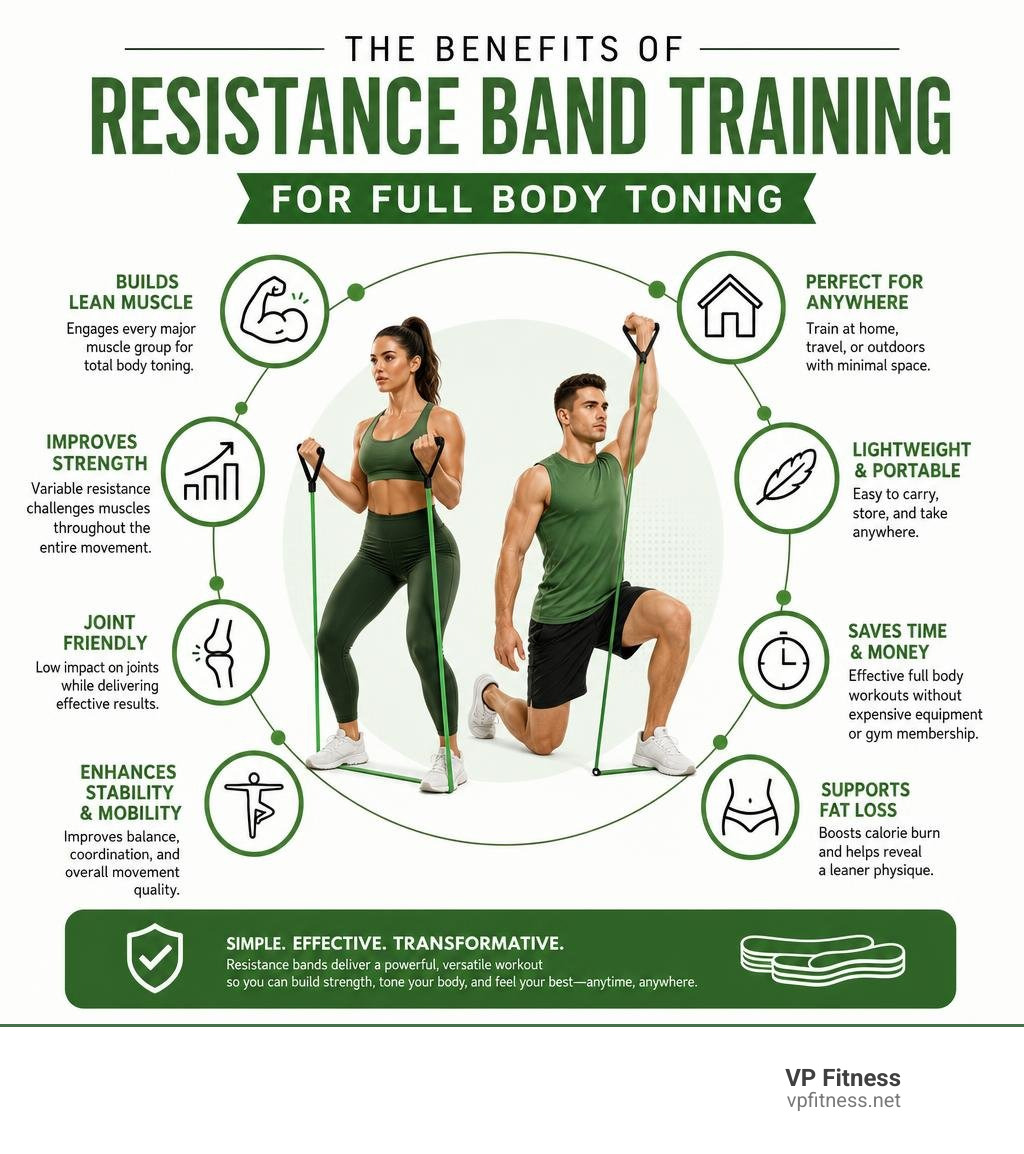
Resistance bands are lightweight, portable, and surprisingly powerful. A 2019 meta-analysis confirmed that elastic resistance training produces similar strength gains to conventional weight training. That means you don’t need a full rack of dumbbells to get real results.
Whether you’re working out at home, traveling, or just want a break from machines, bands can load every major muscle group — legs, back, chest, shoulders, arms, and core — with nothing more than a loop of rubber and a few feet of floor space.
I’m Joseph DePena, founder of VP Fitness and a master trainer with over a decade of experience helping clients build strength and improve body composition using band exercises for full body routines. In this guide, I’ll walk you through the exact exercises, structures, and progressions that actually deliver results.
The Science of Variable Resistance
To understand why resistance bands are so effective, we have to look at the physics of how they load your muscles. Unlike free weights or cable machines, which provide a constant gravitational or mechanical load, resistance bands utilize what is known as variable or accommodating resistance.
As a resistance band stretches, the tension increases. This creates an ascending resistance curve.
Think about a standard squat: you are mechanically weakest at the very bottom of the movement (the “hole”) and strongest near the top as you approach lockout. Free weights are limited by your weakest point; if you cannot lift a barbell out of the hole, you cannot complete the rep, even if your muscles could handle twice that weight at the top.
Resistance bands solve this problem. Because the band is under less stretch at the bottom of the squat, the load is lighter where your joints are in their most vulnerable positions. As you rise and your mechanical leverage improves, the band stretches, increasing the tension exactly where your muscles are strongest. This joint-friendly loading pattern allows you to maximize muscle activation throughout the entire range of motion without overloading your joints at their weakest angles.
Furthermore, electromyography (EMG) studies show no meaningful difference in muscle activation when comparing elastic resistance to traditional gym equipment. For example, a 2010 study published in the Journal of Strength and Conditioning Research found that chest activation during a banded push-up was virtually identical to a standard barbell bench press. This scientific backing is further detailed in a comprehensive 2019 systematic review on elastic resistance training which concluded that bands produce strength and hypertrophy outcomes comparable to conventional weights when training volume and effort are matched.
By incorporating variable resistance into your routine, you can safely stimulate muscle growth, improve joint stability, and transform your body with a full body workout routine that doesn’t require heavy, joint-jarring iron.
Additionally, a 2022 systematic review found that resistance band training improved body fat levels in overweight or obese individuals more effectively than other resistance training modalities. This makes bands an incredible tool not just for building strength, but for body recomposition and overall cardiovascular health.
Choosing the Right Resistance Bands for Your Goals
Before we dive into the exercises, let’s talk gear. Walking into a fitness store or browsing online can be overwhelming because bands come in all shapes, sizes, and colors. To build a balanced routine, you need to know which tool is right for the job.
Here are the three primary types of resistance bands you will encounter:
- Long Loop Bands (Power Bands): These are giant rubber bands, typically 41 inches long. They are the most versatile bands available. You can stand on them for squats, anchor them to a door for rows, or use them to assist you in pull-ups. If you can only buy one type of band, make it a set of these.
- Tube Bands with Handles: These bands feature plastic handles at the ends and often come with a door anchor. They are excellent for replicating cable-machine exercises like chest presses, lat pulldowns, and bicep curls.
- Mini Bands (Loop & Fabric): Small, tight loops designed to go around your thighs or ankles. Latex mini bands are great for quick upper-body activation, while thicker fabric mini bands are ideal for lower-body movements like lateral walks because they won’t roll up or pinch your skin.
To get the most out of your training, you must understand how to apply progressive overload—the gradual increase of stress placed upon the body during exercise. With free weights, you simply grab a heavier dumbbell. With bands, you can progress by switching to a thicker band, “choking up” on the band to shorten the starting length, standing further from your anchor point, or slowing down your tempo to increase time under tension.
For a structured approach to starting out, check out our beginners guide to full body routine to establish a solid foundation.
Below is a quick-reference guide to help you match band types and resistance levels to your specific goals:
| Band Type | Typical Tension Range | Best For | Progression Method |
|---|---|---|---|
| Yellow / Light Loop | 5 – 15 lbs | Warm-ups, rotator cuff rehab, face pulls | Increase reps, add 2-second pauses |
| Green / Medium Loop | 15 – 35 lbs | Overhead press, bicep curls, chest flyes | Choke up on the band, slow down tempo |
| Blue / Heavy Loop | 35 – 65 lbs | Seated rows, chest press, single-leg hinges | Double the band, step further from anchor |
| Black / Extra Heavy | 65 – 100+ lbs | Squats, deadlifts, hip thrusts | Widen stance to increase starting tension |
| Fabric Mini Band | High Resistance | Lateral walks, glute bridges, clamshells | Increase step width, increase total volume |
The Best Band Exercises for Full Body Strength

To build an efficient routine, we focus on compound movements—exercises that recruit multiple joint systems and large muscle groups simultaneously. Compound movements create high levels of mechanical tension, force your stabilizer muscles to fire constantly, and burn more calories than isolated movements.
To help you organize these movements into a structured progression, you can follow a 6-week progressive circuit plan designed to systematically increase difficulty. Pairing this structure with the best muscle exercises ensures no muscle group is left untrained.
Lower Body Band Exercises for Full Body Toning
1. Banded Squats
- Muscles Worked: Quadriceps, glutes, hamstrings, core.
- How-to: Stand on the inside of a heavy loop band with your feet shoulder-width apart. Pull the other end of the band up and rest it across the front of your shoulders (front squat style) or loop it behind your neck across your upper back. Keep your chest high, push your hips back, and squat down until your thighs are parallel to the floor. Drive through your heels to return to the starting position, squeezing your glutes at the top.
- Pro Tip: Research in the Journal of Strength and Conditioning Research indicates that performing banded squats during a warm-up can improve sprinting speed, change-of-direction ability, and jump explosiveness by waking up the nervous system.
2. Banded Deadlifts
- Muscles Worked: Hamstrings, glutes, erector spinae (lower back), lats.
- How-to: Lay a heavy loop band flat on the floor. Stand on top of the doubled band with feet hip-width apart. Hinge at your hips, bending slightly at the knees, and grab the loops of the band on either side of your feet. Your spine should be perfectly neutral. Keep your shoulder blades squeezed together, drive your hips forward, and stand tall, locking out your hips at the top of the movement.
- Pro Tip: Focus on pushing the floor away with your feet rather than pulling the band up with your lower back.
3. Glute Bridges with Mini Band
- Muscles Worked: Gluteus maximus, gluteus medius, hamstrings, core.
- How-to: Place a fabric mini band around your thighs, just above your knees. Lie on your back with your knees bent and feet flat on the floor, hip-width apart. Push your knees outward against the band to tension your outer glutes. Drive through your heels to lift your hips toward the ceiling until your body forms a straight line from your shoulders to your knees. Squeeze your glutes hard at the top for two seconds before lowering slowly.
4. Lateral Walks (Monster Walks)
- Muscles Worked: Gluteus medius (side glutes), hip abductors.
- How-to: Place a mini band around your ankles (harder) or just above your knees (easier). Lower yourself into a quarter-squat position. Step laterally to the right, maintaining tension on the band at all times. Follow with your left foot, ensuring your feet never fully come together. Take 10 to 15 steps in one direction, then reverse.
Upper Body Band Exercises for Full Body Toning
1. Band Chest Press
- Muscles Worked: Pectorals (chest), anterior deltoids (front shoulders), triceps.
- How-to: Wrap a medium loop band or tube band around your upper back, just beneath your armpits. Hold the ends of the band in each hand. Step forward into a staggered stance to stabilize your posture. Start with your elbows bent at 90 degrees, tucked slightly inward (not flared straight out). Press your hands forward and inward, squeezing your chest at full extension. Control the return for a slow, three-second eccentric phase.
2. Seated Rows
- Muscles Worked: Latissimus dorsi (back), rhomboids, rear deltoids, biceps.
- How-to: Sit on an exercise mat with your legs extended straight in front of you. Loop a medium or heavy band around the soles of your feet. Hold the ends of the band with a neutral grip (palms facing each other). Sit tall with a straight spine and pulled-in core. Lead with your elbows and pull the band toward your lower ribs, pinching your shoulder blades tightly at the peak of the movement.
3. Overhead Press
- Muscles Worked: Deltoids (shoulders), triceps, upper chest, core stabilizers.
- How-to: Stand with one or both feet stepping on a light-to-medium loop band. Bring your hands up to shoulder height, palms facing forward, with the band resting behind your forearms. Keep your core braced and glutes squeezed to prevent your lower back from arching. Press your hands straight up overhead until your elbows lock out, then slowly lower back to shoulder height.
4. Band Pull-Aparts
- Muscles Worked: Rear deltoids, middle trapezius, rhomboids.
- How-to: Stand tall, holding a light loop band in front of you at chest height with your arms completely straight. Your hands should be shoulder-width apart. Keeping your shoulders down and away from your ears, pull your hands outward to the sides, stretching the band until it touches your chest. Pause for one second, feeling the squeeze between your shoulder blades, then slowly return. This is one of the best movements for correcting the “hunched shoulder” posture caused by prolonged sitting.
Core and Stabilizer Movements
1. Pallof Press
- Muscles Worked: Transverse abdominis, obliques, rectus abdominis (anti-rotation core).
- How-to: Anchor a light-to-medium band to a sturdy object (like a door frame or pole) at chest height. Stand sideways to the anchor point and hold the band with both hands at the center of your chest. Step away from the anchor to create tension. Brace your core and press the band straight out in front of you. The band will try to pull and rotate your torso toward the anchor; your job is to resist this rotation completely. Hold for two seconds at extension, then pull your hands back to your chest.
2. Banded Bicycle Crunches
- Muscles Worked: Rectus abdominis, obliques, hip flexors.
- How-to: Loop a light mini band around the arches of both feet. Lie on your back, hands behind your head, with your knees bent at 90 degrees. Lift your shoulders off the mat. Drive your right knee toward your chest while simultaneously extending your left leg straight out, twisting your torso so your left elbow meets your right knee. The band around your feet adds progressive resistance to the hip flexors and deep core.
- Pro Tip: According to research conducted by the American Council on Exercise (ACE), the bicycle crunch ranks as the number one exercise for rectus abdominis activation and second for oblique activation. Adding a band takes this gold-standard movement to the next level.
How to Structure Your Full-Body Resistance Band Workout
Now that we have our exercise arsenal, we need to assemble them into a cohesive, time-efficient routine.
To maximize muscle pump and save time, we highly recommend utilizing mechanical drop sets and tri-sets. A mechanical drop set involves starting with a highly challenging variation of an exercise (such as a banded push-up) and immediately transitioning to an easier variation (like a bodyweight push-up) without rest when you reach muscular fatigue.
To organize your training across the week, refer to our guide on workout splits to find a schedule that fits your lifestyle.
Here is a highly effective, 30-minute full-body circuit sequence that you can perform anywhere, 3 days per week on non-consecutive days (e.g., Monday, Wednesday, Friday):
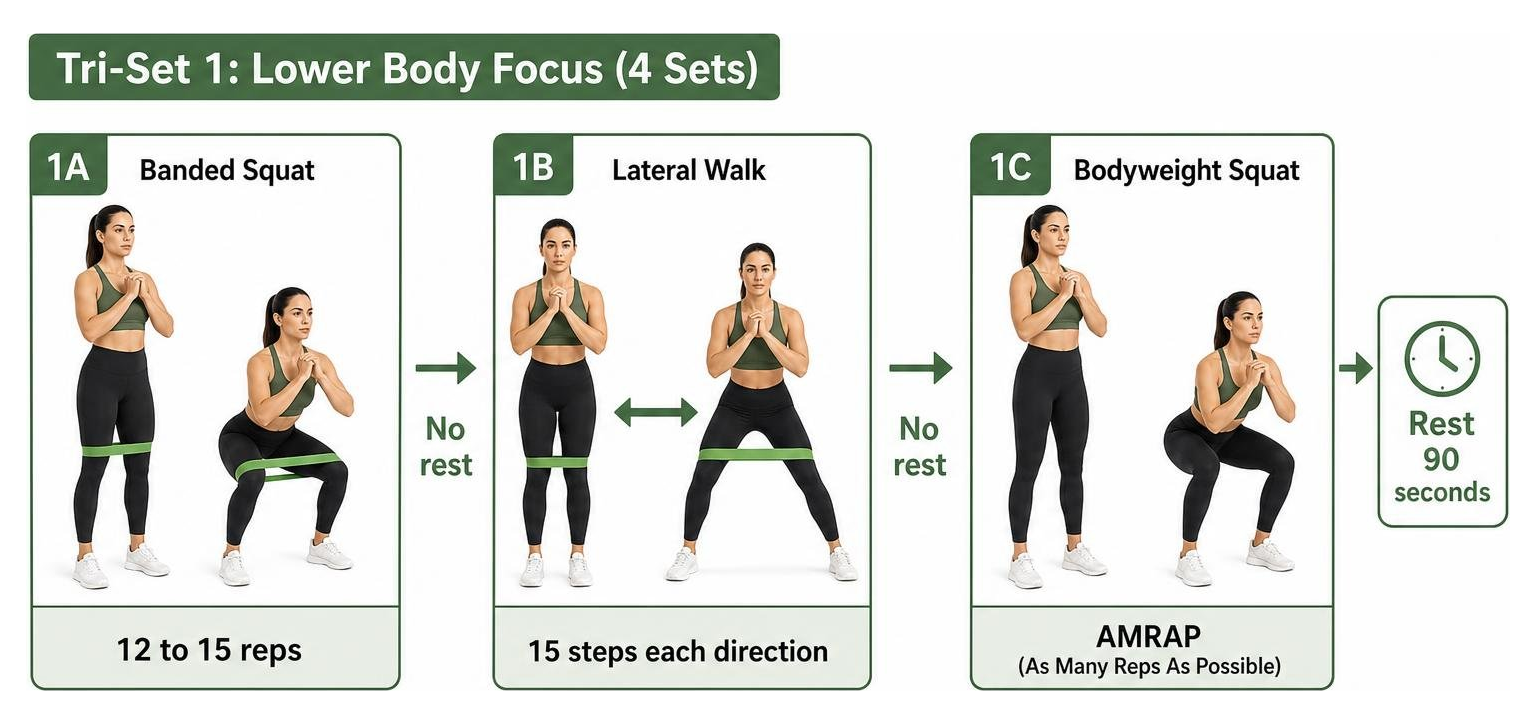
Tri-Set 1: Lower Body Focus (4 Sets)
- 1A. Banded Squat – 12 to 15 reps (No rest)
- 1B. Lateral Walk – 15 steps each direction (No rest)
- 1C. Bodyweight Squat – AMRAP (As Many Reps As Possible) (Rest 90 seconds)
Tri-Set 2: Upper Body Focus (4 Sets)
- 2A. Band Chest Press – 12 to 15 reps (No rest)
- 2B. Seated Row – 15 to 20 reps (No rest)
- 2C. Push-Up (Bodyweight) – AMRAP (Rest 90 seconds)
Tri-Set 3: Core & Posture Focus (3 Sets)
- 3A. Overhead Press – 12 reps (No rest)
- 3B. Band Pull-Apart – 20 reps (No rest)
- 3C. Banded Bicycle Crunch – 45 seconds (Rest 60 seconds)
Frequently Asked Questions about Band Training
Can you actually build muscle with just resistance bands?
Absolutely. Muscle hypertrophy (growth) does not care if tension is generated by a heavy iron plate or a piece of stretched latex. Your muscles respond to three primary drivers: mechanical tension, muscle damage, and metabolic stress.
By training close to failure (within 2 to 3 reps of complete exhaustion) and applying progressive overload, bands can stimulate significant muscle growth. To support this recovery and growth, ensure you are consuming a balanced diet with a protein target of 1.6 to 2.2 grams of protein per kilogram of body weight (or roughly 0.7 to 1.0 grams per pound of body weight).
How do resistance bands compare to free weights?
Both are incredible tools, but they serve different purposes:
- Free Weights provide constant tension based on gravity. They are easier to micro-load (adding 2.5 lb plates) and are superior for maximizing peak force production and absolute strength. However, they place high amounts of stress on joints at their weakest angles.
- Resistance Bands provide accommodating variable resistance, meaning the exercise gets harder as you reach your strongest joint angles. This makes them incredibly joint-friendly, highly portable, and exceptional for targeting stabilizer muscles and joint rehabilitation.
Ideally, a balanced program utilizes both modalities to build a resilient, strong physique.
How long do resistance bands typically last?
With regular use, high-quality latex loop bands will last between 1 to 3 years. Tube bands with handles tend to wear out slightly faster at the connection points.
To maximize the lifespan of your bands:
- Store them out of direct sunlight (UV rays degrade latex).
- Avoid anchoring them to sharp or abrasive surfaces.
- Never stretch a band more than 2.5 times its resting length.
- Always inspect your bands for small tears, nicks, or discoloration before every workout. A snapping band mid-exercise is a quick way to ruin your day!
Conclusion
Band exercises for full body toning offer an incredibly versatile, effective, and joint-friendly path to building strength and improving your physical fitness without ever stepping foot inside a traditional gym. By understanding the science of variable resistance, choosing the right equipment, and structuring your routine with progressive overload, you can achieve remarkable results from the comfort of your living room or a hotel room.
However, while home workouts are fantastic for consistency and convenience, there comes a point in everyone’s fitness journey where personalized coaching, advanced progression, and hands-on guidance make all the difference.
If you are ready to take your training to the next level, working with a professional trainer can help you craft individualized training and nutrition plans tailored specifically to your unique anatomy, goals, and lifestyle.
Whether you want to master your home band routine, incorporate heavy lifting, or work through physical therapy, we are here to support you. Explore our comprehensive full body workout programs and let’s build your strongest self together.