

Your Body, Your Gym: Unlock Strength with These Exercises

The Power of Your Own Bodyweight
Bodyweight exercises strength training is an accessible and effective way to build muscle, improve endurance, and develop functional fitness without a gym or expensive equipment.
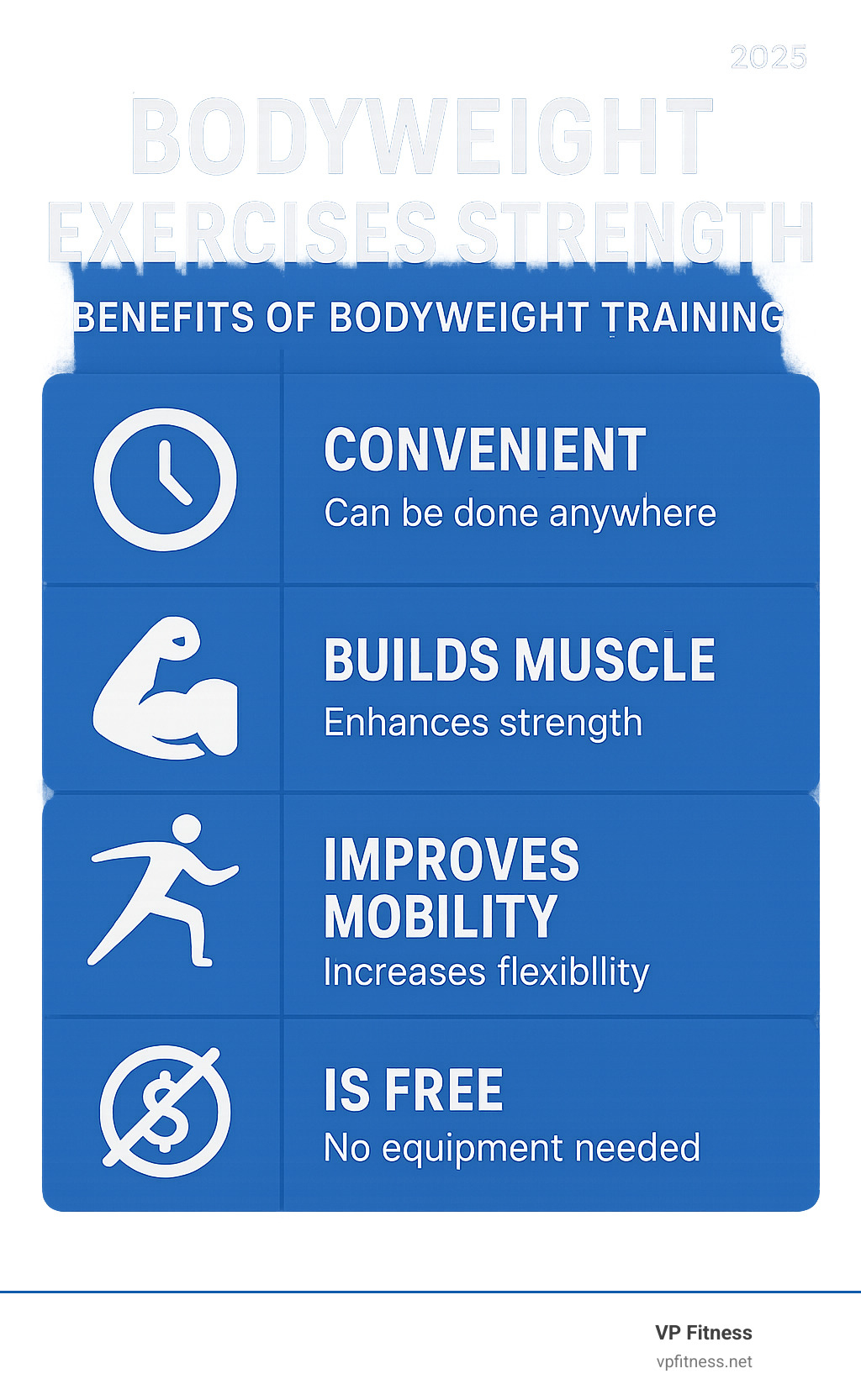
Key benefits of bodyweight strength training:
- Builds muscle mass through progressive overload and time under tension
- Improves functional strength for everyday activities
- Requires zero equipment – your body provides all the resistance needed
- Can be done anywhere, anytime – perfect for busy schedules
- Scales to any fitness level through exercise modifications
- Combines strength and cardio for maximum efficiency
Research shows bodyweight exercises are as effective as traditional weight training for muscle growth when performed with a full range of motion. High-intensity bodyweight training builds muscle, improves insulin resistance, and reduces inflammation.
Whether you’re a busy professional or just starting your fitness journey, bodyweight training offers the perfect solution. You can build serious strength using nothing but your own body weight as resistance.
With over a decade of experience as a fitness professional, I’ve seen how correctly programmed bodyweight exercises strength training delivers incredible results.
Bodyweight exercises strength terms to know:
- How to build muscle
- Consistent gym routine
- Workout split routine
Can You Really Build Muscle and Strength with Just Your Body?
Yes, bodyweight exercises strength training can build serious muscle and strength. Your body adapts to challenges, whether the resistance comes from a barbell or your own weight.
The key is progressive overload: consistently challenging your muscles so they grow stronger. With bodyweight training, you can do this by increasing reps, using harder variations, or manipulating your time under tension by slowing down movements.
Muscle hypertrophy (muscle growth) happens when your muscles work hard enough to trigger adaptation. A push-up to fatigue creates the same muscle-building stimulus as a bench press, as long as you’re working through a full range of motion and truly challenging yourself.
Scientific studies confirm that muscle growth occurs regardless of external weights, as long as you train with enough intensity to reach fatigue. Calisthenics—another term for bodyweight training—is just as effective as traditional weight training for building muscle when programmed correctly.
High-intensity bodyweight training also improves insulin sensitivity and reduces inflammation, boosting your overall health.
Crucially, your muscles grow during rest. Allowing 48 hours between training the same muscle groups is essential for maximizing your results, as your body needs this time to repair and rebuild stronger tissue.
The beauty of bodyweight exercises strength training is its scalability. Whether you’re doing wall push-ups or one-armed variations, you’re applying the same muscle-building principles. The key is finding your current challenge level and progressively making it harder.
If you’re serious about building lean muscle mass, consistency trumps complexity. Start where you are, focus on proper form, and gradually increase the challenge. For more detailed strategies, check out our guide on how to build muscle.
Your body is the only piece of equipment you truly need to build impressive strength and muscle.
The Ultimate Full-Body Bodyweight Workout
This full-body workout uses compound movements to target every major muscle group for maximum results. We’ll use circuit training: move from one exercise to the next with minimal rest, then take a longer break after each round. This builds strength and provides cardiovascular benefits. Every exercise can be modified for your fitness level.

The Best Bodyweight Exercises for Strength: Upper Body
These exercises will transform your shoulders, chest, back, and arms using both pushing and pulling movements.
Push-ups are the cornerstone of upper body strength, targeting your chest, triceps, shoulders, and core. For a perfect push-up, keep a straight line from head to heels. Lower your chest to the floor with elbows at a 45-degree angle, then push back up.
Variations scale the difficulty. Beginners can start with wall push-ups, knee push-ups, or liftd push-ups on a bench. To progress, try hand release push-ups to ensure a full range of motion. For explosive power, plyometric push-ups (with a clap) target fast-twitch muscle fibers.
Dips using a chair or bench are incredibly effective for triceps. Sit on the edge of a chair, hands gripping beside your hips. Slide forward, lower your body by bending your elbows, then press up. Bend your knees to make it easier; straighten your legs for a greater challenge.
Inverted rows solve the pulling problem without a pull-up bar. Grip a door frame, lean back, and pull your chest toward your hands, squeezing your shoulder blades. The more horizontal your body, the harder the exercise. This works your back and biceps.
For comprehensive upper body development, explore our detailed chest workout routines guide.
The Best Bodyweight Exercises for Strength: Lower Body
These bodyweight exercises strength movements will build incredible functional strength in your quads, hamstrings, and glutes.
Bodyweight squats are fundamental. Stand with feet shoulder-width apart. Push your hips back, keeping your chest up and knees over your toes. Squat as low as is comfortable, then drive through your heels to stand.
Perfect squat form is crucial. Check out our guide on proper squat form to master this movement.
Lunges build unilateral strength. Step forward into a forward lunge, lowering until both knees are at 90-degree angles. Reverse lunges are often gentler on the knees. Walking lunges add a dynamic balance challenge. For explosive power, try jump lunges.
Glute bridges strengthen your posterior chain. Lie on your back with knees bent. Lift your hips to form a straight line from shoulders to knees, squeezing your glutes at the top. This improves posture and can reduce low back pain.
Single-leg variations dramatically increase the challenge. Pistol squats (one-legged squats) are an ultimate challenge; start by holding on for support. Single-leg deadlifts improve balance by hinging at the hips on one leg. Bulgarian split squats, with your rear foot liftd on a chair, provide an intense unilateral challenge.
Core and Stability Exercises
A strong core is the foundation of all movement. These exercises build stability from your shoulders to your hips.
Planks are the gold standard. In a forearm or high plank, maintain a straight line from head to heels. Side planks target your obliques. For an extra challenge, try the RKC plank by creating full-body tension.
Mountain climbers combine core work with cardio. From a high plank, alternate driving your knees to your chest.
Leg raises and flutter kicks target your lower abs. Lie on your back and lift your legs toward the ceiling, or perform small, rapid kicks.
Burpees are the ultimate full-body exercise, combining a squat, plank, push-up, and jump into one fluid motion.
Other great stability exercises include dead bugs (lowering opposite arm and leg from your back), supermans (lifting arms and legs while face down to strengthen your lower back), and bird dogs (extending opposite arm and leg from all fours).
These exercises form the foundation of effective functional training and will build the kind of bodyweight exercises strength that carries over into everything you do.
Bodyweight Training vs. Weight Training: Which Is Right for You?
When it comes to building strength, both bodyweight exercises strength training and weight training are fantastic options. Neither is inherently “better”; they are different tools, and the real magic often happens when you combine them in a hybrid approach, as many of our most successful clients do.
Let’s break down how these two training styles stack up:
| Feature | Bodyweight Training | Weight Training |
|---|---|---|
| Accessibility | High (no equipment, can be done anywhere) | Low (requires equipment, often a gym membership) |
| Cost | Free | Can be expensive (gym fees, equipment purchase) |
| Progression | Increases reps, decreases rest, advanced variations, time under tension | Increases weight, reps, sets |
| Ceiling | Advanced moves like one-arm push-ups, pistol squats, planche | Very high (can lift progressively heavier loads) |
| Skill Req. | Focus on form, body control, balance | Focus on form, technique, bracing, stability |
| Max Strength | Excellent for relative strength (strength relative to body mass) | Excellent for absolute strength (max force production) |
Bodyweight training excels in convenience and accessibility. You can do a full workout anywhere, making it perfect for busy schedules or home workouts.
You build incredible functional strength that transfers directly to daily life, as the exercises mimic natural movements like squatting, pushing, and lunging.
Bodyweight exercises also improve your mobility and stability by challenging the small stabilizer muscles that keep you steady and injury-free.
Weight training, on the other hand, offers a higher strength ceiling. For goals like lifting very heavy or maximizing muscle mass, the unlimited progressive overload of adding more weight is key.
Weights also excel at targeted muscle growth by isolating specific muscles more precisely than most bodyweight movements.
The bone density benefits of lifting heavier weights are also significant, providing a strong stimulus for bone growth, which is especially important as we age.
So which is right for you? If you want an accessible, flexible way to build functional strength, bodyweight exercises strength training is perfect. If your goal is maximum muscle growth or strength, weight training is essential.
Most people find a hybrid approach works best. Use bodyweight circuits on busy weeks and add dumbbell workout routines when you have access to equipment. This gives you the convenience of bodyweight training and the progression of weights. The key is choosing what fits your lifestyle and goals.
How to Structure Your Bodyweight Exercises Strength Routine
A solid structure is what separates random movement from real results in your bodyweight exercises strength routine.
Finding Your Sweet Spot for Workout Frequency
Aim for 2-4 sessions per week. This allows for the crucial 48-hour rest period your muscles need to recover and grow stronger. Muscle recovery is where the magic happens, not during the workout itself.
The Power of High-Intensity Interval Training with Bodyweight
Bodyweight exercises strength training pairs perfectly with High-Intensity Interval Training (HIIT)—short bursts of intense exercise followed by brief recovery. A study on HIIT effectiveness showed a 20-minute bodyweight circuit provided a greater training stimulus than 20 minutes of treadmill running, which is great for those short on time!
HIIT with bodyweight exercises burns calories and improves cardiovascular fitness. You can learn more about the benefits of HIIT to see why this approach is so effective.
Essential Workout Components
Every great bodyweight exercises strength workout follows a winning formula.
Your Dynamic Warm-up Sets the Stage
Spend 5-10 minutes on a dynamic warm-up to prime your muscles and prevent injury. Include jogging in place, jumping jacks, arm circles, leg swings, and mobility moves like “groiners” to open up your hips and increase your range of motion.
The Main Event: Your Strength Circuit
For the main workout, perform a circuit of your chosen exercises for 3-4 rounds. Use either 10-15 reps or 30-60 second intervals for each exercise. Rest 60-90 seconds between rounds.
Cool-down and Recovery: The Often-Forgotten Hero
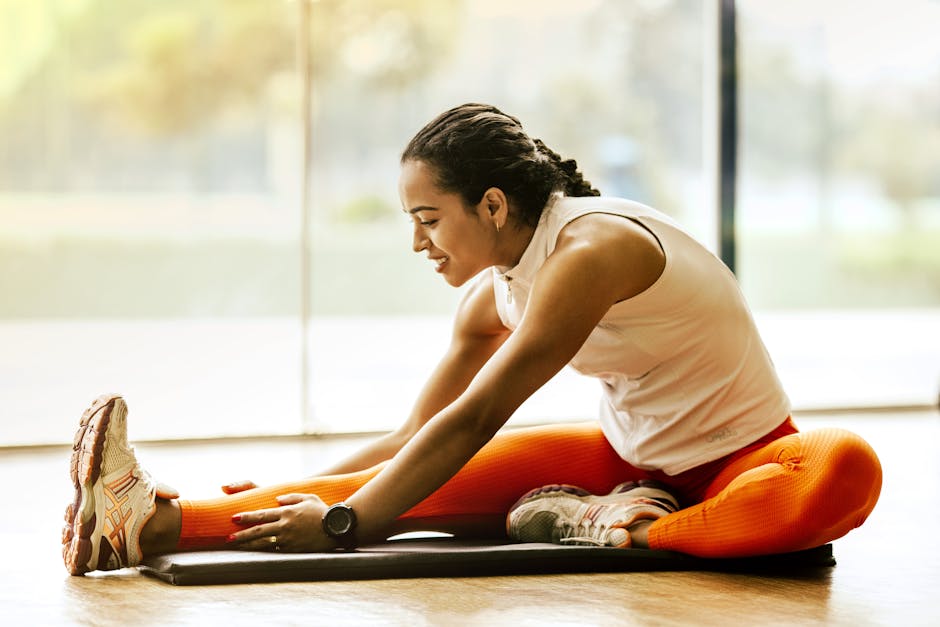
A 5-10 minute cool-down helps your heart rate return to normal. Use static stretching (holding stretches for 20-30 seconds) and mobility work to improve flexibility and prevent injury.
Progressing Your Bodyweight Exercises Strength Routine
Once an exercise becomes comfortable, use these methods to keep progressing and building strength.
The Art of Making Things Harder
- Increasing repetitions: Simply do more reps of an exercise.
- Decreasing rest periods: Shorten the rest time between sets or exercises to increase intensity.
- Adding more sets: Increase your total training volume by performing more sets.
- Advanced variations: Move to more difficult versions of an exercise, like progressing from push-ups to one-arm push-ups, or from squats to pistol squats.
- Increasing time under tension: Slow down your movements (e.g., take 3-5 seconds to lower into a squat) to increase the stress on your muscles.
The beauty of bodyweight exercises strength training lies in this endless potential for progression. Consistency and listening to your body are your best guides as you take on the next challenge.
Frequently Asked Questions about Bodyweight Strength
Here are answers to the most common questions we get about bodyweight exercises strength training.
How often should I do bodyweight workouts for optimal results?
For optimal bodyweight exercises strength results, perform a full-body routine 2-4 times per week. This frequency allows for the necessary 48 hours of recovery time your muscles need to rebuild and get stronger. This aligns with general health guidelines and promotes consistency, which is more important than training every day and risking burnout.
Is bodyweight training effective for weight loss?
Yes, but it’s only part of the equation. Nutrition accounts for about 80% of weight loss success, while exercise contributes 10-20%. However, bodyweight training is a powerful tool. Building muscle increases your resting metabolism, meaning you burn more calories all day.
High-intensity bodyweight workouts, especially HIIT sessions, are effective for burning calories and boosting your metabolism post-exercise. Combining bodyweight exercises strength training with a balanced, sustainable eating plan is the key to changing your body composition and achieving a “toned” look.
Can older adults benefit from bodyweight exercises?
Absolutely! Bodyweight exercises are incredibly beneficial and safe for older adults because you can’t use more resistance than your body can handle. They are proven to improve physical function and muscular strength, combat age-related muscle loss (sarcopenia), and improve balance, flexibility, and overall mobility—all crucial for maintaining independence.
A 2022 study found that a 24-week bodyweight training program improved functional fitness in postmenopausal women. Because every exercise is adaptable, it’s a perfect way to start building strength at any age. From modified squats to wall push-ups, exercises can be custom to your current level and progressed as you get stronger.
Conclusion: Your Next Step to a Stronger You
You now have the tools to build muscle and functional strength using just your body. You’ve learned about progressive overload, how to structure a routine, and that consistency is key. Bodyweight exercises strength training grows with you, from beginner movements to advanced challenges like one-arm push-ups and pistol squats.
This training style is empowering because it gives you the freedom to maintain your fitness anywhere, with no equipment needed—just your commitment.
Remember to listen to your body. Some days you’ll feel unstoppable, and other days you might need to scale back. What matters most is showing up consistently.
We’ve seen countless clients transform through smart, consistent training. An individualized approach means meeting you where you are, whether you’re perfecting a push-up or mastering advanced bodyweight exercises strength movements. An expert team provides the guidance you need.
That extra guidance can make all the difference in reaching your goals.
Ready to take your strength training to the next level? Working with a professional to create a personalized plan can help you build a stronger, more confident you.