

Build Serious Muscle with This 3 Day Dumbbell Workout Routine

Build Serious Muscle with This 3 Day Dumbbell Workout Routine
A Simple 3 Day Split Dumbbell Workout Routine for Muscle and Strength
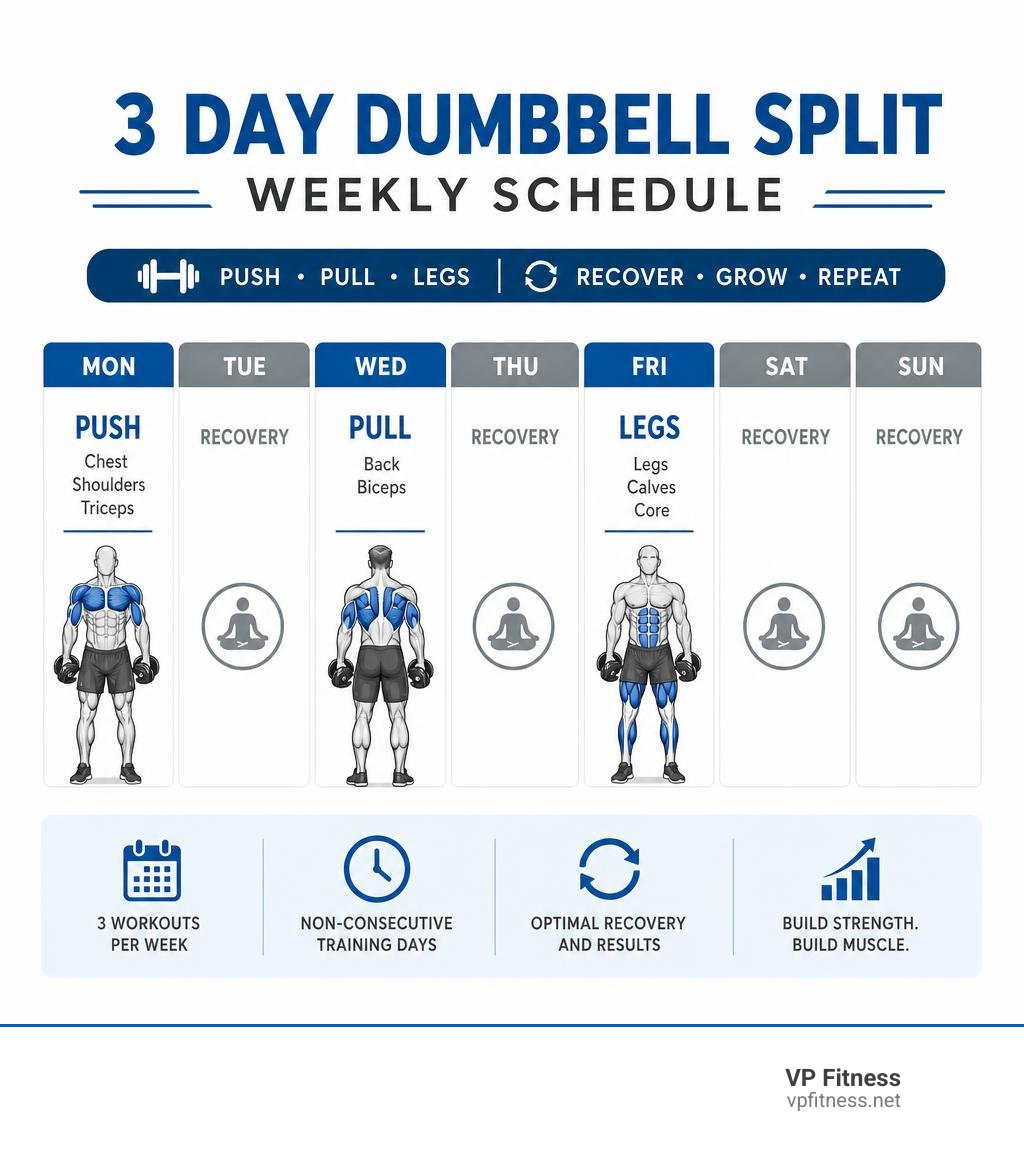
A 3 day split dumbbell workout routine trains your whole body across three non-consecutive days each week. A simple structure is: train chest, shoulders, and triceps on Day 1; back and biceps on Day 2; then legs, calves, and core on Day 3.
| Workout day | Main focus | Example schedule |
|---|---|---|
| Day 1 | Push muscles | Monday |
| Day 2 | Pull muscles | Wednesday |
| Day 3 | Legs and core | Friday |
This approach gives busy people a clear plan, enough recovery between sessions, and a practical way to build strength with dumbbells and a bench. Unlike a full-body workout, each session gives a smaller group of muscles more focused work while keeping the weekly commitment realistic.
I am Joseph Depena, a fitness entrepreneur, powerlifting enthusiast, and trainer who has helped clients build consistent strength habits through focused programming and measurable progress. In this guide, I will show how a 3 day split dumbbell workout routine can fit into a sustainable muscle-building plan, whether you train at home or need a simple routine to follow in the gym.
3 day split dumbbell workout routine word guide:
Why You Need a 3 Day Split Dumbbell Workout Routine
Building significant muscle mass does not require spending six days a week living inside a weight room. Muscle growth—scientifically known as hypertrophy—is primarily driven by mechanical tension, sufficient volume, and adequate recovery time. When you perform resistance exercises, you place stress on your muscle fibers, triggering micro-tears. The actual growth occurs when your body repairs these fibers during rest, a process known as muscle protein synthesis.
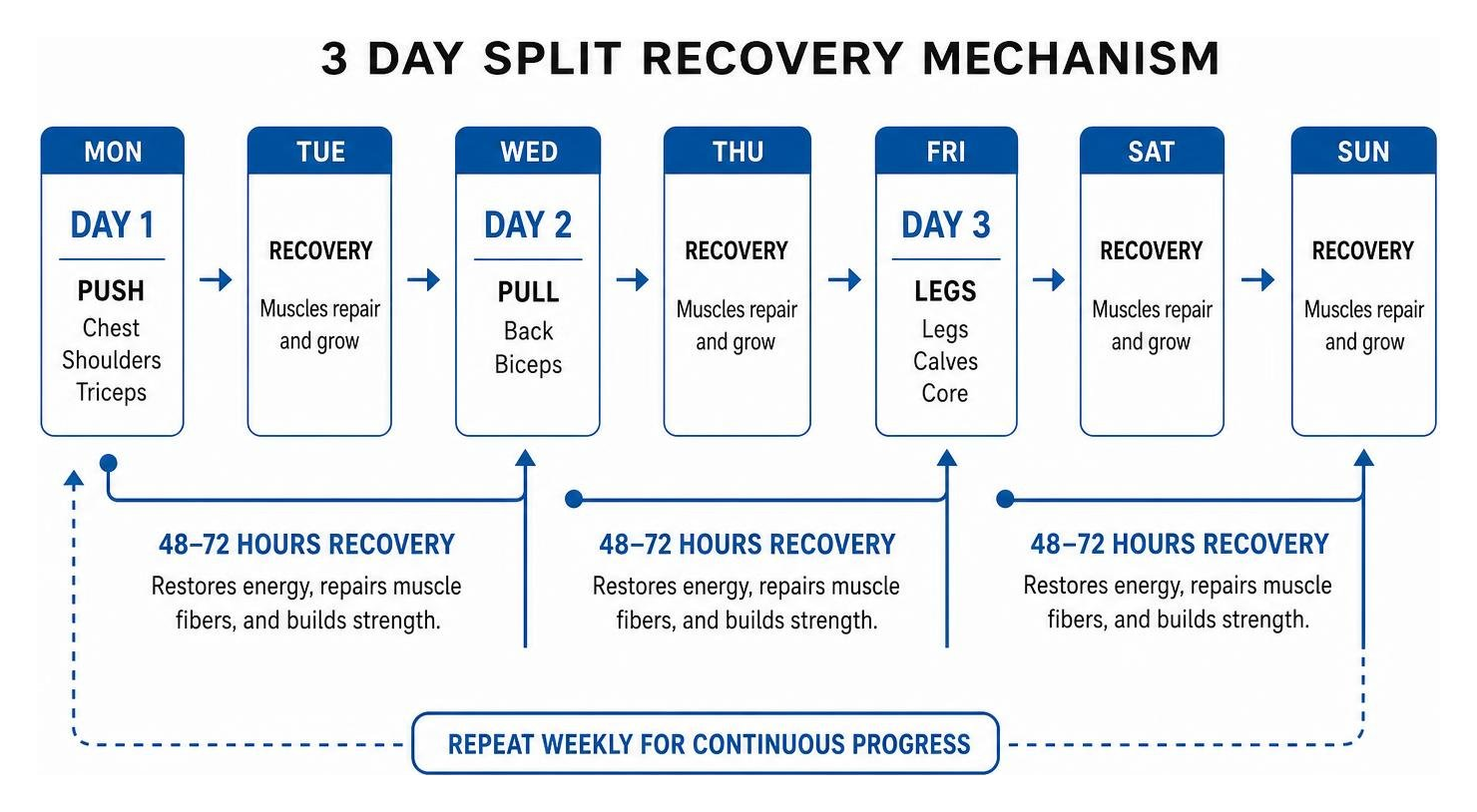
Spreading your training volume across three structured sessions each week strikes a sweet spot for both natural lifters and busy professionals. Research demonstrates that spreading your training across multiple dedicated days yields superior hypertrophic adaptations compared to low-frequency routines because it optimizes the recovery window between workouts. When following a 3 day split dumbbell workout routine, your muscle groups receive intense targeted training followed by 48 to 72 hours of uninterrupted rest before being stressed again.
This setup helps keep fatigue in check. When you attempt high-volume full-body routines every single session, system-wide central nervous system fatigue can accumulate quickly, leading to diminished performance on your final exercises. By splitting body parts into specific movement patterns, you can attack each target muscle group with high effort while fresh. To explore why training three days per week remains the absolute benchmark for long-term adherence, check out our deep dive on Why the 3 Day Weight Split is the King of Consistency.
Designing Your 3 Day Split Dumbbell Workout Routine
The most popular and biomechanically sound structure for a three-day split is the classic Push / Pull / Legs (PPL) template. This arrangement organizes training by foundational movement patterns rather than isolated body parts:
- Push Day (Day 1): Focuses on exercises where you push the resistance away from your body, targeting the chest, shoulders, and triceps.
- Pull Day (Day 2): Focuses on pulling movements, hitting the upper back, lats, rear deltoids, biceps, and forearms.
- Leg Day (Day 3): Hits the lower body, including the quadriceps, hamstrings, glutes, calves, and core stability muscles.
To structure this routine effectively throughout the week, always place at least one full recovery day between workout sessions. A typical weekly schedule looks like this:
- Monday: Day 1 – Push (Chest, Shoulders, Triceps)
- Tuesday: Rest & Active Recovery
- Wednesday: Day 2 – Pull (Back, Biceps, Forearms)
- Thursday: Rest & Active Recovery
- Friday: Day 3 – Legs, Calves & Core
- Saturday: Rest
- Sunday: Rest
Equipment requirements for this program are straightforward and minimal. You will need:
- Adjustable Dumbbells: Ideally a pair that allows quick weight adjustments (ranging from 10 lbs up to 50+ lbs per hand depending on your strength level).
- Adjustable Weight Bench: Essential for performing incline presses, seated presses, supported rows, and chest flies.
- Optional Pull-Up Bar or Resistance Bands: Great additions to expand your back exercises.
For a broader look at how different program frequencies compare, read our comprehensive Workout Split Routine Ultimate Guide.
Who Should Follow a 3 Day Split Dumbbell Workout Routine?
This training template is remarkably versatile and adapts well across almost every experience level:
- Beginner Lifters: If you are new to structured resistance training, a 3-day split teaches foundational movement mechanics without overwhelming your ability to recover.
- Intermediate Athletes: Intermediate lifters can utilize heavier loads and higher volume per muscle group to push through growth plateaus without burning out.
- Busy Professionals & Parents: Finding 45 to 60 minutes three times a week is far easier to maintain over months and years than trying to squeeze in daily workouts.
- Home Gym Lifters: Because dumbbells take up minimal physical footprint, this program delivers complete physique development right from your living room or garage.
According to research from major strength publications, popular programs like the Frankoman 3-day split demonstrate that 45-minute sessions performed three times weekly provide more than enough stimulus to build serious muscle size. If you want to review structured dumbbell options online, you can examine resource guides such as JEFIT’s 3 Day Split Program.
The Ultimate 3-Day Dumbbell Workout Routine Breakdown

Now, let’s look at the complete exercise selection, set structures, and target rep ranges for your 3 day split dumbbell workout routine.
Each exercise in this routine should be executed with controlled tempo—roughly 2 seconds during the lowering (eccentric) phase, a brief pause at the bottom, and 1 to 2 seconds during the lifting (concentric) phase. Rest approximately 60 to 90 seconds between compound sets and 45 to 60 seconds between isolation sets. For additional routine structures, check out our guide on Unlock Your Gains: A Complete 3-Day Muscle Building Routine.
Day 1: Chest, Shoulders, and Triceps (Push Day)
Day 1 hits the upper body pushing muscles, beginning with heavier compound pressing for the chest and shoulders before isolating the triceps.
| Exercise | Target Muscle Groups | Sets | Rep Range | Rest Interval |
|---|---|---|---|---|
| Flat Dumbbell Bench Press | Lower & Mid Chest, Anterior Deltoids | 4 | 8–10 | 90 sec |
| Incline Dumbbell Press (30° Angle) | Upper Chest, Shoulders | 3 | 8–12 | 75 sec |
| Standing Dumbbell Shoulder Press | Deltoids, Upper Triceps | 3 | 8–10 | 90 sec |
| Dumbbell Side Lateral Raises | Medial (Side) Deltoids | 3 | 12–15 | 60 sec |
| Overhead Dumbbell Tricep Extension | Triceps (Long Head) | 3 | 10–12 | 60 sec |
| Dumbbell Tricep Kickbacks | Triceps (Lateral Head) | 3 | 12 | 45 sec |
Execution Notes: On the Flat Dumbbell Bench Press, keep your feet planted firmly on the floor and maintain a natural arch in your lower back. Lower the dumbbells smoothly until your upper arms are just below parallel to the chest before pressing back up. On Standing Dumbbell Shoulder Presses, brace your core tightly to prevent hyperextending your lower back.
Day 2: Back, Biceps, and Forearms (Pull Day)
Day 2 builds back thickness, outer lat width, and arm size through pulling movements. If you have access to a pull-up bar, you can substitute wide-grip pull-ups for the first exercise.
| Exercise | Target Muscle Groups | Sets | Rep Range | Rest Interval |
|---|---|---|---|---|
| One-Arm Dumbbell Row | Lats, Rhomboids, Core | 4 | 8–10 | 90 sec |
| Dumbbell Pullover | Lats, Serratus, Chest | 3 | 10–12 | 60 sec |
| Incline Dumbbell Chest-Supported Row | Upper Back, Rear Delts | 3 | 10–12 | 75 sec |
| Standing Dumbbell Bicep Curl | Biceps (Short/Long Head) | 3 | 8–12 | 60 sec |
| Alternating Dumbbell Hammer Curl | Brachialis, Forearms, Biceps | 3 | 10–12 | 60 sec |
| Dumbbell Wrist Curls | Forearms & Grip Strength | 2 | 15 | 45 sec |
Execution Notes: When executing the One-Arm Dumbbell Row, support your non-working hand and knee on your bench. Pull the dumbbell back toward your hip rather than upward toward your chest; this engages the lats fully and keeps the load off your traps. During Dumbbell Pullovers, keep a slight bend in your elbows and focus on stretching the lats at the top position behind your head.
Day 3: Legs, Calves, and Core (Leg Day)
Day 3 targets the lower body, loading your quadriceps, hamstrings, glutes, and core.
| Exercise | Target Muscle Groups | Sets | Rep Range | Rest Interval |
|---|---|---|---|---|
| Dumbbell Goblet Squat | Quadriceps, Glutes, Core | 4 | 8–10 | 90 sec |
| Dumbbell Romanian Deadlift (RDL) | Hamstrings, Glutes, Lower Back | 4 | 8–10 | 90 sec |
| Dumbbell Step-Ups | Glutes, Quads, Stabilizers | 3 | 10 per leg | 60 sec |
| Bulgarian Split Squats | Quadriceps, Glutes | 3 | 8–10 per leg | 75 sec |
| Standing Dumbbell Calf Raises | Gastrocnemius, Calves | 4 | 15 | 45 sec |
| Dumbbell Russian Twists | Obliques, Abs, Core | 3 | 15 per side | 45 sec |
Execution Notes: The Dumbbell Romanian Deadlift relies on a hip hinge. Push your hips back as if trying to touch a wall behind you while lowering the dumbbells along your shins. Stop when you feel a strong stretch in your hamstrings, then squeeze your glutes to return to standing.
For Dumbbell Step-Ups, choose a flat sturdy bench or box. Research shows that step-ups achieve gluteus maximus muscle activation levels as high as 125% MVIC (Maximum Voluntary Isometric Contraction), making them one of the single most effective lower-body movements available. To discover more exercise ideas to try at home, check out our guide to Dumbbell Exercises at Home.
Progressive Overload, Nutrition, and Recovery Strategies

Executing your workouts consistently is only half of the muscle-building equation. To ensure your body adapts and builds new muscle tissue week after week, you must apply systematic progressive overload and support your training with nutrition and rest.
Choosing the Right Dumbbell Weight and Progressing Over Time
Selecting the right starting resistance determines whether a set builds muscle or simply wastes energy. As a general starting guideline:
- Men: Try starting compound presses with 25–30 lb dumbbells and rows with 30–35 lb dumbbells.
- Women: Try starting compound presses with 10–15 lb dumbbells and rows with 15–20 lb dumbbells.
Regardless of your gender or current fitness level, use the Reps in Reserve (RIR) metric. Choose a weight that leaves you with approximately 1 to 2 reps in reserve at the end of each set. That means if your target is 10 reps, you should feel capable of completing 11 or 12 reps with good form before failing.
To keep building muscle, you must apply progressive overload over time:
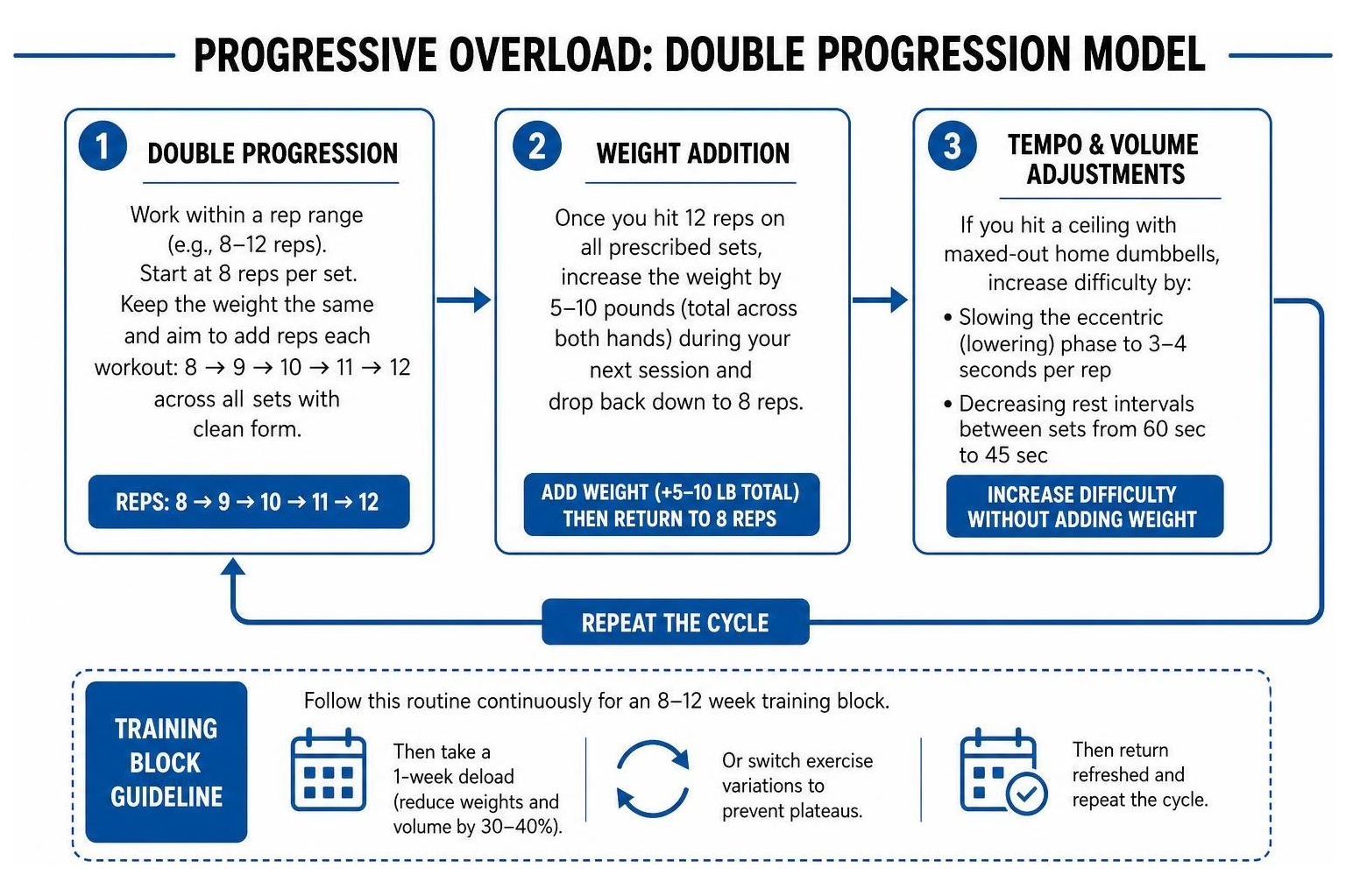
- Double Progression: Work within a rep range (e.g., 8 to 12 reps). Start at 8 reps per set. In subsequent workouts, keep the weight identical and aim to complete 9, 10, 11, and eventually 12 reps across all sets with clean form.
- Weight Addition: Once you hit 12 reps on all prescribed sets, increase the weight by 5 to 10 pounds (total across both hands) during your next session and drop back down to 8 reps.
- Tempo & Volume Adjustments: If you hit a ceiling with maxed-out home dumbbells, slow down the eccentric lowering phase to 3–4 seconds per rep or decrease your rest intervals between sets from 60 seconds down to 45 seconds to increase total mechanical difficulty.
Follow this routine continuously for an 8 to 12-week training block before taking a week-long deload (reducing weights and volume by 30-40%) or switching exercise variations to prevent plateaus.
Fueling Growth Through Proper Nutrition and Recovery
Muscle growth occurs outside of the gym while your body is at rest. To fuel muscle synthesis and prevent performance drop-offs, align your lifestyle habits with your physical training:
- Caloric Balance: To build maximum muscle mass (bulking phase), aim for a slight caloric surplus of roughly 250 to 500 calories above your daily maintenance level. If your goal is fat loss while maintaining strength, maintain a slight caloric deficit while keeping protein intake elevated.
- Protein Guidelines: Consume between 1.6 to 2.2 grams of protein per kilogram of body weight daily (roughly 0.8 to 1.0 grams per pound of body weight). Quality sources include lean chicken breast, beef, eggs, whey protein, fish, tofu, and legumes.
- Hydration: Drink 2 to 3 liters of water per day to maintain cellular hydration, joint health, and muscle endurance during heavy lifting sets.
- Sleep Quality: Prioritize 7 to 9 hours of quality sleep every night. Growth hormone release peaks during deep sleep cycles, making high-quality rest non-negotiable for repairing muscle fibers.
- Active Recovery: On off-days, engage in light walking for 20 to 30 minutes, dynamic mobility drills, or gentle stretching to keep blood circulating through sore muscle tissue without introducing system fatigue.
To read broader research on full-body dumbbell programming, review external resources like Legion Athletics’ Full-Body Dumbbell Routine Guide, Macros Inc’s 3-Day Home Workout Plan, or Muscle & Strength’s 3-Day Full Body Dumbbell Workout.
Frequently Asked Questions About 3 Day Dumbbell Workouts
Can you build significant muscle using only dumbbells?
Yes, absolutely. Muscle growth depends on mechanical tension, total volume, and sufficient effort close to muscular failure—not the specific equipment you use. Dumbbells offer several distinct advantages over barbells, including independent limb loading (which eliminates strength side-to-side imbalances), an increased active range of motion, and greater joint movement freedom during heavy pressing movements. As long as you apply progressive overload continuously, dumbbells are completely sufficient to build an impressive physique.
How long should you follow this routine before changing programs?
You should stick with a 3 day split dumbbell workout routine for 8 to 12 weeks continuously. This timeframe allows your nervous system to master exercise mechanics, build strength, and achieve noticeable muscle hypertrophy. Changing exercises every couple of weeks limits progress because your body stays in a perpetual state of adaptation to basic movement patterns rather than overloading muscle strength. After 8 to 12 weeks, take a deload week, then evaluate whether to adjust your rep ranges, substitute exercises, or transition to a higher-volume split.
How does a 3-day split compare to 4-day or 5-day splits?
Choosing between workout splits comes down to your personal schedule, physical recovery capability, and training goals. Here is how a 3-day split compares directly with higher-frequency options:
| Feature / Goal | 3-Day Split (PPL) | 4-Day Upper/Lower Split | 5-Day “Bro” Split |
|---|---|---|---|
| Weekly Frequency | 3 days lifting, 4 days rest | 4 days lifting, 3 days rest | 5 days lifting, 2 days rest |
| Recovery Demands | Low to Moderate (Ideal for beginners/busy lifters) | Moderate (Great all-round balance) | High (Requires dedicated recovery protocols) |
| Volume per Session | Moderate to High | Moderate | Very High per muscle group |
| Muscle Group Target Frequency | 1x per week (Direct) + indirect overlap | 2x per week | 1x per week |
| Consistency / Adherence | Highest | High | Moderate (Harder to sustain long term) |
To review more details about dumbbell programming choices, inspect our detailed resource, the Dumbbell Workout Routine Guide.
Conclusion
A structured 3 day split dumbbell workout routine is one of the most efficient pathways to build noticeable muscle mass, build functional strength, and establish long-term fitness habits. By dividing your weekly training into dedicated Push, Pull, and Leg workouts on non-consecutive days, you maximize mechanical tension during your sessions while allowing adequate recovery time for muscle repair and growth.
Staying consistent with a workout plan requires individual dedication and clear guidance. Whether you want to refine your form on dumbbell compound lifts, break through training plateaus, or need tailored dietary and nutrition strategies, structured programming can accelerate your progress. Explore our comprehensive resources today on the Workout Splits Ultimate Guide to learn how tailored training can help you reach your strength potential!