

Cardio King: Routines to Boost Your Fitness and Health

Why Cardio is Essential for Optimal Health and Fitness
Cardio workout routines are foundational to any fitness program, offering proven physical and mental health benefits. From strengthening your heart and managing weight to boosting energy, a solid cardio plan can transform your well-being.
Quick Answer – Top Cardio Workout Routines:
- Beginner: Walking, marching in place, light cycling (20-30 minutes)
- Intermediate: Treadmill intervals, elliptical training, swimming (30-45 minutes)
- Advanced: HIIT circuits, burpees, mountain climbers (15-30 minutes)
- Frequency: 150 minutes moderate OR 75 minutes vigorous per week
- Equipment: Bodyweight exercises require nothing; gym machines offer variety
Science shows that regular cardio strengthens your heart, improves blood flow, and lowers the risk of heart disease, stroke, and high blood pressure. A 60-minute cardio session can improve sleep quality, while just 15 minutes of vigorous activity can reduce the risk of depression.
Cardio also releases endorphins, your body’s natural mood boosters, leading to better stress management, more energy, and improved mental clarity for busy professionals.
Basic Cardio workout routines glossary:
- Consistent gym routine
- Workout split routine
- Kettlebell workout routine
Why Cardio is a Non-Negotiable for Your Health
Cardio workout routines are more than just a tool for aesthetics; they’re fundamental for your body to thrive. Regular cardio improves oxygen flow to every cell, helping protect against chronic diseases like diabetes and heart disease. This also boosts mental focus and daily energy, so you have more stamina for the activities you love.

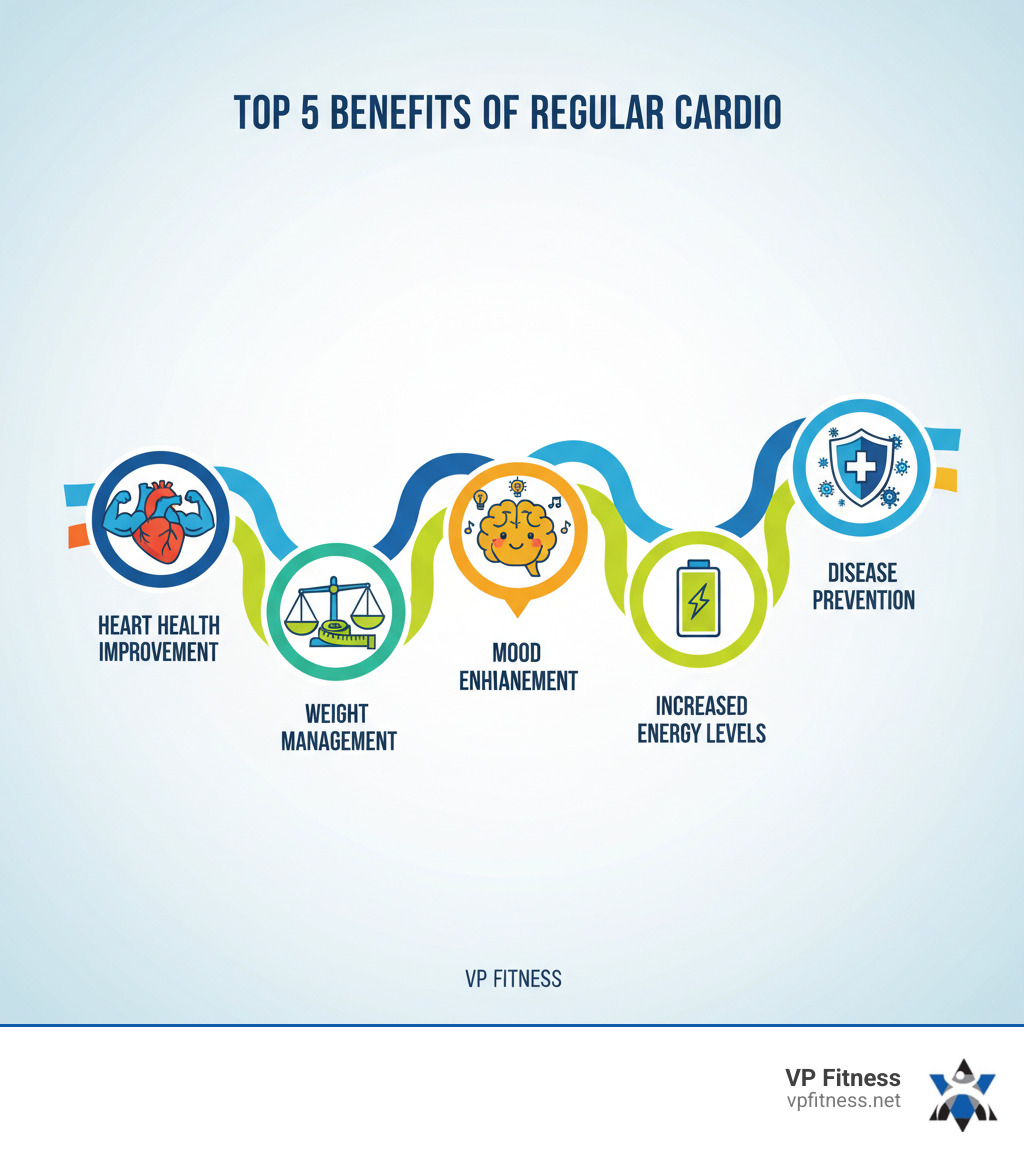
Boosts Cardiovascular Health
Cardio workout routines make your heart stronger and more efficient. Regular exercise means your heart works less hard during daily activities, leading to lower blood pressure and improved cholesterol levels, which significantly reduces your risk of heart disease and stroke. Research shows cardio can even reverse some damage from a sedentary lifestyle. It’s never too late to start reaping these benefits.
For the science enthusiasts among us, you can dive deeper into the scientific research on exercise and cardiovascular health to see just how powerful these effects really are.
Improves Mood and Brain Function
Cardio is a natural mood booster. When your heart pumps, your brain releases feel-good chemicals called endorphins, along with serotonin and dopamine. Just 15 minutes of vigorous activity can reduce depression risk, while a 60-minute session can help you fall asleep faster and improve sleep. Regular cardio also slows age-related brain decline, keeping your mind sharp and focused.
You can explore more about this fascinating connection in this study on physical activity and mood.
Aids in Weight Management
Many people use cardio workout routines for weight management, and they are highly effective for burning calories. Beyond the workout, regular cardio boosts your metabolism, helping you burn more calories even at rest. For best results, pair cardio with proper nutrition. This combination ensures you’re losing fat, not muscle, and provides the fuel needed for performance and recovery.
Increases Energy and Stamina
Cardio workout routines can help you reclaim youthful vitality by training your body to use oxygen more efficiently, measured by your VO2 max. A higher VO2 max means more stamina and endurance. As a result, daily tasks become easier, you recover faster from exertion, and you have more energy for the things that matter most.
It’s like upgrading your body’s entire operating system – everything just works better.
Understanding the Fundamentals of Cardio Exercise
To get the most from your cardio workout routines, you need to understand the key ingredients: intensity, duration, and frequency. Mastering these three pillars allows you to tailor workouts to your specific goals.

How Much Cardio Do You Need?
The American Heart Association and NHS provide clear, science-backed guidelines: 150 minutes of moderate-intensity or 75 minutes of vigorous-intensity cardio per week for adults. You can also mix and match intensities. The key is to spread your workouts throughout the week. Consistency allows your body to adapt and recover, which is far more effective than cramming it all into one session.
For the complete breakdown of these recommendations, check out the AHA recommendations for physical activity.
LISS vs. HIIT: Choosing Your Cardio Style
Cardio workout routines generally fall into two styles: Low-Intensity Steady-State (LISS) and High-Intensity Interval Training (HIIT).
Low-Intensity Steady-State (LISS) involves longer sessions (30-60+ minutes) at a sustainable pace, like a comfortable jog. It’s great for building endurance and is easy on the joints.
High-Intensity Interval Training (HIIT) involves short bursts of all-out effort (e.g., sprints, burpees) followed by brief recovery periods, packing a powerful workout into just 10-30 minutes.
| Feature | LISS (Low-Intensity Steady-State) | HIIT (High-Intensity Interval Training) |
|---|---|---|
| Duration | Longer (30-60+ minutes) | Shorter (10-30 minutes, including warm-up/cool-down) |
| Intensity | Consistent, moderate effort (can hold a conversation) | Alternating high effort with short recovery periods (hard to talk) |
| Benefits | Endurance, active recovery, fat burning, joint-friendly | Cardiovascular fitness, calorie burn, metabolism boost, time-efficient |
| Examples | Brisk walking, light jogging, cycling, swimming, elliptical | Sprints, burpees, jump squats, mountain climbers, kettlebell swings |
Incorporating both LISS and HIIT creates a well-rounded cardio plan.
Monitoring Your Workout Intensity
Monitoring your workout intensity is key for safety and results. Three common methods are:
- Rate of Perceived Exertion (RPE) Scale: A 0-10 scale to rate how you feel. Aim for RPE 3-4 for moderate intensity (can talk in sentences) and RPE 5-7 for vigorous intensity (can only speak a few words). The explanation of the RPE scale from the National Academy of Sports Medicine provides excellent detail on using this tool effectively.
- Target Heart Rate Zones: A more precise method using a fitness tracker. Aim for 60-70% of your maximum heart rate for moderate intensity and 70-85% for vigorous.
- The Talk Test: A simple check. If you can chat comfortably, you’re in the moderate zone. If you can only manage a few words, it’s vigorous.
Mastering these techniques helps you find the right balance between challenge and safety in your cardio workout routines.
The Ultimate Guide to Cardio Workout Routines
Let’s explore specific cardio workout routines for every fitness level. The beauty of cardio is its adaptability, allowing you to create an effective routine at home or in the gym. The key is progression: start with accessible movements to build a solid base, then gradually increase the challenge as your strength and endurance improve.

Beginner-Friendly Cardio Workout Routines at Home
These cardio workout routines require no equipment and focus on simple, effective movements.
- Marching in place: A perfect foundation. Lift your knees high, swing your arms, and engage your core. For more challenge, transition to jogging in place.
- Jumping jacks: A classic full-body move. Start slowly, land softly, and use the step-out modification if jumping is too intense.
- Bodyweight squats: Perform continuously for a great cardio workout. Keep your chest up, sit back as if into a chair, and maintain a steady rhythm.
- Air jump rope: Get the benefits of a real rope without the coordination challenge. Swing your arms and hop lightly on the balls of your feet.
- Dancing to music: A fun and effective cardio workout. Just put on your favorite songs and move!
Sample Beginner Circuit Structure: Perform each exercise for 45 seconds, then rest for 30 seconds. Complete the entire circuit 2-3 times.
Intermediate Gym-Based Cardio Routines
The gym offers a variety of equipment to keep your cardio workout routines fresh and challenging.
- Treadmill intervals: Alternate between work and recovery. For example, run for 2 minutes at a challenging pace, then walk for 1 minute. Repeat this cycle.
- Elliptical machine: A joint-friendly, full-body option. Try a pyramid workout by increasing and then decreasing the resistance in 5-minute intervals.
- Rowing machine: A powerful full-body workout. Focus on form: drive with your legs, engage your core, and pull with your arms.
- Stationary bike: Great for targeting your legs. Vary your workout by cruising at a steady pace or creating “hill climbs” with increased resistance.
Sample Treadmill Interval Plan: Warm up with a 5-minute brisk walk. Then, alternate 2 minutes of running with 1 minute of brisk walking, repeating 5 times. Cool down with 5 minutes of easy walking.
Advanced HIIT Cardio Workout Routines
Advanced HIIT cardio workout routines are designed for maximum intensity and efficiency.
- Burpees: A challenging full-body exercise. Move from a squat to a plank, add a push-up, return to the squat, and explode into a jump.
- Mountain climbers: A core-shredding cardio move. From a plank position, quickly alternate driving your knees to your chest.
- Squat jumps: Add explosive power to a standard squat. Squat down, then jump up powerfully, landing softly back in the squat.
- Kettlebell swings: Build strength and cardio endurance. The power comes from a strong hip-hinge, snapping your hips forward to swing the bell to chest height.
Sample HIIT Ladder Workout: After a 5-minute warm-up, use a concept bike and burpees in a ladder format. Round 1: 500m bike, 2 burpees. Round 2: 400m bike, 4 burpees. Continue to 300/6, 200/8, and 100/10. Rest 60-90 seconds between rounds, then cool down.
Best Practices for a Safe and Effective Cardio Session
To maximize your cardio workout routines, focus on smart preparation, proper technique, and consistency. A solid warm-up, good form, and strategies to stay motivated are essential for long-term success.

The Perfect Warm-Up and Cool-Down
A proper warm-up is a smart investment. Spend 5-10 minutes on dynamic warm-ups like arm circles, leg swings, and high knees to get your blood flowing and prepare your muscles. This gradually raises your heart rate for the workout ahead.
The cool-down is just as crucial. After your workout, perform static stretching, holding each stretch for 15-30 seconds. This helps your heart rate return to normal and can reduce next-day soreness.
Mastering Proper Form and Technique
Proper form is your insurance against injury and the key to getting results from your cardio workout routines. For example, good running posture—eyes forward, body upright—prevents overuse injuries and improves efficiency. This principle applies to all exercises. If you’re unsure about form, seek guidance from reliable resources like the ACE Fitness exercise library for form guides. Prioritize quality reps over quantity to avoid injury.
Staying Motivated and Consistent
Motivation can be unpredictable, so a solid strategy is key.
- Set SMART goals: Aim for something specific, like “I’ll do 30 minutes of cardio three times this week.”
- Find activities you enjoy: If you hate running, try dancing or a group fitness class. Enjoyment is key to sustainability.
- Track your progress: Use a notebook or app to see how far you’ve come, which is a powerful motivator.
- Vary your workouts: Mix up your cardio workout routines to keep things fresh and prevent overuse injuries.
- Find a workout partner: Accountability and shared experiences make the journey more enjoyable.
Frequently Asked Questions about Cardio Workouts
Starting your journey with cardio workout routines can be overwhelming. Let’s tackle the most common questions so you can move forward with confidence.
Should I do cardio before or after strength training?
The golden rule is to do your main cardio session after strength training. Lifting weights requires significant energy (glycogen), and doing intense cardio first can leave you running on empty for your lifts. However, a light 5-10 minute cardio warm-up before lifting is beneficial. Save the intense sessions for after your strength work to maximize performance.
Can I lose weight with just cardio?
Yes, you can lose weight with just cardio workout routines, as they burn calories. However, this isn’t the most effective long-term strategy. Combining cardio with strength training builds muscle, which boosts your metabolism. For sustainable results, combine cardio, strength training, and a healthy diet. Remember to track progress beyond the scale, like energy levels and how your clothes fit.
How long does it take to see results from cardio?
Results from cardio workout routines appear at different stages:
- Immediately: You’ll feel a mental boost from endorphins, reduced stress, and more energy after just one session.
- 2-3 Weeks: Stamina and endurance improvements become noticeable. Daily activities will feel easier.
- 4-6 Weeks: Physical changes, like weight loss, typically appear with consistent effort, proper nutrition, and rest.
Consistency is key. Three solid workouts a week are more effective than sporadic, intense sessions. Trust the process and celebrate the small wins.
Conclusion
You now have a complete roadmap to cardiovascular success, from understanding the benefits of cardio workout routines to choosing between LISS and HIIT. The best cardio workout is the one you do consistently. Whether you’re a beginner or an advanced athlete, every step counts.
Consistency is more important than perfection. Start where you are, choose activities you enjoy, and listen to your body. Aim for the recommended 150 minutes of moderate or 75 minutes of vigorous activity per week—that’s just 20-25 minutes on most days.
Your healthiest self is waiting. You’ve got this!