

Maximize Your Gains: The Ultimate Full Body Workout Routine

Why Full Body Workouts Are Taking Over Modern Fitness
A full body workout is a training approach that targets all major muscle groups in a single session. Instead of splitting muscle groups across different days, you train everything at once.
Key Components:
- Upper body exercises: chest, back, shoulders, arms
- Lower body movements: quads, hamstrings, glutes, calves
- Core strengthening: abs, obliques, lower back
- Compound movements: exercises working multiple muscles simultaneously
Main Benefits:
- Time-efficient (45-75 minutes per session)
- Higher training frequency (2-3x per week)
- Increased calorie burn
- Ideal for busy schedules
- Builds functional strength
Full body workouts offer a proven path to strength and muscle growth, whether you’re a beginner or a busy professional. They work by hitting each muscle group multiple times per week, a frequency research shows is highly effective for muscle building. Their simplicity is a major advantage; you can achieve excellent results with just 2-3 focused sessions per week, making them perfect for juggling work, family, and fitness goals.
I’m Joseph Depena, a master trainer since 2011. I’ve helped hundreds of clients transform their bodies using strategic full body workout programs. My experience shows that properly structured routines deliver faster results with less time commitment than traditional splits.
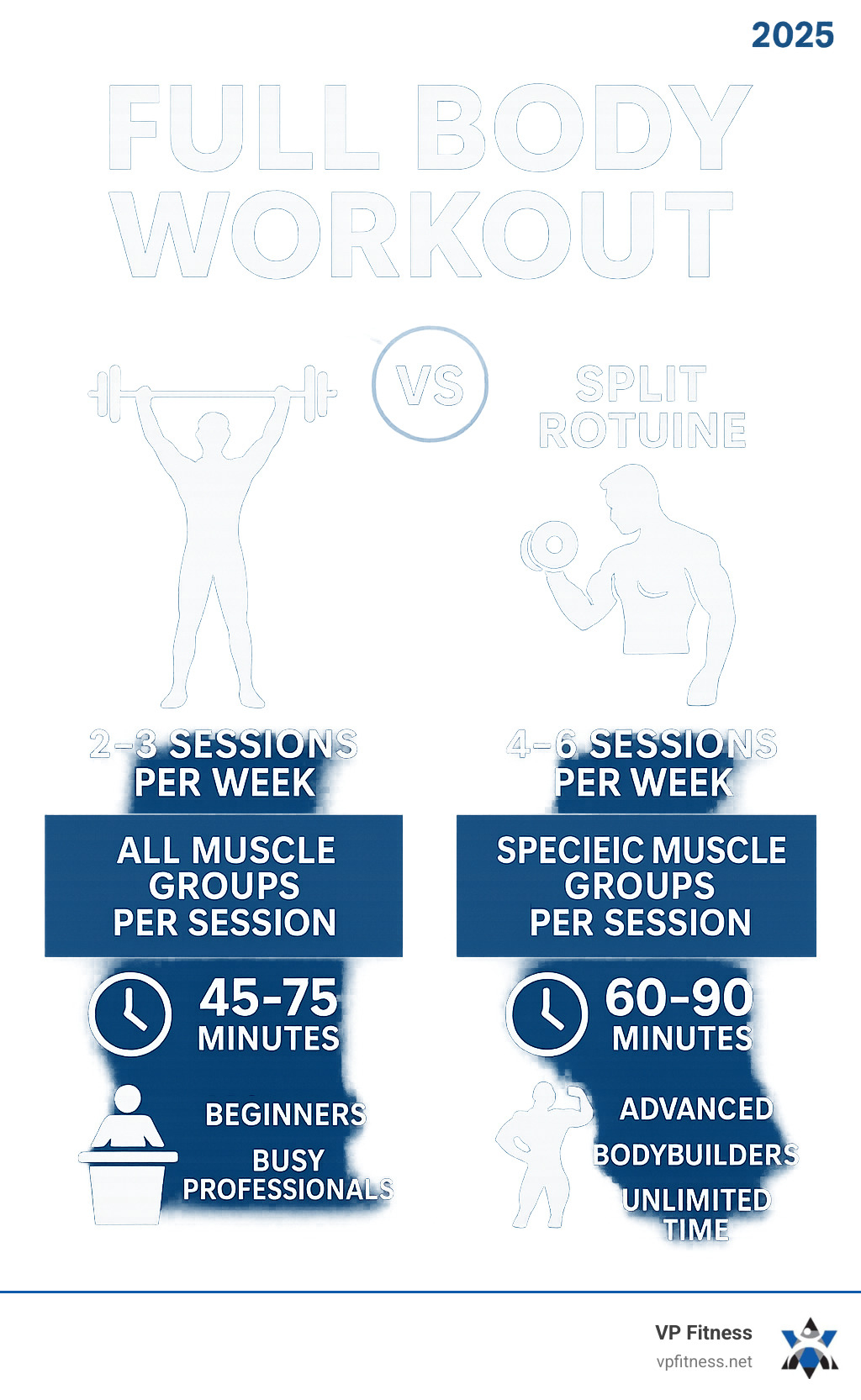
Full Body vs. Split Routines: Which is Right for You?
Choosing between a full body workout and a split routine depends on your goals and schedule. A full body workout hits all major muscle groups in one session, while a split routine focuses on specific muscle groups on different days (e.g., chest on Monday, legs on Wednesday).
Here’s how they stack up:
| Feature | Full Body Workout | Split Workout |
|---|---|---|
| Frequency | Each muscle group trained 2-3 times per week | Each muscle group trained 1-2 times per week |
| Time Commitment | 2-3 sessions per week | 4-6 sessions per week |
| Volume per Session | Lower volume per muscle group | Higher volume per muscle group |
| Session Length | 45-75 minutes | 60-90 minutes |
| Ideal User | Beginners, busy individuals, general fitness | Advanced lifters, bodybuilders |
Both approaches are effective; the right choice depends on your lifestyle. The importance of strength training for long-term health is paramount regardless of the method.
Who Should Choose a Full Body Workout?
Full body workouts are highly versatile and effective for many people:
- Beginners: They help build a solid foundation by teaching proper form on major lifts and developing balanced, all-over strength without the complexity of pairing muscle groups.
- Individuals with busy schedules: If you can only train 2-3 times per week, a full body workout ensures every muscle is stimulated multiple times, which is optimal for growth.
- Those focused on weight loss: These workouts burn more calories per session by engaging more muscle mass at once, leading to a greater “afterburn effect.”
- Athletes: The emphasis on compound movements builds functional strength that translates directly to better performance in sports and daily life.
When is a Split Routine More Beneficial?
Split routines become more valuable in specific scenarios:
- Advanced lifters: To continue progressing, advanced trainees often need the higher training volume per muscle group that splits provide.
- Bodybuilders: For bringing up lagging body parts or achieving a highly sculpted physique, the focused attention of a split routine is essential.
- Those training 4-6 days per week: If you have the time and recovery capacity, splits are a practical way to structure frequent training.
- Breaking through plateaus: Switching from a full body routine to a split can provide the new stimulus your body needs to overcome a training stall.
The best routine is the one you can stick with consistently. Consistency is what ultimately drives results.
The Core Benefits of a Full Body Workout Program
A full body workout program is effective for more than just saving time. Several powerful benefits explain why this approach delivers superior results for many people.

-
Higher Training Frequency: Research shows that training each muscle group 2-3 times per week is more effective for growth than the once-a-week stimulation typical of split routines. A full body workout provides this frequent stimulus, keeping your muscles in a constant state of adaptation.
-
Increased Calorie Burn: Engaging your entire body with exercises like squats, deadlifts, and rows demands significantly more energy than isolated movements. This makes full body workouts highly effective for weight management and fat loss.
-
The EPOC Effect (Afterburn): EPOC, or Excess Post-exercise Oxygen Consumption, means your body continues to burn extra calories for hours after your workout. The high demand of full body training creates a significant afterburn, boosting your metabolism as your body recovers.
-
Improved Hormonal Response: Using large muscle groups with compound movements triggers the release of beneficial hormones like testosterone and growth hormone, which aid in muscle repair, recovery, and overall well-being.
-
Time-Efficiency: A complete, effective session can be done in 45-60 minutes. This practicality makes it easier to stay consistent without spending hours in the gym.
-
Functional Strength: Full body routines are built on compound movements that mimic real-world activities like lifting, carrying, and pushing. This builds strength that transfers directly to daily life, a topic that bridges the cardio vs. strength training debate by focusing on overall capability.
These benefits combine to create a training approach that is both efficient and highly effective for building balanced, functional strength.
Structuring Your Weekly Routine: Sample Workouts
A full body workout routine offers simplicity and flexibility, delivering great results with just 2-3 sessions per week. This schedule provides ample recovery time while ensuring optimal training frequency for muscle growth.
- Scheduling: A 3-day schedule (e.g., Mon/Wed/Fri) is ideal, providing sufficient rest between sessions. A 2-day routine also works well for tight schedules.
- Alternating Workouts: Use an A/B system to keep training fresh. Alternate between two different full body workout sessions (Week 1: A-B-A, Week 2: B-A-B) to vary the stimulus.
- Progressive Overload: To build muscle and strength, you must gradually increase the challenge by adding weight, reps, or sets. Without progression, your body adapts and plateaus.
- Essential Equipment: A basic setup includes dumbbells, a barbell, a bench, and a pull-up bar or resistance bands. Exercises can be adapted to the equipment you have.
Beginner 3-Day Full Body Workout
Focus on mastering form to build a strong, injury-free foundation. Perform 3 sets of 8-12 reps with 45-60 seconds rest. Use an A/B split on a 3-day schedule.
- Workout A: Goblet Squats, Dumbbell Bench Press, Bent-Over Rows, Overhead Press, Planks.
- Workout B: Dumbbell Romanian Deadlifts, Push-ups (from knees or toes), One-Arm Dumbbell Rows, Dumbbell Lunges, Crunches.
Intermediate 3-Day Full Body Workout
Once you’ve mastered the basics, increase intensity with heavier compound lifts. Aim for 3-4 sets of 6-10 reps with 60-90 seconds rest.
- Workout A: Barbell Back Squats, Flat Barbell Bench Press, Bent-Over Barbell Rows, Standing Overhead Press, Weighted Planks.
- Workout B: Romanian Deadlifts, Pull-ups (or Lat Pulldowns), Dips, Leg Press, Dumbbell Flyes.
Advanced Full Body Workout Variations
Seasoned lifters need more sophisticated programming to manage fatigue and drive growth. This can include supersetting antagonist muscles (e.g., bench press and rows) or using intensity techniques like drop sets. The structure shifts to 4-5 sets of 5-8 reps for main lifts, with longer rest periods (90-180 seconds). An advanced session might feature heavy deadlifts, followed by weighted pull-ups and incline dumbbell press. Some may incorporate elements from high-intensity interval training (HIIT). Always prioritize progression by adding weight when you can hit your target reps with good form.
Progression, Nutrition, and Special Considerations
Success with a full body workout requires more than just gym time; it depends on smart progression and proper nutrition.

Progressive overload is the golden rule for results. To prevent plateaus, you must continually challenge your muscles. This can be done by increasing weight, adding repetitions or sets, decreasing rest times, or simply improving your form and range of motion. Small, consistent improvements lead to significant long-term gains.
Nutrition is the fuel for your progress. A solid strategy includes:
- Protein: Essential for muscle repair. Aim for 0.7-1 gram per pound of body weight daily.
- Carbohydrates: Your primary energy source. Focus on complex carbs like whole grains, fruits, and vegetables to power your workouts.
- Healthy Fats: Support hormone production and overall health. Include sources like avocados, nuts, and olive oil.
- Calorie Intake: Eat in a slight surplus for muscle gain or a deficit for fat loss, always keeping protein high to preserve muscle.
- Hydration: Water is critical for performance, nutrient transport, and joint health.
Your nutrition strategy is as vital as your training.
Considerations for Trainees Over 40
A full body workout is excellent for aging gracefully, but some adjustments are key.
- Combat Muscle and Bone Loss: Resistance training is proven to slow or even reverse age-related muscle and bone density loss, as shown by research.
- Use Joint-Friendly Modifications: Listen to your body. If an exercise causes pain, switch to an alternative, like goblet squats instead of back squats.
- Prioritize Warm-ups and Cool-downs: These become essential for preparing joints and maintaining flexibility. Don’t skip your cool-down stretches.
- Allow for Longer Recovery: You may need two full days between sessions. A Monday/Thursday/Saturday schedule can be very effective.
- Focus on Mobility: Dedicate time to mobility drills on rest days to improve how you feel and move.
By training smart, individuals over 40 can thrive with a full body workout program.
Frequently Asked Questions about Full Body Workouts
Here are answers to the most common questions we receive about full body workouts.
How many times a week should you do a full body workout?
The sweet spot for most people is 2-3 times per week. This frequency provides an ideal balance of stimulus and recovery.
- Twice a week is a great minimum effective dose for busy schedules, ensuring each muscle is trained twice.
- Three times a week is the gold standard, allowing for 48 hours of recovery between sessions (e.g., Mon/Wed/Fri), which aligns with research on optimal muscle growth.
Training more than three times per week with a full body routine increases the risk of overtraining. As research shows, recovery is just as important as the workout itself.
Can you build significant muscle with a full body workout?
Yes, absolutely. For beginners and intermediates, it’s one of the most effective ways to build muscle. A full body workout stimulates muscle protein synthesis (the body’s muscle-building process) 2-3 times per week for every muscle group, which is more frequent than most split routines.
As long as you apply progressive overload (consistently adding weight, reps, or sets), your muscles will adapt and grow. While some advanced lifters may eventually need the higher volume of a split routine for specific goals, many continue to make great progress with full body training.
How long should a full body workout last?
An effective full body workout should last between 45-75 minutes. This includes a 5-10 minute warm-up, 30-50 minutes for the main exercises (5-8 total), and a 5-minute cool-down.
The efficiency of this approach is a major benefit. A focused, intense 60-minute session is far more productive than a longer, distracted one. Prioritize quality over quantity by maintaining proper form and appropriate rest periods.
Conclusion
Your journey with full body workouts is just beginning. We’ve covered the science, benefits, and sample routines to get you started. The beauty of a full body workout is its blend of simplicity and effectiveness, making it ideal for anyone.
The key advantages are clear:
- Efficiency: Train every major muscle group in just 45-75 minutes.
- Frequency: Stimulate muscles 2-3 times per week for optimal growth.
- Balanced Development: Build functional, real-world strength by training your body as a coordinated unit.
However, the most critical factor for success is consistency. The best program is the one you stick with. A well-designed plan custom to your goals and schedule is essential for staying on track.
Expert guidance from a personal training professional can make all the difference. A trainer can optimize your routine, ensure proper form, and provide the accountability needed to turn intentions into results.
Your full body workout journey starts with a single session.