

Unlock Your Body’s Potential: Functional Fitness Training Explained

Train for Life, Not Just the Gym
Functional fitness training is exercise that prepares your body for real-world activities, like carrying groceries, climbing stairs, or playing with your kids. Unlike traditional gym routines that focus on building bigger muscles, functional training teaches your body to move better in everyday situations.
What is functional fitness training?
- Training that mimics daily movement patterns (squatting, lifting, pushing, pulling)
- Exercises using multiple muscle groups working together
- Focus on practical strength rather than just appearance
- Uses compound movements that translate to real-world activities
Key benefits:
- Makes daily tasks easier and safer
- Improves balance, coordination, and posture
- Reduces injury risk through better movement patterns
- Builds core strength and stability
- More time-efficient than isolation exercises
Common functional exercises:
- Squats (sitting/standing from chairs)
- Deadlifts (lifting objects safely)
- Push-ups (pushing movements)
- Planks (core stability)
- Farmer’s carries (carrying heavy items)
Can you bench press 200 pounds but struggle to lift a heavy box from the floor without hurting your back? That’s where functional fitness makes the difference.
With over a decade of experience, master trainers have seen how functional fitness training transforms not just how people look, but how confidently they move through their daily lives.
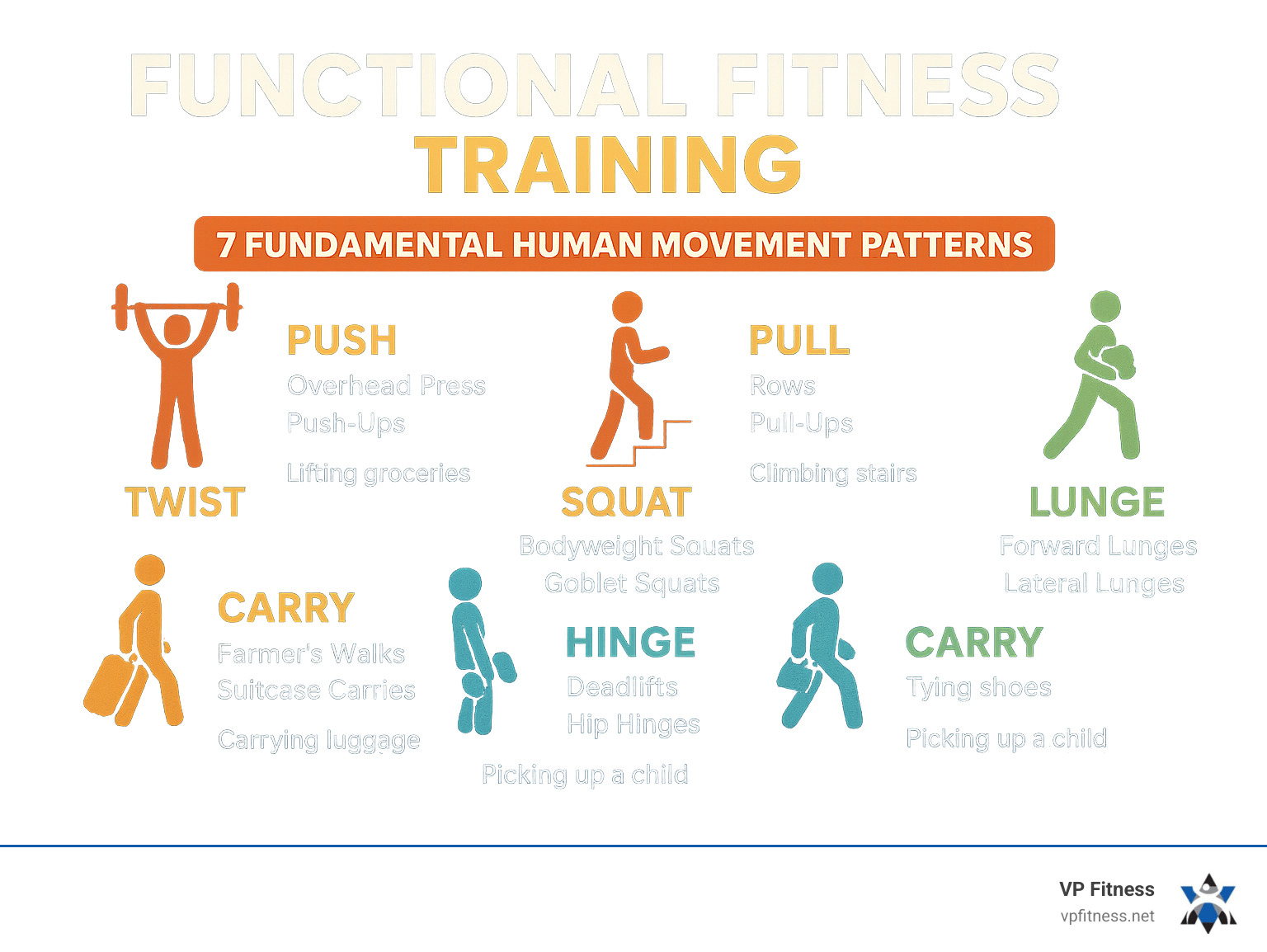
What is Functional Fitness and Why Does It Matter?
Functional fitness training trains your body to move the way it naturally needs to in real life. Instead of focusing on isolated muscles, this approach trains whole movement patterns.
Functional fitness has its roots in physical therapy, where therapists found that training movements mimicking a patient’s daily tasks was the most effective path to recovery. This task-oriented training helped patients not just heal but become more resilient.
Its effectiveness comes from mirroring the complexity of everyday tasks. When you pick up a child, your legs, core, back, and arms all work together. Functional training teaches these muscle groups to coordinate, building neuromuscular control.
A 2019 study on functional strength confirmed that functional training delivers greater real-world benefits than traditional resistance training. This principle is the foundation of many effective fitness philosophies.
Core stability is at the heart of functional movement. Your core is the powerhouse connecting your upper and lower body, providing the stable foundation for all other movements.
The Core Principles of Functional Movement
Functional fitness training is built on these fundamental principles:
- Compound exercises are the backbone, engaging multiple joints and muscles at once. A squat, for example, works the entire lower body and core, mimicking the act of sitting and standing.
- Multi-planar movements are crucial because life isn’t linear. Functional training prepares you for the bending, twisting, and side-stepping of the real world.
- Body awareness and coordination (proprioception) are improved, leading to better balance, smoother movements, and fewer stumbles.
- Six foundational patterns cover nearly everything your body does: squat, lunge, push, pull, bend/hinge, and core stability.
- Free weights and bodyweight exercises are key. Unlike machines, they force your stabilizer muscles to engage, building strength that translates to unpredictable, real-world environments.
Functional Fitness vs. Traditional Strength Training
While both approaches build strength, they have different purposes and outcomes.
| Feature | Functional Fitness Training | Traditional Strength Training |
|---|---|---|
| Goal | Movement efficiency, daily life performance, injury prevention | Muscle hypertrophy (size), aesthetics, isolated strength |
| Exercises | Compound, multi-joint, mimics real-world movements | Isolation, single-joint, targets specific muscle groups |
| Equipment | Free weights, bodyweight, resistance bands, kettlebells, TRX | Machines, barbells, dumbbells (often for isolation) |
| Real-World Carryover | High (directly improves daily tasks) | Lower (strength gains may not directly translate to complex movements) |
Traditional training is excellent for building muscle size, but that strength doesn’t always translate. A powerful leg press doesn’t guarantee the balance and coordination needed to carry groceries upstairs.
Functional fitness training builds strength for a real purpose, preparing you for life’s unpredictable moments with confidence and ease. It’s about building a body that’s ready for anything.
The Transformative Benefits of Functional Fitness Training
When you adopt functional fitness training, you change how your body moves through life. The benefits ripple out from the gym into your daily experience, with positive changes you’ll notice right away.
The most immediate change is that everyday tasks become easier. Functional fitness training prepares you for real-world challenges like carrying heavy groceries or climbing stairs, making them feel effortless.
Your posture and balance also get a major upgrade. By strengthening deep core and stabilizer muscles, your body finds better alignment, helping you stand taller and feel more stable. This is especially valuable for older adults, helping them maintain independence and reduce fall risk.
The core strength you build is a powerful foundation for your entire body. It acts as a central command center, transferring energy, protecting your spine, and keeping you stable. Research confirms these improvements lead to better posture, balance, and stability, which creates a cycle of better movement and reduced pain.
Mobility and flexibility improve as you move your body through its full range of motion. Functional movements actively lengthen and strengthen tissues at the same time, keeping joints healthy and muscles supple.
Expert guidance can help you unlock these benefits safely. A personalized program that addresses your specific movement patterns and goals is key to success.
Reducing Injury Risk Through Smarter Training
Functional fitness training makes you more resilient and less prone to injury by preparing your body to handle life’s unexpected moments safely.
Contrary to some worries, proper functional training isn’t risky. A Mayo Clinic study on low injury risk found that even high-intensity programs had low injury rates when performed correctly.
- Strengthening stabilizer muscles, often ignored by machines, is key. These muscles act as natural shock absorbers, protecting your joints.
- Correcting muscle imbalances that develop from daily habits like sitting at a desk. Functional movements restore balance by requiring all muscle groups to work together.
- Improving neuromuscular control—the communication between your brain and muscles. This leads to more precise movements and faster reaction times.
Consistent practice builds muscle memory for safe movement patterns. Your body learns the most efficient way to bend, lift, and carry. When you face an unexpected physical challenge, your body automatically defaults to these safe patterns, acting as a built-in safety system.
Getting Started: Functional Exercises for All Levels
The beauty of functional fitness training is its adaptability, offering a perfect entry point for any fitness level.

Starting with bodyweight exercises is a brilliant way to begin. Your body is the only equipment you need to establish proper form and build a foundation of strength and awareness. Once you’re confident, you can introduce progressive overload by adding resistance with dumbbells, kettlebells, or resistance bands.
Proper form is everything. We’re teaching your body to move correctly, so we emphasize quality over quantity. The goal is to move better, not just to move more weight. A personalized approach ensures your workouts support your specific goals and help you progress safely.
Beginner Functional Fitness Training Exercises
These foundational movements build the strength and balance that make daily life feel effortless.
- Bodyweight Squats: Stand with feet shoulder-width apart and chest up. Lower your hips back and down as if sitting in a chair, keeping your back straight. Stand back up, squeezing your glutes. This mimics daily actions like sitting and standing.
- Incline Push-ups: Place your hands on an liftd surface (bench, counter) slightly wider than your shoulders. Lower your chest toward the surface and push back up with control. This builds strength for pushing movements. For more detail, see this Incline Push-up guide.
- Plank: On your forearms and toes, create a straight line from head to heels. Brace your core, avoiding sagging hips or an arched back. This builds core stability essential for nearly all movements.
- Glute Bridges: Lie on your back with knees bent and feet flat. Lift your hips until your body is in a straight line from shoulders to knees, squeezing your glutes at the top. This strengthens your posterior chain, protecting your lower back.
- Farmer’s Carry with light weights: Hold a light weight in each hand, keep your shoulders back and core engaged, and walk for a set distance or time. This directly mimics carrying heavy items like groceries or luggage.
Intermediate & Advanced Functional Fitness Training Exercises
Ready to level up? These exercises demand greater strength, coordination, and control.
- Deadlifts: Stand with feet hip-width apart, shins close to the weight. Hinge at your hips with a straight back to grab the weight. Stand up by extending your hips and knees, keeping the weight close to your body. This teaches you to lift heavy objects safely.
- Kettlebell Swings: Stand with feet slightly wider than shoulders, holding a kettlebell. Hinge at the hips, swing the bell back between your legs, then explosively drive your hips forward to propel it to chest height. This builds powerful hip drive.
- Pull-ups: Hang from a bar with an overhand grip. Pull your body up until your chin clears the bar, then lower with control. This builds upper body pulling strength. If needed, start with assisted variations or inverted rows.
- Overhead Press: Stand holding dumbbells at shoulder height, palms forward. Press the weights directly overhead until your arms are fully extended, then lower with control. This prepares you for lifting objects overhead.
- Walking Lunges with weight: Holding weights, take a large step forward and lower your back knee until both knees are at 90-degree angles. Push off the back foot to stand and step into the next lunge. This improves strength and coordination for walking and climbing.
Programming Functional Fitness into Your Weekly Routine
Functional fitness training fits naturally into a busy schedule. Because the exercises work multiple muscle groups, they are time-efficient and deliver real results.

For most people, 2-4 days per week is the sweet spot. This gives your body enough challenge to adapt while allowing for proper recovery. A full-body approach is ideal, allowing you to train all major movement patterns in each workout.
A sample week could be full-body workouts on Monday, Wednesday, and Friday, focusing on different functional movements each day. Schedule rest days or light activity like walking in between. Rest and recovery are not optional; they’re when your muscles rebuild and get stronger. Listen to your body and take an extra day off if you feel sore or fatigued.
The simplicity of equipment is a major benefit. Your bodyweight is a powerful tool, and you can get an effective home workout with minimal gear like kettlebells, resistance bands, and dumbbells. A suspension trainer (like a TRX) is also a great option that uses gravity as resistance.
Whether you work out at home or in a gym, the principles of consistency and progressive challenge remain the same. If you enjoy the energy of group settings, many group fitness classes incorporate functional movements in a supportive environment.
The best routine is the one you’ll stick with. Start simple, focus on quality movement, and build from there.
Frequently Asked Questions about Functional Fitness
Here are answers to the most common questions about functional fitness training.
Is functional fitness the same as CrossFit?
While there’s overlap, they are not the same. Functional fitness is a training philosophy focused on improving movement for everyday life. It’s adaptable and designed to build practical strength, making daily activities easier and safer.
CrossFit is a branded sport that uses functional movements but adds high-intensity competition, complex Olympic lifts, and gymnastics. These elements often go beyond what’s needed for general fitness.
In short: functional fitness aims to make you better at life, while CrossFit aims to make you better at the sport of CrossFit. For practical strength and injury reduction without the competitive intensity, functional fitness is the ideal choice.
Can functional training help with weight loss?
Absolutely. Functional fitness training is highly effective for weight loss. Functional exercises are compound movements that engage multiple large muscle groups, burning more calories than isolated exercises. A squat, for example, uses far more energy than a leg extension.
This training also builds lean muscle, which boosts your resting metabolism. More muscle means your body burns more calories around the clock, helping with sustainable weight management.
Is functional fitness safe for seniors or beginners?
Yes, functional fitness training is not only safe but ideal for seniors and beginners. Its key benefit is adaptability. Every exercise can be scaled to your current fitness level. For example, a beginner can do wall push-ups instead of floor push-ups, or practice chair squats instead of weighted squats.
For seniors, this training is crucial for maintaining independence. It improves the ability to perform essential daily tasks like getting up from a chair, walking confidently, and maintaining balance, which are vital for quality of life.
The focus on proper form over heavy weights makes it inherently safer. By building a strong foundation with correct movement patterns, it helps prevent common injuries and falls.
This type of training has been shown to work for clients of all ages. It’s about meeting you where you are and helping you build strength and confidence safely, no matter your starting point.
Conclusion: Build a Body That’s Ready for Anything
Functional fitness training is more than a workout; it’s a shift in perspective. It moves beyond aesthetics to build a body that serves you in real life.
This approach bridges the gap between gym strength and real-world capability. It builds the practical strength needed for daily tasks, from chasing kids to climbing stairs, making life easier and safer.
The benefits—better balance, posture, mobility, and reduced injury risk—are the foundation for living life to the fullest. It’s about progress, not perfection, and building a body that supports your goals.
Its power lies in sustainability. Unlike extreme programs that lead to burnout, functional training integrates naturally into your life, offering sensible movements and usable results.
A personalized approach is key. Every body is unique, and your fitness journey deserves individual attention. A good trainer creates personalized programs that challenge you appropriately and evolve with you. This commitment to individualized training ensures effective, meaningful results.
If you’re ready to find what your body is truly capable of, now is the time to get started. Building a strong, resilient, and capable body is exactly what you deserve.