

How to Master a Full Body Exercise Routine Without Passing Out

How to Master a Full Body Exercise Routine Without Passing Out
Why Starting with a Full Body Exercise Routine Is the Smartest Move You’ll Make
A beginner full body exercise routine is the single most effective way to start building real strength — and you don’t need a complicated plan or hours in the gym to make it work.
Here’s a quick snapshot of what beginners need to know:
| Question | Quick Answer |
|---|---|
| How often should I train? | 3 days per week on non-consecutive days |
| How long per session? | 30-45 minutes including warm-up |
| What equipment do I need? | None required — bodyweight works |
| How many sets and reps? | 2-3 sets of 8-12 reps per exercise |
| When will I see results? | Noticeable changes in 6-8 weeks |
| What movements should I do? | Squat, hinge, push, pull, and core |
Most beginners walk into a gym (or open a fitness app) and feel completely lost. Too many exercises. Too many options. Too much conflicting advice. The result? They either do too much and burn out, or do too little and quit. A structured full body routine cuts through all of that noise.
The truth is simple: your muscles don’t care how clever your program looks. They respond to consistent, progressive effort — and full body training gives you the most of that with the least complexity.
I’m Joseph DePena, a master trainer with over a decade of experience helping everyday people build strength through smart, structured beginner full body exercise programming. In the sections below, I’ll walk you through exactly how to build a routine that works — and that you’ll actually stick to.
Why Full Body Training is the Ultimate Starting Point
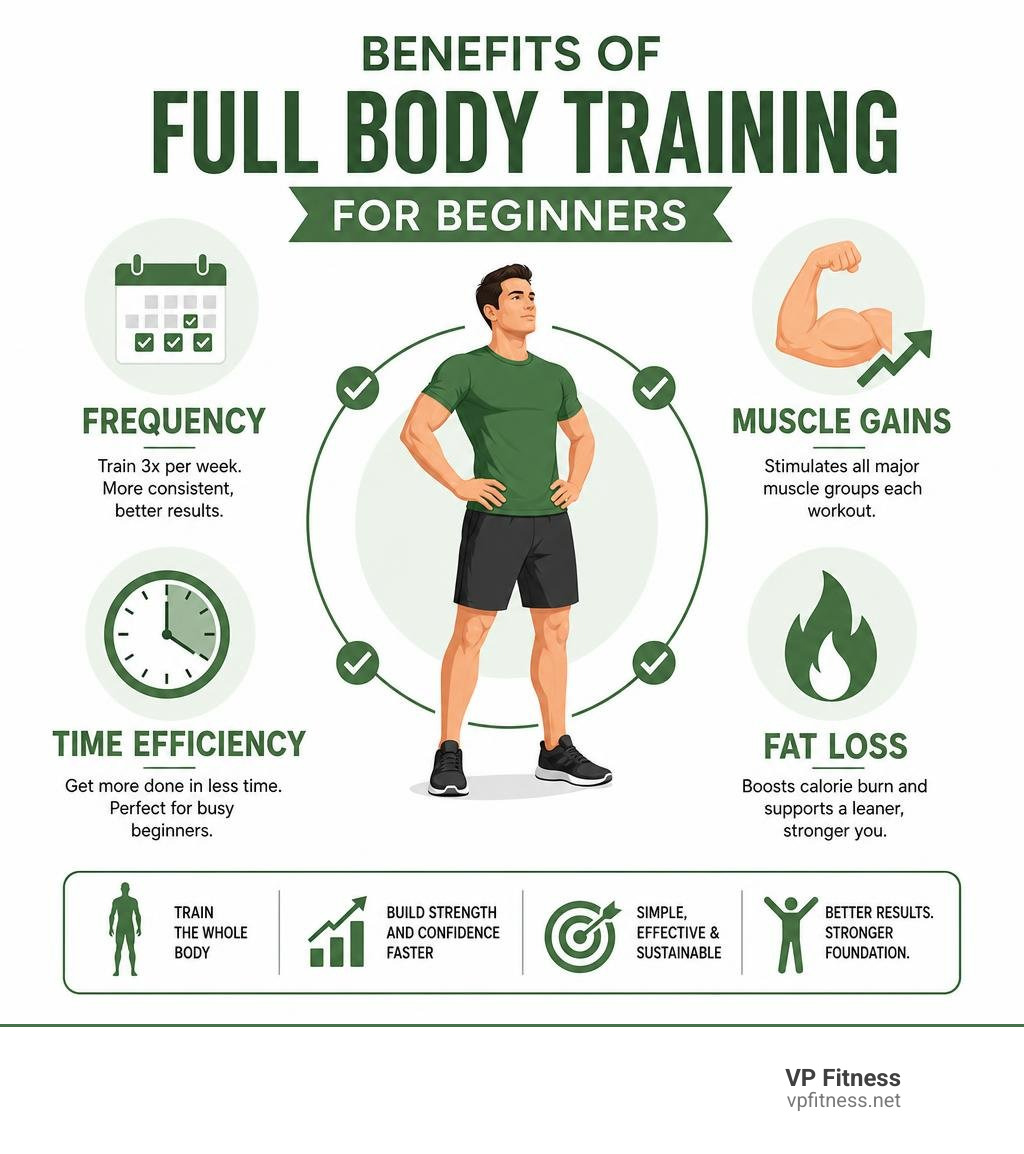
When you are starting your fitness journey in June 2026, the sheer volume of training styles can make your head spin. You have probably heard of “push-pull-legs” splits, “bro splits” where you dedicate an entire hour to your left tricep, and high-intensity interval programs that leave you gasping for air on the floor.
But if you want the absolute best return on your investment of time and energy, you need to Transform Your Body with a Full Body Workout Routine.
A full body workout engages all of your major muscle groups—legs, chest, back, shoulders, arms, and core—in a single, coordinated session. For someone new to resistance training, this approach is highly effective because it aligns perfectly with how our bodies are wired to adapt and learn.
First, let’s talk about motor learning. When you are a beginner, your muscles aren’t the only things adapting; your nervous system is also learning how to coordinate new movements. Think of it like learning to play an instrument. If you only practice a scale once a week, it will take you months to master it. If you practice that scale three times a week, your brain builds those neural pathways much faster. Full body training allows you to practice foundational movements (like squatting and pushing) multiple times a week, accelerating your coordination and strength gains.
Second, training frequency directly impacts muscle protein synthesis (MPS). MPS is the biological process where your body repairs and builds muscle tissue after a workout. In beginners, MPS peaks around 24 to 48 hours after a session before returning to baseline. By training your entire body 2 to 3 times per week, you keep your muscle-building machinery constantly turned on, rather than letting it sit idle for a week between body-part splits.
Why a Beginner Full Body Exercise Program Beats Split Routines
For years, bodybuilding magazines pushed the idea that you must isolate your muscles to see results. While split routines have their place for advanced lifters, they are highly inefficient—and often counterproductive—for beginners.
Scientific research consistently shows that for untrained individuals, training each muscle group 2 to 3 times per week produces superior hypertrophic adaptation (muscle growth) and strength gains compared to training each muscle group only once a week, even when the total weekly training volume is identical.
Additionally, split programs are incredibly unforgiving. If you are on a 5-day split and you miss “Leg Day” on Tuesday due to a late meeting at work, your entire week is thrown out of balance, and you won’t train your legs again for another seven days. With a beginner full body exercise routine, if you miss a Wednesday session, you simply push it to Thursday. Every workout is a complete package, giving you ultimate program flexibility.
The Science-Backed Benefits of Total Body Workouts
If the neural benefits don’t convince you, the metabolic science will. Total body workouts create an incredibly high metabolic demand. Because you are recruiting massive muscle groups—such as your glutes, hamstrings, and lats—in a single session, your body has to work significantly harder to fuel those muscles and recover afterward.
This leads to a phenomenon known as EPOC (Excess Post-Exercise Oxygen Consumption), often referred to as the “afterburn effect.” After a demanding full body session, your metabolism remains elevated for up to 14 hours as your body works to restore oxygen levels, clear metabolic byproducts, and repair muscle tissue. This makes full body training an incredibly efficient tool for fat loss.
Furthermore, these workouts are exceptionally time-efficient. You don’t need to live in the gym. By focusing on high-yield compound movements, you can complete a highly effective session in just 30 to 45 minutes. If you are looking for a structured, sustainable way to build this habit at home, starting with a clear Beginner Workout Plan: A 4-Week Full-Body Routine to Start Exercising at Home | Life by Daily Burn is a fantastic way to establish your baseline consistency.
Designing Your First Beginner Full Body Exercise Routine
The secret to a great full body workout lies in compound movements. These are multi-joint exercises that recruit several muscle groups at the same time. Think of a squat: it works your quads, glutes, hamstrings, calves, and core all at once. Compare that to a leg extension machine, which only isolates your quads.
By prioritizing compound movements, you get maximum results in minimal time while building functional, real-world strength.
The Five Foundational Movement Patterns
Every balanced beginner routine should be built around the five foundational movement patterns. These patterns mimic human movements we perform daily:
- The Squat (Knee Dominant): Mimics the action of sitting down and standing up. It targets the quadriceps, glutes, and adductors.
- The Hip Hinge (Hip Dominant): Bending at the hips with a flat back, like picking up a heavy grocery bag from the floor. It targets the hamstrings, glutes, and lower back.
- The Push (Horizontal or Vertical): Pushing weight away from your body (like a push-up or overhead press). It targets the chest, shoulders, and triceps.
- The Pull (Horizontal or Vertical): Pulling weight toward your body (like a row or lat pulldown). It targets the upper back, lats, and biceps.
- Core Anti-Movement: Resisting movement to stabilize your spine (like a plank). This builds deep core strength and protects your lower back.
Selecting the Right Beginner Full Body Exercise Variations
You don’t need to jump straight to heavy barbells on day one. In fact, starting with simpler variations allows you to master the mechanics safely. Here are the best beginner-friendly exercises for each pattern:
- Squat Variation: The Goblet Squat
Holding a single dumbbell or kettlebell vertically against your chest naturally pulls your torso upright, preventing your lower back from rounding and helping you achieve great depth safely. - Hip Hinge Variation: The Romanian Deadlift (RDL)
Unlike a standard deadlift from the floor, the RDL starts from a standing position. You soft-bend your knees and push your hips straight back as if trying to touch a wall behind you with your glutes, keeping the weights close to your thighs. - Push Variation: The Floor Press or Incline Dumbbell Press
The floor press is an incredible variation for beginners. By lying flat on the floor and pressing dumbbells upward, the floor acts as a natural safety stop for your elbows, protecting your shoulder joints from hyperextension. - Pull Variation: The Dumbbell Bent-Over Row or Chest-Supported Row
Focus on pulling with your elbows rather than your hands. Imagine trying to elbow someone standing directly behind you to fully engage your lats and upper back. - Core Variation: The Forearm Plank
A proper plank is an active, full-body contraction. Squeeze your glutes, brace your abs as if someone is about to punch you in the stomach, and keep your body in a straight line from head to heels.
If you are training at home without weights, you can build incredible strength using your own body mass. Learn more about modifying these patterns in our guide on Bodyweight Exercises Strength.
If you have a set of dumbbells and want a fast, structured routine, you can follow a 30-Minute Beginner Full-Body Dumbbell Workout at Home – FED Fitness. For those who prefer a pure strength-focused approach in their living room, check out this excellent resource on Full Body Strength Workout for Beginners at Home – Strength 4 Life.
Structuring Your Workouts for Maximum Safety and Efficiency
A common beginner mistake is thinking that a workout has to last two hours to be effective. In reality, a focused, high-quality session should take no more than 45 to 60 minutes total. This timeframe includes your warm-up, the main lifting session, and a brief cool-down.
Keeping your workouts concise prevents excessive fatigue, preserves your form, and makes the routine easy to fit into a busy schedule.
Warm-Up and Cool-Down Protocols
Never walk into the gym and head straight to the heavy weights. A proper warm-up increases your core body temperature, lubricates your joints with synovial fluid, and prepares your nervous system for movement.
Spend 5 to 10 minutes on a dynamic warm-up. This should include movements like arm circles, bodyweight squats, hip openers, and cat-cow stretches. Static stretching (holding a stretch for 30+ seconds) should be avoided before lifting, as research shows it can temporarily reduce muscle power. Save those deep stretches for your cool-down to help lower your heart rate and kickstart recovery.
To build a safe, effective routine, make sure to follow our structured Warm Up Routine before you lift, and finish your session with these relaxing Cool Down Stretches.
Sets, Reps, and Rest Periods
For beginners, the sweet spot for muscle growth and strength is 2 to 3 sets of 8 to 12 repetitions per exercise.
Your rest periods are just as important as the exercises themselves. For large compound movements (like squats and rows), rest 90 to 120 seconds between sets. This allows your muscles’ primary energy systems (ATP-PC) to fully recover, ensuring you can perform the next set with perfect form. For core exercises, 60 seconds of rest is plenty.
| Training Phase | Sets | Reps | Rest Period | Focus |
|---|---|---|---|---|
| Beginner | 2-3 | 8-12 | 90-120 sec | Movement quality, motor control, habit building |
| Intermediate | 3-4 | 6-10 | 90-120 sec | Strength development, volume accumulation |
| Advanced | 4-5 | 5-8 | 2-3 min | Maximal strength, power, advanced progression |
During your sets, you should aim to leave 2 to 3 Reps in Reserve (RIR). This means you stop your set when you feel you could have completed 2 or 3 more reps with perfect form before reaching total failure. Training to absolute failure is unnecessary for beginners and drastically increases your recovery time and injury risk.
How to Progress and Avoid Common Mistakes
When you first start exercising, your body adapts incredibly fast. This is often called “newbie gains.” However, to keep making progress, you must apply the principle of progressive overload. If you use the exact same weights, reps, and rest periods forever, your body has no reason to grow stronger.
The Principle of Progressive Overload
Progressive overload doesn’t mean you have to add 10 pounds to the bar every single week. For beginners, progress can be achieved in several ways:
- Adding 1 or 2 repetitions to a set with the same weight.
- Improving your movement control and slowing down your tempo (e.g., taking 3 seconds to lower a squat).
- Adding an extra set to your routine.
- Increasing the weight slightly when the current weight becomes too easy.
A great guideline to use is the two-for-two rule: if you can complete two more repetitions than your target rep count on your final set of an exercise for two consecutive workouts, it is time to increase the weight or difficulty.
If you are looking for a complete, structured road map to guide you through these progressions over the next few months, explore our comprehensive guide on Exercise for Beginners.
Additionally, you can follow a highly structured 12 Week Full Body Workout Routine for Beginners – Muscle & Strength to keep your progress on track step-by-step.
Common Pitfalls to Avoid
- Ego Lifting: Trying to lift weights that are too heavy at the expense of your form. Remember: a light weight lifted with perfect form builds far more muscle and strength than a heavy weight swung around with momentum.
- Chasing Extreme Soreness: Feeling slightly stiff a day or two after a workout (Delayed Onset Muscle Soreness, or DOMS) is normal. However, being so sore that you can’t walk or brush your teeth is not a badge of honor—it is a sign that you overdid the volume and are hurting your recovery.
- Neglecting Sleep and Hydration: Your muscles don’t grow while you are working out; they grow while you are resting. Aim for 7 to 9 hours of quality sleep per night, and stay hydrated. Even a 2% drop in hydration can noticeably degrade your strength and focus in the gym.
Frequently Asked Questions about Beginner Full Body Workouts
How many times per week should a beginner perform a full body workout?
The American College of Sports Medicine (ACSM) recommends that beginners engage in resistance training 2 to 3 times per week.
Crucially, you must allow at least 48 hours of rest between sessions that target the same muscle groups. For example, a Monday-Wednesday-Friday or Tuesday-Thursday-Saturday schedule is perfect. This gives your muscle fibers ample time to repair and grow stronger before you challenge them again.
If you want a professional team to help you map out your weekly schedule and ensure you are moving safely, check out our Beginner Fitness Program.
Can I build muscle and lose fat at the same time?
Yes! This process is known as body recomposition. It is highly achievable for beginners because your body is incredibly sensitive to the new stimulus of resistance training.
To maximize body recomposition, you should maintain a mild caloric deficit (or eat at maintenance calories) while consuming adequate protein—ideally 0.7 to 1.0 grams of protein per pound of body weight daily. This provides your body with the building blocks to repair muscle tissue while using stored fat for daily energy.
For a great, simple starting plan that walks you through this initial phase, take a look at the Beginner Workout Routine: A 4-Week Starter Plan That Actually Works – Gym Plus.
What if I have no equipment or limited space?
You absolutely do not need a gym membership or a room full of weights to get in great shape. Your own body weight provides incredible resistance. Exercises like push-ups (which can be modified by placing your hands on a wall or kitchen counter), bodyweight squats, reverse lunges, and planks can build a powerful foundation of fitness.
If you want a highly efficient, minimalist routine that you can perform anywhere, check out how This Beginner Workout Builds Full-Body Strength with Just 2 Moves using only bodyweight patterns.
Conclusion
Embarking on a fitness journey is one of the most rewarding commitments you can make for your health, longevity, and confidence. By focusing on a structured beginner full body exercise routine, you are choosing the most efficient, science-backed path to building sustainable strength and movement skill.
A structured program takes the guesswork out of your training, helping you focus on what truly matters: consistency and proper form. With the right plan, you can create individualized fitness and nutrition habits tailored to your unique goals, body mechanics, and lifestyle.
Ready to take the first step toward a stronger, healthier version of yourself? Learn how to Transform Your Body with a Full Body Workout and start your journey today.