

How to Master the One Muscle a Day Workout Plan

How to Master the One Muscle a Day Workout Plan
What Is a 1 Muscle a Day Workout Plan (And Does It Actually Work)?
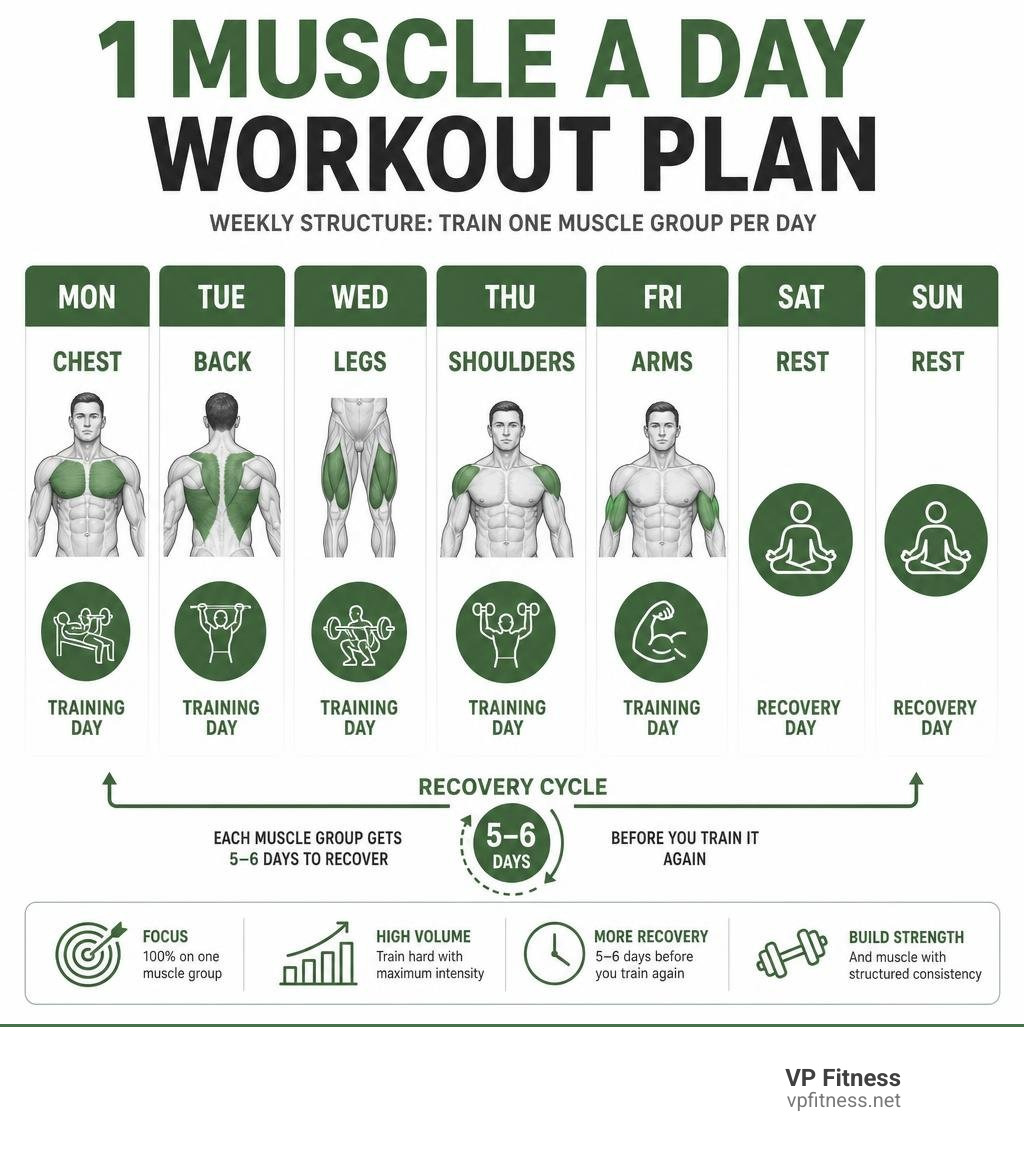
A 1 muscle a day workout plan — often called a “bro split” — is a training structure where you dedicate each workout session to one specific muscle group. Here’s a quick overview:
- Monday – Chest
- Tuesday – Back
- Wednesday – Legs
- Thursday – Shoulders
- Friday – Arms
- Saturday/Sunday – Rest
This gives each muscle group roughly 5–6 days to recover before you train it again. It’s one of the oldest training methods in bodybuilding — and it’s still widely used in 2026.
Is it effective? Yes, for the right person. It’s especially popular with intermediate and advanced lifters who want to train with high volume and intensity on each muscle group without burning out. Beginners, however, may get better results from higher-frequency splits.
The appeal is simple: you walk into the gym knowing exactly what you’re doing. You focus entirely on one muscle, hit it hard, and leave. No splitting attention across five different muscle groups.
That said, there are real trade-offs — mainly around training frequency. Research consistently shows that training each muscle group at least twice per week tends to produce better muscle growth for most people. A strict one-muscle-per-day split only hits each group once. Whether that matters depends on your experience level, your volume per session, and how well you recover.
I’m Joseph DePena, a master trainer with over a decade of experience programming splits — including the 1 muscle a day workout plan — for clients at every fitness level. In this guide, I’ll break down exactly how to structure, optimize, and get real results from this approach.
Simple 1 muscle a day workout plan glossary:
What is a Single-Muscle Split and How Does It Compare?

To truly understand the 1 muscle a day workout plan, we have to look at how it stacks up against other popular training setups. In the fitness world, we constantly balance two primary variables: training volume (how much work you do per session) and training frequency (how often you target a specific muscle group per week).
When following a traditional workout split routine, you divide your muscle groups across your weekly schedule to maximize recovery. With a single-muscle split, you are choosing extreme session volume over weekly frequency. Instead of hitting your chest three times a week with a few sets each time, you blast your chest with 15 to 20 sets in a single day, then leave it alone to recover for a full week.
This triggers the core building blocks understanding muscle hypertrophy by creating massive localized mechanical tension and metabolic stress. However, it means your protein synthesis cycles for that muscle will peak and return to baseline long before you train it again.
To help you visualize how this compares to other setups, here is a quick breakdown:
| Split Type | Weekly Frequency per Muscle | Session Volume | Typical Schedule | Best For |
|---|---|---|---|---|
| Full-Body | 3x per week | Low to Moderate | Mon / Wed / Fri | Beginners, busy schedules |
| Upper / Lower | 2x per week | Moderate | Mon / Tue / Thu / Fri | Intermediates, strength athletes |
| Push / Pull / Legs (PPL) | 2x per week | Moderate to High | 6 Days on, 1 Day off | Hypertrophy-focused lifters |
| Single-Muscle Split | 1x per week | Very High | Mon through Fri (5 Days) | Advanced lifters, mind-muscle connection |
Pros and Cons of Training One Muscle Group Per Day
Like any training style, the 1 muscle a day workout plan has its passionate advocates and its vocal critics. Let’s look at the objective benefits and drawbacks of this high-volume approach:
The Pros:
- The Ultimate Muscle Pump: Because you are dedicating 45 to 60 minutes to a single muscle group, the blood flow and localized swelling (the “pump”) are incredible. This can enhance the mind-muscle connection and make workouts highly satisfying.
- Unmatched Recovery Time: Muscles can take 48 hours or more to recover from intense resistance training. With a single-muscle split, you give each target area a massive 168 hours of rest before hitting it again, virtually eliminating local overtraining risks.
- Simplicity and Focus: You can completely exhaust a muscle using a variety of angles, compound lifts, and isolation exercises without worrying about saving energy for other body parts.
The Cons:
- Missed Frequency Window: Muscle protein synthesis typically stays elevated for 36 to 48 hours post-workout. With a once-weekly frequency, your muscles spend several days in a neutral state rather than an active growth state.
- The “Junk Volume” Risk: Doing 20 sets for a single muscle group in one session can lead to a point of diminishing returns. The last few exercises may turn into “junk volume,” where you are too fatigued to recruit high-threshold motor units effectively.
- Inflexible Schedule: If you miss “Leg Day” on Wednesday, it throws off your entire week, or forces you to wait another seven days to train your legs.
For those looking to maximize efficiency with a higher frequency, comparing this to options like The #1 Full Body Routine to Build Muscle & Lose Fat can help you decide which style matches your lifestyle.
Who is the 1 Muscle a Day Workout Plan Best For?
This training split is not a one-size-fits-all solution. Your experience level plays a massive role in whether this routine will help you make progress or leave you unnecessarily sore.
We find that this split is best suited for intermediate to advanced lifters who already know how to build muscle and have developed the work capacity to handle high-volume sessions. Advanced bodybuilders often require an immense amount of localized stimulus to force new adaptation. For them, a standard 3-set routine won’t cut it; they need to attack a muscle from multiple angles using compound and isolation movements in a single session.
Conversely, we do not recommend this split for absolute beginners. Beginners do not have the neuromuscular coordination to isolate a single muscle for an hour, nor do they need that much volume to grow. A beginner will see far better results training their entire body or using a simple upper/lower split two to three times a week.
Designing Your 1 Muscle a Day Workout Plan

To build an effective 1 muscle a day workout plan, you cannot just throw random exercises together. You need a structured approach that prioritizes progressive overload while utilizing both compound movements and isolation exercises to target every angle of the muscle.
When designing a workout for hypertrophy, your exercise selection should start with your heaviest, most demanding compound lifts while your energy is high, and gradually transition to targeted isolation movements and machine exercises as the muscle fatigues.
For a structured, printable template of this style of training, you can refer to this One-Muscle-Per-Day Workout Plan PDF.
Sample 5-Day 1 Muscle a Day Workout Plan
Here is a highly effective, field-tested 5-day split designed to maximize muscle hypertrophy. This program is structured to fit perfectly into a standard Monday-to-Friday work week, leaving your weekends free for complete recovery. This structure is inspired by classic Focused Training: One Muscle Group/Day protocols.
Monday: Chest Day
- Incline Barbell Bench Press: 4 sets x 6-8 reps (Rest: 2 mins)
- Flat Dumbbell Press: 3 sets x 8-10 reps (Rest: 90 secs)
- Weighted Chest Dips: 3 sets x 10-12 reps (Rest: 90 secs)
- Standing Cable Flyes (High-to-Low): 3 sets x 12-15 reps (Rest: 60 secs)
- Pec Dec Machine: 2 sets x 15 reps (Focus on a 2-second squeeze at peak contraction)
Tuesday: Back Day
- Conventional Deadlifts: 3 sets x 5 reps (Rest: 2-3 mins)
- Barbell Rows (Overhand Grip): 4 sets x 8 reps (Rest: 90 secs)
- Wide-Grip Lat Pulldowns: 3 sets x 10-12 reps (Rest: 90 secs)
- Single-Arm Dumbbell Rows: 3 sets x 10 reps per side (Rest: 60 secs)
- Straight-Arm Cable Pull-Downs: 3 sets x 12-15 reps (Rest: 60 secs)
Wednesday: Leg Day
- Barbell Back Squats: 4 sets x 6-8 reps (Rest: 2-3 mins)
- Romanian Deadlifts (RDLs): 3 sets x 8-10 reps (Rest: 90 secs)
- Leg Press: 3 sets x 10-12 reps (Rest: 90 secs)
- Walking Dumbbell Lunges: 3 sets x 12 steps per leg (Rest: 60 secs)
- Seated Leg Curls: 3 sets x 12-15 reps (Superset with Standing Calf Raises for 4 sets of 15-20 reps)
Thursday: Shoulder Day
- Overhead Barbell Press (OHP): 4 sets x 6-8 reps (Rest: 2 mins)
- Dumbbell Lateral Raises: 4 sets x 12-15 reps (Rest: 60 secs)
- Seated Dumbbell Shoulder Press: 3 sets x 10 reps (Rest: 90 secs)
- Bent-Over Dumbbell Rear Delt Flyes: 3 sets x 15 reps (Rest: 60 secs)
- Cable Face Pulls: 3 sets x 15-20 reps (Rest: 60 secs)
Friday: Arm Day (Biceps & Triceps)
- Close-Grip Bench Press: 3 sets x 8 reps (Rest: 90 secs)
- Barbell Bicep Curls: 3 sets x 8-10 reps (Rest: 90 secs)
- Overhead Dumbbell Tricep Extension: 3 sets x 10-12 reps (Rest: 60 secs)
- Incline Dumbbell Hammer Curls: 3 sets x 10-12 reps (Rest: 60 secs)
- Tricep Cable Pushdowns (V-Bar): 3 sets x 12-15 reps (Superset with Cable EZ-Bar Curls for 3 sets of 12-15 reps)
Structuring Sets, Reps, and Rest Periods
To stimulate maximum hypertrophy on a single-muscle split, you must manage your training intensity. Since you are only training each muscle group once a week, those sessions have to count.
We recommend aiming for 12 to 20 total working sets per muscle group per weekly session.
- For Compound Lifts: Keep your reps in the 5 to 8 range to build baseline strength. Rest for 2 to 3 minutes between these sets to ensure your nervous system fully recovers. This ensures you can lift heavy enough to recruit high-threshold muscle fibers.
- For Isolation Movements: Keep your reps in the 10 to 15 range to maximize metabolic stress and volume. Rest for 60 to 90 seconds between these sets to keep the target muscle engorged with blood.
If you prefer a minimalist approach that prioritizes heavy compound movements over multiple exercises, you might find the concepts in the 1-Lift Per Day Training Plan highly valuable for building raw power.
Smart Exercise Substitutions for Home and Gym
Don’t have access to a fully equipped commercial gym? Or is your local gym packed during peak hours? You can easily swap out exercises while keeping the same stimulus.
Here are some smart substitutions to keep your training consistent:
- Instead of Cable Flyes: Use Dumbbell Flyes on a flat or incline bench, or utilize resistance bands anchored to a sturdy post.
- Instead of Lat Pulldowns: Perform wide-grip bodyweight pull-ups or chin-ups. If those are too challenging, use an assisted pull-up machine or band assistance.
- Instead of Leg Press: Perform Bulgarian Split Squats or heavy Goblet Squats with a dumbbell or kettlebell.
- Instead of Cable Tricep Pushdowns: Perform Skull Crushers with dumbbells or an EZ-bar, or do bodyweight bench dips.
Maximizing Recovery and Nutrition for High-Volume Splits
Because a 1 muscle a day workout plan inflicts a high amount of localized muscle damage, your recovery protocols must be on point. If you do not feed your body the raw materials it needs to rebuild, you will simply break down muscle tissue without ever supercompensating (growing back bigger and stronger).
Nutrition and Protein Synthesis
To support muscle repair, aim to consume 0.8 to 1 gram of protein per pound of body weight daily. Spreading this intake across 4 to 5 meals ensures a steady supply of amino acids to trigger muscle protein synthesis throughout the day.
Additionally, unless you are actively trying to lose body fat, we recommend eating in a slight caloric surplus (roughly 5% to 10% above your maintenance calories) to give your body the energy required to construct new muscle tissue.
The Power of Sleep
Muscle growth doesn’t happen while you are lifting weights; it happens while you rest. Aim for 7 to 9 hours of high-quality sleep per night. Deep sleep is when your body releases the vast majority of its natural growth hormone and testosterone, facilitating deep tissue repair.
For a complete breakdown on optimizing your post-training routine, check out our guide on post workout recovery to maximize your hard work in the gym.
Frequently Asked Questions About Single-Muscle Training
We hear a lot of questions from lifters who are curious about trying a single-muscle split. Here are the honest answers to the most common queries.
How long should I follow a one-muscle-per-day program?
We recommend running a single-muscle split for 8 to 12 weeks at a time. After this period, your body will begin to adapt to the high-volume stimulus, and your gains may start to plateau.
Following a structured training block, it is wise to take a deload week (reducing your training volume and weight by 50%) before transitioning to a higher-frequency, lower-volume split to keep your muscles guessing and progressing.
Can beginners use a single-muscle-per-day split?
Technically, anyone can follow any split, but we do not advise it for beginners. Beginners lack the neuromuscular efficiency to truly exhaust a single muscle group over 15 to 20 sets.
For someone in their first year of lifting, a full-body routine or a simple 2-day split is far superior because it allows them to practice the primary compound lifts (squats, bench press, rows) multiple times per week, accelerating their strength gains and motor learning.
Which muscle groups pair well together if I want to modify the split?
If a strict 5-day single-muscle split doesn’t fit your schedule, you can easily pair synergistic muscle groups together to create a highly effective 4-day split. Excellent pairings include:
- Chest and Triceps (Pushing muscles)
- Back and Biceps (Pulling muscles)
- Shoulders and Abs
- Legs and Calves
This modification allows you to hit your major muscle groups with high volume while freeing up an extra day in your weekly schedule.
Conclusion
The 1 muscle a day workout plan is a classic, time-tested approach to bodybuilding that can help you bust through training plateaus, achieve incredible muscle pumps, and enjoy highly focused workouts. While it may not offer the high weekly frequency of a full-body or PPL routine, its unmatched recovery time and sheer session intensity make it a favorite among intermediate and advanced lifters worldwide.
We believe that the best workout split is the one you can perform consistently. Whether you want to try a high-volume single-muscle split or design a highly customized routine tailored to your unique busy lifestyle, expert coaching can help. Personalized fitness coaching, custom nutrition guidance, and elite-level physical therapy can help you reach your goals safely and efficiently.
Ready to take your physical progress to the next level? Let us help you design a custom workout plan tailored to your specific biomechanics and goals. For a deeper dive into all your training options, explore our comprehensive workout splits ultimate guide today!