

The Kettlebell Chronicles: Routines for Every Level

Why Kettlebells are a Full-Body Powerhouse
A kettlebell workout routine can transform your fitness journey with just one piece of equipment. Here’s what you need to know:
Quick Kettlebell Workout Routine Guide:
- Beginner weights: Women 8-15 lbs, Men 15-25 lbs
- Workout frequency: 2-3 times per week with rest days
- Basic routine: 20-minute circuit with 6 exercises, 3 rounds
- Core exercises: Swings, Goblet Squats, Overhead Press, Bent-Over Row
- Benefits: Full-body strength + cardio + flexibility in one workout
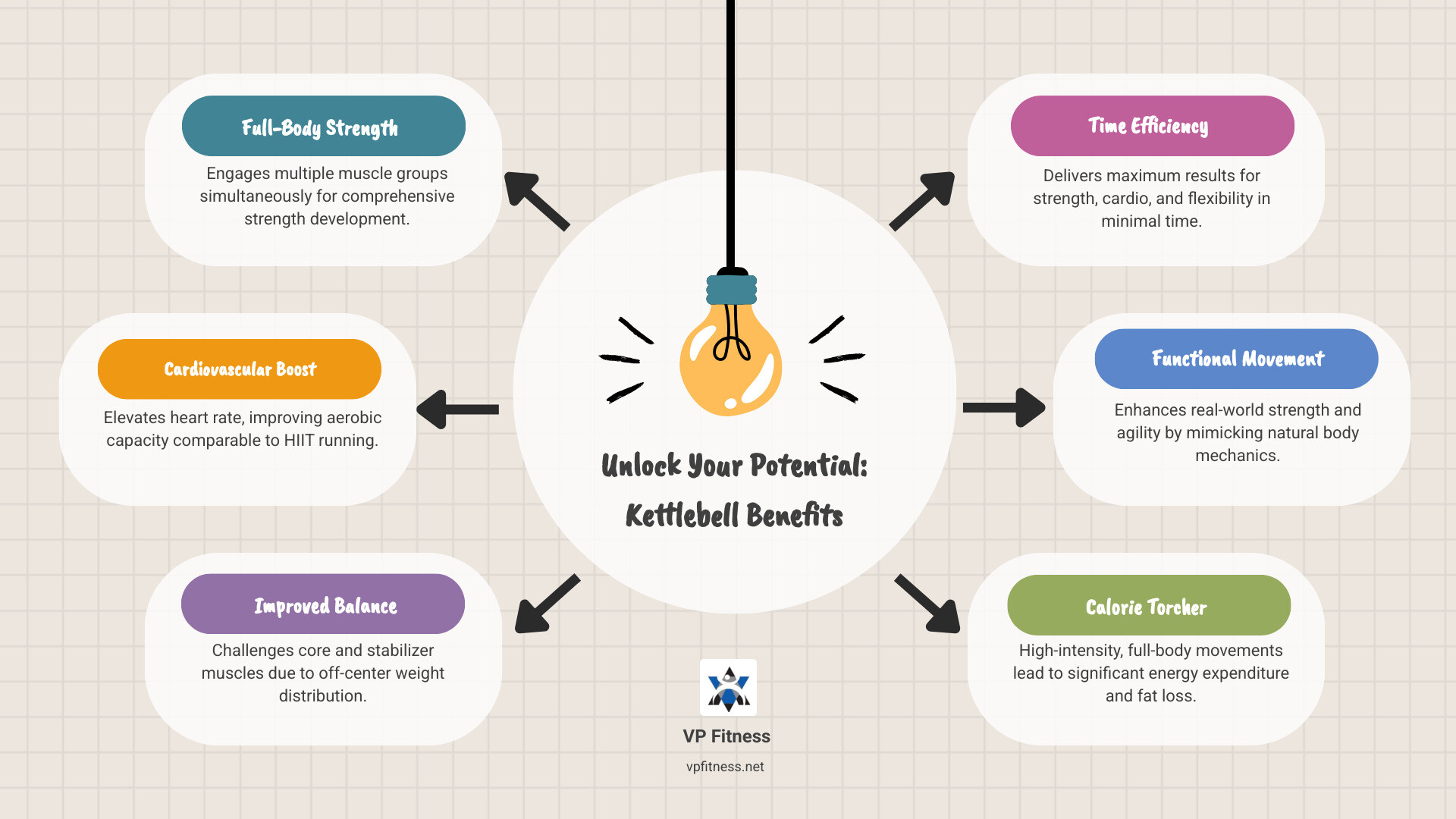
Kettlebells aren’t just trendy; they’re Russian “girya” that have built functional strength for centuries. Their off-center weight distribution forces your core to work harder, allowing you to build strength, burn calories, and improve balance simultaneously.
Research from the American Council of Exercise shows kettlebell training can improve aerobic capacity as much as high-intensity interval running. A 2020 study of ballet dancers found their balance improved significantly after just five months of kettlebell training. This versatile tool delivers what busy professionals need: maximum results in minimum time.
With over 12+ years in fitness and powerlifting, I’ve seen countless clients transform their fitness with strategic kettlebell routines. My experience has shown me that kettlebells are one of the best tools for building real-world strength while keeping workouts efficient and engaging.
Getting Started: Your Kettlebell Toolkit
Ready to start your kettlebell workout routine? Before you jump into those powerful swings and squats, let’s ensure you’re set up for success. Getting the right equipment and understanding safety basics will make your kettlebell journey both effective and injury-free.
Choosing Your First Kettlebell: Weight and Style
“What weight should I start with?” is the most common question from new kettlebell enthusiasts. Starting with the right weight makes all the difference.
The American Council of Exercise provides solid guidelines: women typically start with 8-15 pounds, while men usually find their sweet spot with 15-25 pounds. However, these are just starting points. Your current fitness level is more important than gender. There’s no shame in starting lighter; in fact, it’s smart.
My favorite way to test a kettlebell’s weight is the press test. Can you comfortably press it overhead about 10 times with good form? If yes, you’re in the right ballpark for grinding movements like squats and presses. For ballistic movements like swings, you might want something slightly heavier to feel the momentum.
When shopping, you’ll notice two main styles: standard cast iron and competition kettlebells.
| Feature | Standard (Cast Iron) Kettlebell | Competition Kettlebell |
|---|---|---|
| Material | Cast iron | Steel |
| Size | Varies with weight (heavier = larger) | Uniform size across all weights |
| Handle Diameter | Varies, often thicker for heavier bells | Standardized, usually 35mm, regardless of weight |
| Finish | Often powder-coated, can be rough | Smooth, polished, sometimes color-coded by weight |
| Balance | Weight distribution can vary slightly | Precisely balanced for consistent feel |
| Use Case | General fitness, strength training, home workouts | Kettlebell sport, precise technique, consistent feel |
For most people starting a kettlebell workout routine, a quality cast iron kettlebell is perfect. They’re affordable and work great for general fitness. For reliable brands, consider Cap Barbell for budget-friendly options, Kettlebell Kings for premium quality, or Dragon Door for the gold standard.
Safety First: Mastering Form and Preventing Injury
Kettlebells can cause injury if used improperly, but the risks are preventable. Common issues include bruising on forearms, muscle strains from poor form, and back injuries from improper lifting. All are avoidable with proper technique and gradual progression.
Proper form is everything in kettlebell training. Five perfect swings are better than 20 sloppy ones. The foundation of safe training is maintaining a neutral spine—no rounding or excessive arching. Your core should be engaged throughout every movement, acting like a natural weight belt.
Remember this golden rule: lift with your legs, not your back. Use hip hinge movements, pushing your hips back and keeping your chest up to let your glutes and hamstrings do the work.
Start slow and progress gradually. Master the basic movements before adding weight. Your ego might want to swing a heavy bell on day one, but your joints will appreciate a measured approach. Most importantly, listen to your body. Muscle fatigue is normal; sharp pain is your cue to stop and reassess.
Consider working with a qualified trainer for personalized guidance. Proper instruction helps people build a safe, effective foundation. For more guidance, check out these safety tips for physical activity. Building strength for the long haul means understanding the importance of strength training for long-term health and staying injury-free.
The Fundamental Kettlebell Movements
Now for the exciting part—learning the movements that make a kettlebell workout routine so effective. Kettlebells are unique because they train you in two ways: slow, controlled “grinding” movements for pure strength, and explosive “ballistic” movements for power and cardio. Mastering a few of these fundamentals open ups the full potential of kettlebell training.
The Kettlebell Swing: The King of Exercises
If you learn only one kettlebell exercise, make it the swing. It’s the foundation for everything else. The swing is a ballistic movement that teaches you to generate explosive power from your hips, which translates to better performance in daily life.
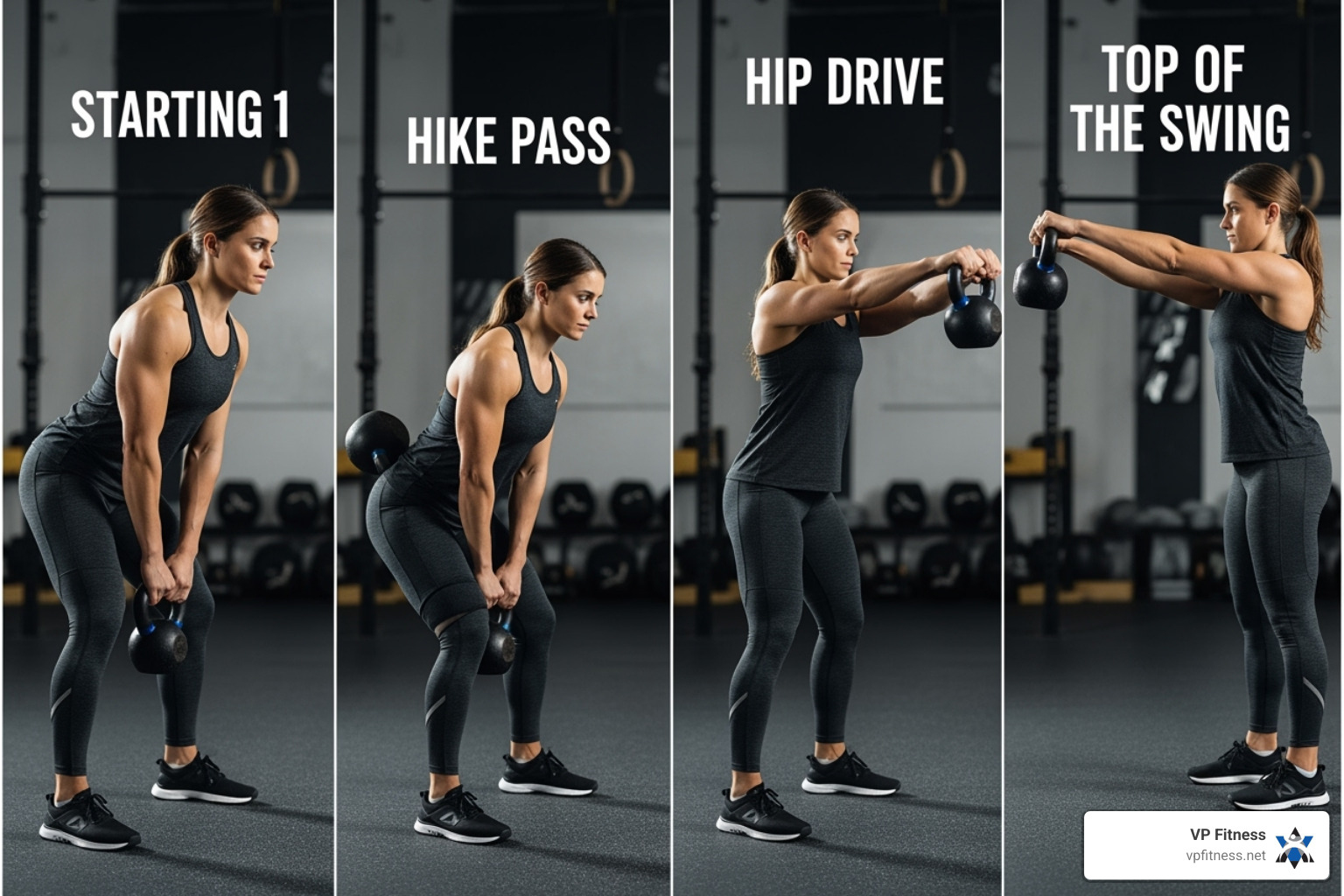
The magic of the swing is the hip hinge, where your hips move back and then snap forward. This targets your posterior chain: glutes, hamstrings, and core. These muscles provide real-world strength and help prevent back pain.
To master the swing, stand with feet slightly wider than shoulder-width, with the kettlebell about a foot in front of you. Hinge at your hips (not your knees), keep your back flat, and grab the kettlebell. Hike the kettlebell back between your legs like a football. Your forearms should touch your inner thighs, and you should feel a stretch in your hamstrings.
Now, drive your hips forward explosively, squeezing your glutes hard. This hip drive—not your arms—sends the kettlebell up to chest level. At the top, the kettlebell should feel momentarily weightless. As gravity takes over, guide the kettlebell back down by hinging at your hips, maintaining control. Remember: it’s a hinge, not a squat. Think of slamming a car door with your glutes.
Essential Grinding Lifts: Squats, Presses, and Rows
While swings get your heart racing, grinding movements build steady strength. These slower exercises focus on muscle engagement and perfect form.
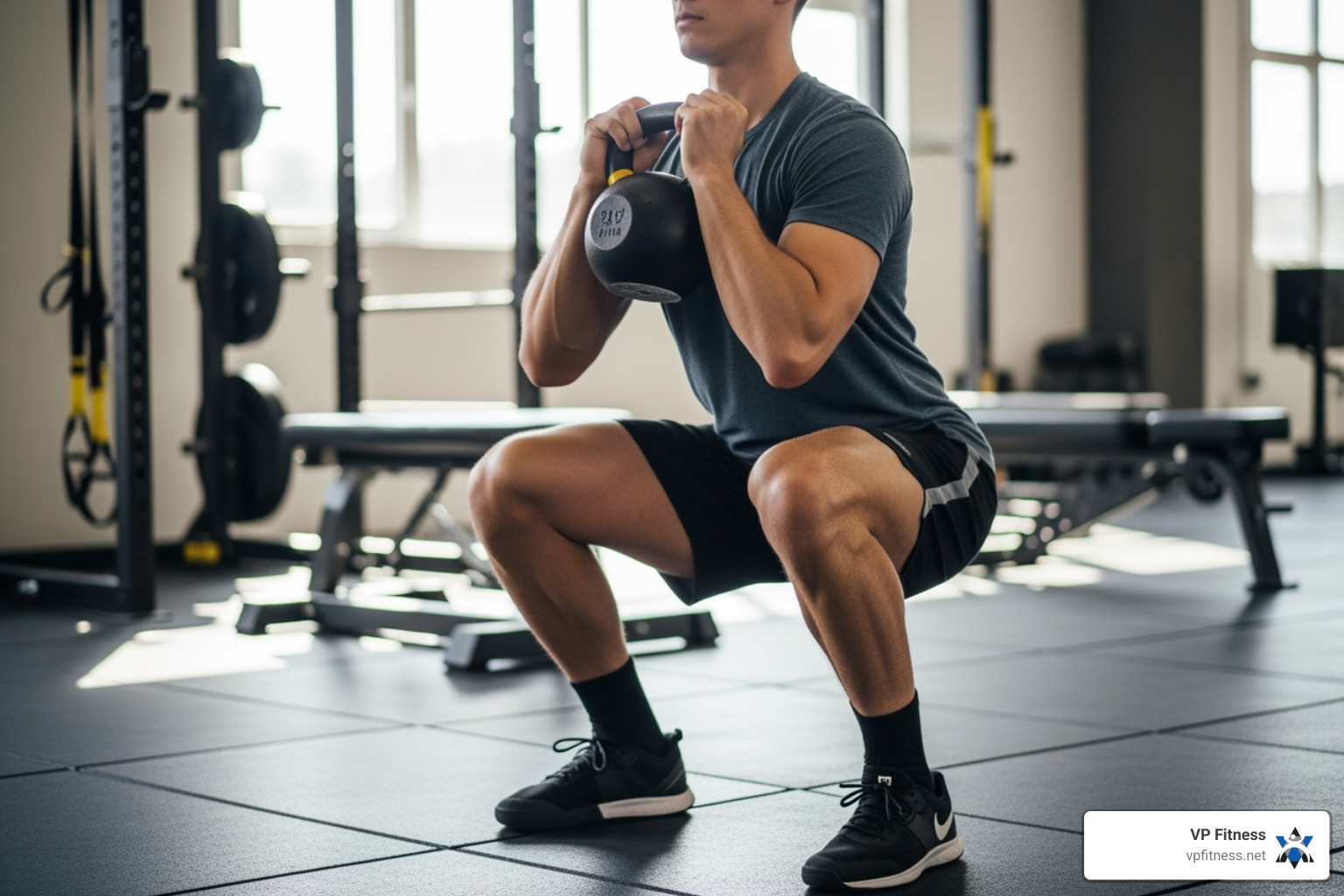
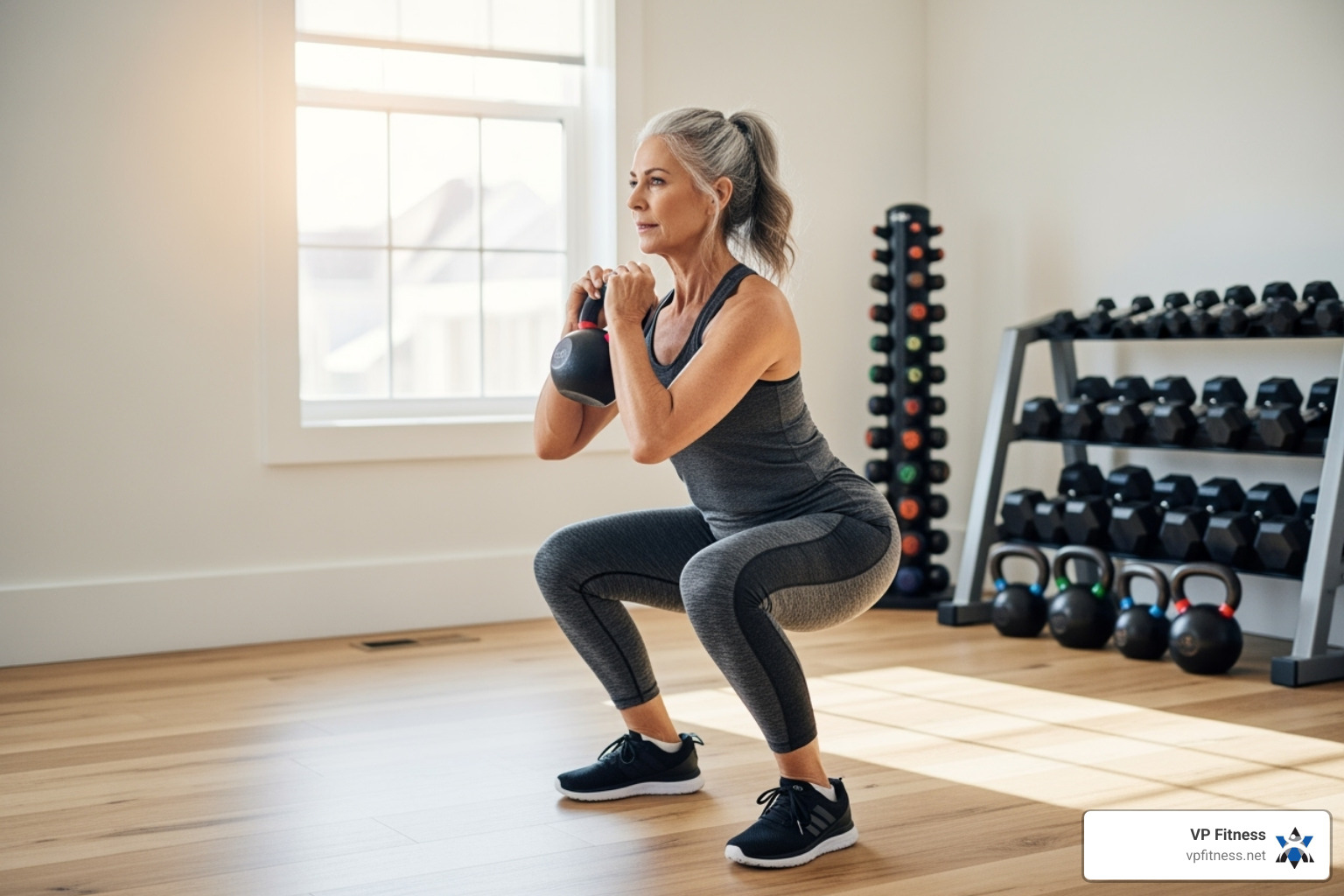
The Goblet Squat is an ideal starting point. Hold the kettlebell by the “horns” against your chest, elbows tucked in. Squat down while keeping your chest upright and elbows inside your knees, then drive through your heels to stand. The weight naturally helps you maintain proper squat form.
The Overhead Press builds shoulder stability and core strength. From the “rack” position (kettlebell on your forearm, elbow tucked), press straight up until your arm is fully extended. Lower with control. Keep your core tight to prevent your back from arching.
For back strength, master the Bent-Over Row. Hinge at your hips with a flat back. Pull the kettlebell toward your hip by driving your elbow back and squeezing your shoulder blade, like starting a lawnmower.
The Romanian Deadlift teaches a proper hinge while building hamstring and glute strength. Hold the kettlebell with both hands. With a slight bend in your knees, push your hips back, lowering the kettlebell until you feel a hamstring stretch. Squeeze your glutes to return to standing.
Finally, the Front Rack Reverse Lunge challenges your legs, glutes, and core. With the kettlebell in the front rack position, step one leg back into a lunge. Push off your back foot to return to the start, then alternate legs.
These fundamental movements are the foundation for any effective kettlebell workout routine. Master them with perfect form to build strength, power, and confidence.
Your Complete Kettlebell Workout Routine
You’ve learned the fundamentals and chosen your kettlebell. Now it’s time to put it all together into a structured kettlebell workout routine that delivers results. Let’s start with a beginner-friendly approach and then explore how to challenge yourself as you get stronger.
The 20-Minute Beginner Kettlebell Workout Routine
When you’re new to kettlebells, consistency beats intensity. This 20-minute circuit builds your foundation while providing a fantastic full-body workout. Circuit training keeps your heart rate liftd while building strength—perfect for busy people.
Plan to do this kettlebell workout routine 2-3 times per week with rest days in between. Your muscles need time to recover and grow stronger.
Here’s your circuit: complete all six exercises in order, then rest for 60-90 seconds before starting the next round. Aim for three total rounds:
- Kettlebell Halos: 8 reps per direction (warms up shoulders and core).
- Goblet Squats: 10 reps (engages lower body and core).
- Overhead Presses: 8 reps per side (builds shoulder strength).
- Kettlebell Swings: 15 reps (or Romanian Deadlifts if perfecting form).
- Bent Over Rows: 8 reps per side (strengthens back).
- Front Rack Reverse Lunges: 6 reps per side (challenges balance, legs, and glutes).
This type of routine incorporates principles from functional training by mirroring real-life movement patterns.
Intermediate Full-Body Kettlebell Workout Routine
Once the beginner routine feels comfortable, it’s time for a challenge. Intermediate training introduces advanced movements like Kettlebell Cleans and Snatches, along with formats like AMRAP (As Many Rounds As Possible) and timed circuits.
The “Take Five” circuit builds work capacity. Cycle through five exercises—Double Handed Squats, Snatches (or One-Handed Swings), Reverse Lunges, Push Ups, and Double Handed Swings—starting with 20 reps of each. Without resting, repeat for 15, then 10, and finally 5 reps.
For a serious challenge, try the “300 Challenge”. Complete 300 total reps across five foundational movements like swings, goblet squats, clean & press, snatches, and Turkish get-ups. Finish in the shortest time possible while maintaining perfect form.
These high-intensity approaches exemplify the benefits of High-Intensity Interval Training (HIIT) by combining strength and cardio.
Warm-Up and Cool-Down Protocols
Never skip your warm-up and cool-down. They are non-negotiable for preventing injury and improving performance.
Your 5-10 minute warm-up should start with 2-3 minutes of light cardio (jogging, jumping jacks). Then, move into dynamic stretching and mobility work like Kettlebell Halos (light/no weight), bodyweight squats, hip hinges, arm circles, and leg swings.
Your cool-down is equally important. After a few minutes of gentle walking, move into static stretching. Hold each stretch for 20-30 seconds, focusing on the muscles you just worked: hamstrings, quads, chest, triceps, and hip flexors.
The Science-Backed Benefits of Kettlebell Training
Committing to a kettlebell workout routine is an investment in your total health. The research behind kettlebell training is impressive, with benefits extending far beyond what most people expect.
More Than Muscle: Cardio, Balance, and Weight Loss
Kettlebells are one of the few tools that simultaneously build strength and provide an incredible cardiovascular workout. When you’re swinging a kettlebell, your heart rate can climb as high as it would during a sprint, but you’re also building muscle power.
This dual benefit is backed by research showing that kettlebell training can improve aerobic capacity as much as high-intensity interval running. It’s a perfect example of how you don’t always have to choose between cardio and strength.
The weight loss potential is significant. By engaging multiple large muscle groups in high-intensity formats, you burn a high number of calories. The “afterburn effect” means your metabolism stays liftd for hours after your workout. Of course, nutrition plays the starring role (80-90%) in weight loss, but combining a solid kettlebell workout routine with healthy eating yields transformative results.
Balance and stability improvements are another standout benefit. The off-center weight forces your stabilizing muscles and core to work overtime. A 2020 study found that kettlebell training for female ballet dancers significantly improved their balance after just five months.
Grip strength is a bonus that pays dividends in daily life. Holding and controlling a kettlebell builds a formidable grip, which is useful for everything from opening jars to carrying groceries and is even considered a marker of overall health.
Research on kettlebell training for older adults is also encouraging. An 8-week study showed that kettlebell exercises improved body composition, muscle strength, and lung function in elderly women. The effects of 8-week kettlebell training on elderly women demonstrated that it’s never too late to build functional strength.
The beauty of kettlebell training lies in its cost-effectiveness and convenience. A single kettlebell provides a complete full-body workout at home with minimal space and investment, yet the results rival more complicated training methods.
Frequently Asked Questions about Kettlebell Training
We get many questions from clients excited to start their fitness journey with kettlebells. Here are the most common concerns.
How many times a week should I do kettlebell workouts?
If you’re just starting, two to three kettlebell workout routine sessions per week is the sweet spot. This frequency gives your body enough challenge to grow stronger while allowing for proper recovery time, as muscles grow during rest.
As you become more experienced (after 4-6 weeks), you might increase frequency or intensity. The key is listening to your body. If you’re still significantly sore, it’s okay to take another rest day. Light walking or gentle stretching are great active recovery options.
Can I lose weight with just kettlebells?
Absolutely! Kettlebell workout routines are fantastic calorie-burners because they engage multiple large muscle groups. Explosive movements like swings can torch calories both during and after your workout due to the “afterburn effect.”
However, nutrition plays the starring role. Diet accounts for about 80-90% of weight loss success. Think of kettlebells as your powerful supporting actor and your kitchen habits as the lead performer.
When you combine a consistent kettlebell workout routine with whole foods and proper portion control, you’re set for incredible results. The muscle you build also boosts your metabolism, helping you burn more calories at rest.
What’s the single most important kettlebell exercise to learn?
Without hesitation, it’s the kettlebell swing. We call it the “king” of kettlebell exercises for good reason.
The swing teaches the fundamental hip-hinge movement, which is the foundation for nearly every other kettlebell exercise. Master this explosive hip drive, and movements like cleans and snatches become much more intuitive.
Plus, the swing delivers incredible bang for your buck. It strengthens your entire posterior chain (glutes, hamstrings, back), provides serious cardiovascular conditioning, and teaches you to generate real power from your hips. This translates beautifully into everyday activities and athletic performance. Investing time in perfecting your swing form will pay dividends throughout your entire kettlebell workout routine.
Conclusion: Master the Kettlebell, Master Your Fitness
Your journey through kettlebells has taken you from their Russian “girya” origins to the fundamental movements that can transform your fitness. A well-executed kettlebell workout routine isn’t just a trend—it’s a proven system that delivers maximum results in minimum time.
The versatility of kettlebells is remarkable; one piece of equipment provides strength training, cardiovascular conditioning, and flexibility work. The efficiency factor alone makes kettlebells perfect for busy lives, whether you’re squeezing in a 20-minute session or tackling an intermediate challenge.
Most importantly, the holistic benefits extend beyond building muscle. Research shows kettlebell training improves balance, grip strength, and burns calories as effectively as high-intensity running. These are life gains that translate into functional strength for everyday activities.
As you begin or continue your kettlebell journey, remember the golden rule: start slow and focus on form. Master the hip hinge in your swing before adding weight. Perfect your goblet squat before moving to more complex movements. This solid foundation is key to long-term success.
Don’t hesitate to seek expert guidance. A knowledgeable eye on your form can make the difference between frustration and breakthrough. If you’re ready for personalized support, consider working with a personal trainer.
Whether you’re perfecting your first swing or helping others, every rep is an investment in a stronger, more capable version of yourself. The kettlebell isn’t just a weight—it’s a tool for change.