

Live Longer, Stronger: Why Both Cardio and Strength Training Are Your Best Bet for Longevity

Live Longer, Stronger: Why Both Cardio and Strength Training Are Your Best Bet for Longevity
Does Cardio or Strength Training Help You Live Longer?
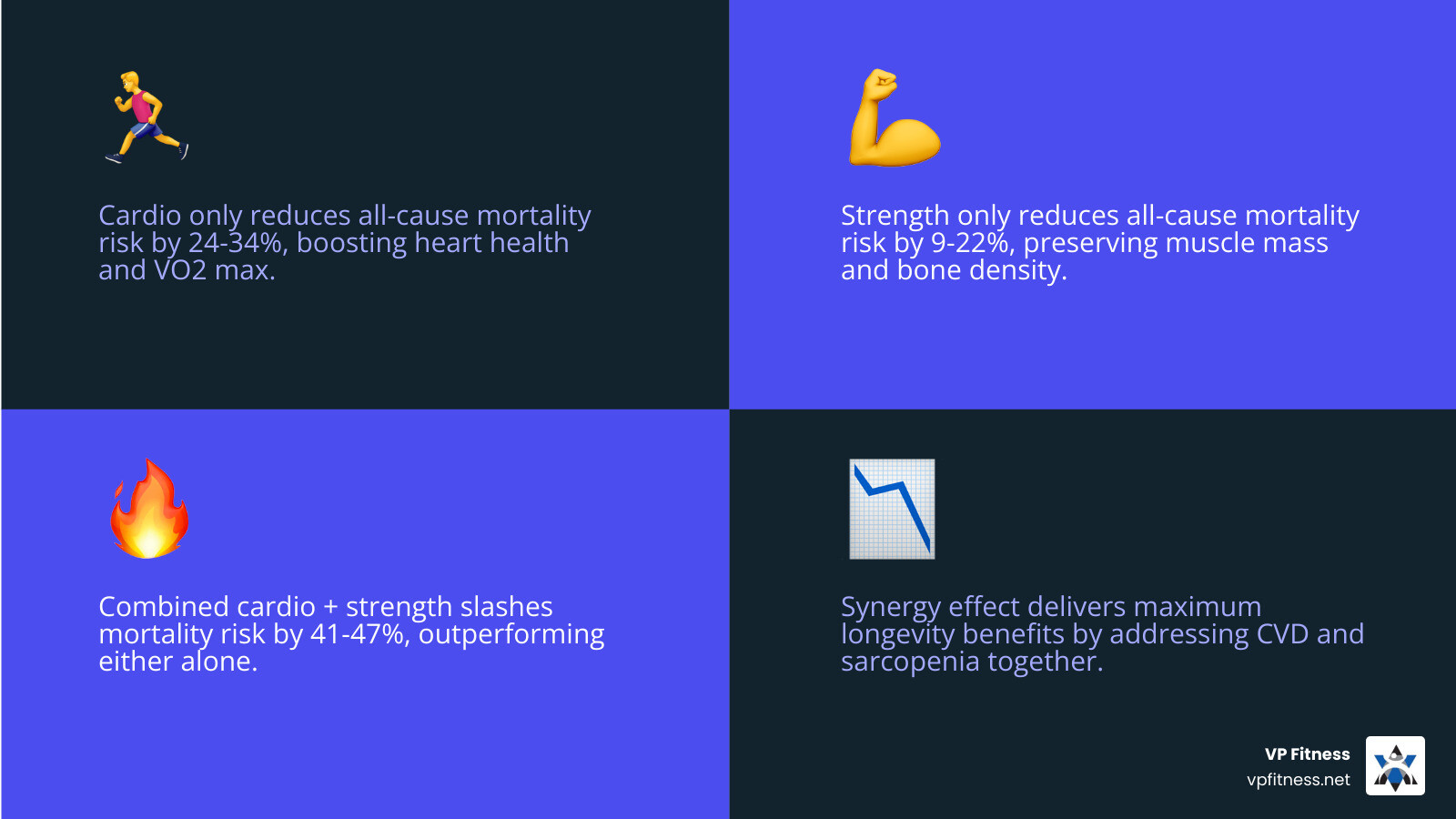
Cardio vs strength longevity is one of the most searched fitness questions — and the answer is clearer than most people think:
| Training Type | All-Cause Mortality Reduction | Best For |
|---|---|---|
| Cardio only | 24-34% lower risk | Heart health, VO2 max |
| Strength only | 9-22% lower risk | Muscle mass, bone density |
| Both combined | 41-47% lower risk | Overall longevity |
The short answer: you don’t have to choose. The research consistently shows that combining both types of exercise produces the greatest reduction in early death risk — significantly more than either one alone.
But most people do choose. They run but skip the weights. Or they lift but never break a sweat on the treadmill. That gap is costing them years.
Cardiovascular disease remains the leading cause of death worldwide. Sarcopenia — the gradual loss of muscle with age — silently increases mortality risk as we get older. Both are preventable with the right exercise habits.
This guide breaks down what the science actually says, cuts through the cardio-vs-weights debate, and shows you exactly how to structure your week for the longest, healthiest life possible.
I’m Joseph DePena, a master trainer and fitness entrepreneur with over a decade of experience helping clients build sustainable, results-driven routines — including those focused on cardio vs strength longevity outcomes. I’ll walk you through the evidence so you can make smarter choices about how you train, starting today.
Cardio vs strength longevity terms to learn:
The Science of Cardio vs Strength Longevity: Which Matters More?
When we talk about living longer, we are looking at two primary metrics: all-cause mortality (the risk of dying from anything) and cardiovascular disease (CVD) risk. For decades, the medical community prioritized aerobic exercise. We were told to “get our steps in” and “protect our hearts.” While that advice is sound, it only tells half the story.
Large-scale research, including a study published in the journal Circulation, has shifted the narrative. We now know that while cardio is a powerhouse for the heart, strength training is the insurance policy for our physical independence and metabolic health.
The data suggests a “synergy effect.” Aerobic fitness, measured by VO2 max, is perhaps the single strongest predictor of how long you will live. However, muscle mass and strength are the strongest predictors of how well you will live and whether you will survive a health crisis. Sarcopenia, the age-related loss of muscle, is linked to a significantly higher risk of falls, fractures, and metabolic failure.
Cardio vs Strength Longevity: The Impact of Aerobic Fitness
Aerobic exercise is the gold standard for improving mitochondrial function—the “power plants” of your cells. When you engage in consistent cardio, you aren’t just burning calories; you are training your heart to pump more blood with less effort and your lungs to process oxygen more efficiently.
The cardio workout benefits extend to every system in the body. Research shows that adults performing 2-4 times the recommended minimum of moderate physical activity (300-599 minutes per week) saw a 26-31% lower all-cause mortality risk. If you prefer higher intensity, doing 150-299 minutes of vigorous activity weekly can yield a 21-23% reduction in mortality.
Specifically, higher cardiorespiratory fitness is associated with a 20-40% lower all-cause mortality. The biggest “win” happens when a person moves from the “low fitness” category to the “below average” or “moderate” category. You don’t need to be an Olympic marathoner to see the benefits; you just need to stop being sedentary.
Cardio vs Strength Longevity: The Role of Muscle Mass
Strength training is often misunderstood as being purely for aesthetics. In reality, it is metabolic medicine. Muscle is a “glucose sink,” meaning it helps regulate blood sugar and insulin sensitivity, which is critical for preventing Type 2 diabetes and systemic inflammation.
The importance of strength training long-term health cannot be overstated. A meta-analysis of over 2 million participants found that higher muscle strength is associated with a 20-25% lower risk of all-cause mortality. Furthermore, just 30-60 minutes of strength training per week is linked to a 10-20% decline in the risk of cardiovascular disease and cancer.
Beyond the internal chemistry, strength training preserves bone density. As we age, our bones naturally become more brittle. Resistance training puts “good stress” on the skeletal system, forcing it to fortify itself. This is why grip strength—a simple measure of how hard you can squeeze—is such a powerful biomarker. If your grip is strong, it usually means your overall muscle mass and nervous system are resilient.
The Synergy Effect: Why Combined Training Wins
If cardio is good and strength is good, doing both is a superpower. A massive cohort study on combined exercise published in the British Journal of Sports Medicine looked at 416,420 adults. The results were staggering: those who did 1-3 hours of aerobic exercise plus 1-2 strength sessions per week had a 40% lower mortality risk compared to those who did nothing.
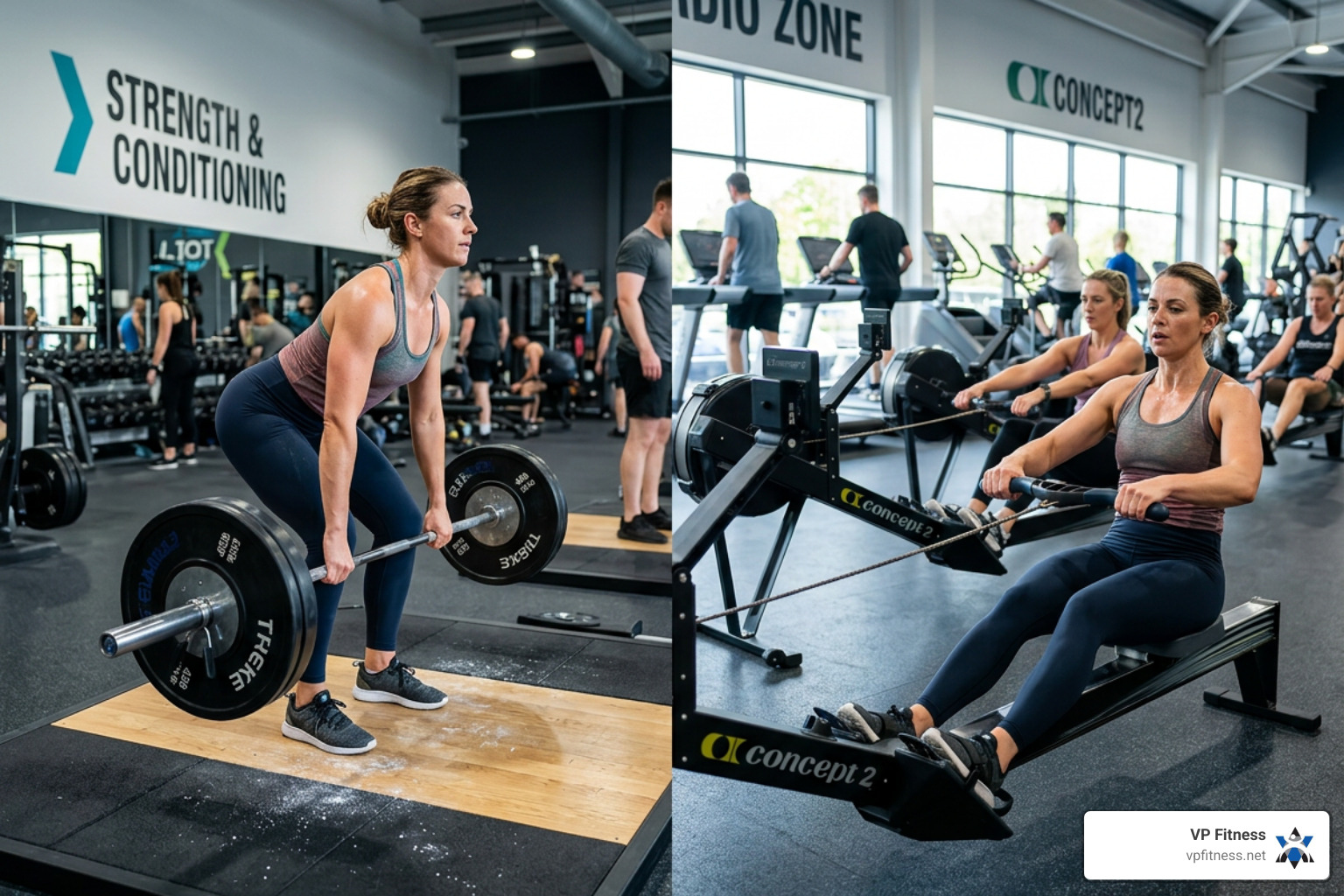
This synergy is especially vital as we age. For seniors (ages 65+), adding strength training at least twice a week to a standard 2.5-hour aerobic routine dropped mortality risk by 30%. Cardio keeps the “engine” (the heart) running, while strength training ensures the “chassis” (the muscles and bones) doesn’t fall apart.
Optimal Weekly Doses for Maximum Lifespan
We often get asked, “How much is enough?” While the cardio-strength ultimate guide provides deep dives into specific routines, the broad scientific consensus for longevity is:
- Moderate Aerobic Activity: 150-300 minutes per week (e.g., brisk walking, light cycling).
- Vigorous Aerobic Activity: 75-150 minutes per week (e.g., running, HIIT, swimming laps).
- Strength Training: At least 2 sessions per week, targeting all major muscle groups.
For those looking to maximize their results, the data suggests that 300-599 minutes of moderate activity or 150-299 minutes of vigorous activity provides the “nearly maximum” mortality reduction of 35-42%. However, even small amounts count. Adding just 10 minutes of activity a day can lead to a 7% decrease in death risk.
Diminishing Returns and the Goldilocks Zone
Is it possible to have too much of a good thing? Yes. The relationship between exercise and longevity often follows a “U-shaped” or “Reverse J-curve.” This means that while moving from zero exercise to some exercise provides a massive benefit, there is a point where adding more volume doesn’t necessarily add more life.
Research on the reverse J-curve for exercise suggests that extreme volumes of vigorous exercise (like training for multiple ultra-marathons a year) may lead to cardiac overuse injuries or atrial fibrillation in some individuals. Similarly, for strength training, the “sweet spot” appears to be around 30-60 minutes per week. Interestingly, some studies show that the mortality benefits of strength training begin to plateau or slightly diminish if you exceed 130-150 minutes of pure heavy lifting per week, though this is still a topic of active debate.
Our advice? Aim for the “Goldilocks Zone”: enough to challenge your systems and improve your fitness, but not so much that you are constantly injured or exhausted.
Key Longevity Biomarkers and How to Test Them
To know if your cardio vs strength longevity plan is working, you need to look at more than just the scale. We focus on biomarkers that actually predict survival.
- VO2 Max: This measures how much oxygen your body can use during intense exercise. It is essentially a measure of your heart and lung “horsepower.”
- Grip Strength: A high grip strength (typically ≥40kg for men and ≥26kg for women) is strongly linked to lower mortality.
- Muscle Mass: Measured via DEXA scans or even simple body-weight-to-strength ratios, muscle mass is your metabolic armor.
At-Home Predictors of Survival
You don’t always need a lab to test your fitness. There are several validated “at-home” tests that correlate strongly with longevity. If you want to see where you stand, try these:
- The Sit-to-Rise Test: Stand in bare feet. Without worrying about the speed, try to sit on the floor and then stand back up using as little support (hands, knees, elbows) as possible. A score of 5 or less (out of 10) can predict a much higher mortality risk.
- The 6-Minute Walk: How much distance can you cover walking briskly in six minutes? This is a great proxy for aerobic capacity.
- 10-Second One-Legged Stance: Can you stand on one leg for 10 seconds? Failing this test in middle age or later is associated with an 84% higher risk of death from any cause within the next decade.
- Chair Stand Test: How many times can you stand up from a chair and sit back down in 30 seconds without using your hands? This tests lower-body power, which is essential for avoiding falls.
For more details on these metrics, check out our more info about cardio vs strength training resource.
How Age and Sex Influence Training Priorities
Your “best bet” for exercise might change depending on your stage of life. For instance, a scientific study on muscular strength and mortality in women highlighted that for postmenopausal women, strength training is non-negotiable for maintaining bone mineral density and preventing fractures.
In men, the decline in testosterone as they age can lead to faster muscle loss (sarcopenia). Therefore, men may need to lean more heavily into progressive overload to maintain their metabolic health. However, across both sexes, the combination of cardio and strength remains the gold standard. Fitness level matters more than weight; a “fit” person with a higher BMI often has a lower mortality risk than a “thin” person who is completely sedentary and has no muscle.
Practical Strategies for a Balanced Longevity Routine
How do you actually fit all of this into a busy lifestyle? You don’t need to live in the gym. You just need a strategy.
We recommend a “Hybrid Routine” that balances different intensities:
- Zone 2 Cardio: This is “steady-state” cardio where you can still hold a conversation (like a brisk walk or light jog). Aim for the bulk of your cardio here.
- Progressive Overload: In the weight room, you must gradually increase the challenge to your muscles. If you lift the same 10-pound dumbbells for five years, your body has no reason to adapt.
- Circuit Training: This is a great way to save time. By alternating a strength move (like a squat) with a cardio move (like jumping jacks), you get the benefits of both in one session.
For a deeper dive into these methods, see our guide on strength training vs high-intensity cardio.
Incorporating Vigorous Intermittent Lifestyle Physical Activity (VILPA)
One of the most exciting recent findings in longevity science is the power of “exercise snacks” or VILPA. This refers to brief, sporadic bursts of vigorous activity during daily life—like running for the bus, carrying heavy groceries up three flights of stairs, or power-walking to a meeting.
A study on vigorous intermittent activity and cancer showed that just 3 to 4 one-minute bursts of VILPA daily were associated with a significantly lower risk of cancer and all-cause mortality. This is great news for those who “don’t have time to exercise.” You can find “longevity minutes” throughout your day just by moving with a bit more urgency.
Building a Sustainable Hybrid Schedule
The key to cardio vs strength longevity is consistency, not intensity. A “20-minute build and burn” session three times a week is infinitely better than a two-hour workout once a month.
When building your schedule, remember:
- Prioritize Recovery: Muscles grow when you rest, not when you lift.
- Nutrition Matters: You need adequate protein to repair the muscle you break down and enough healthy fats to support heart health.
- Don’t Overcomplicate: Start with the basics. A good complete cardio workout guide and a simple 2-day-a-week lifting plan are all most people need to get started.
Frequently Asked Questions About Exercise and Longevity
Is cardio or strength training better for heart health?
While cardio is the direct “trainer” for your heart—improving stroke volume and lowering resting heart rate—strength training plays a massive supporting role. Resistance training improves blood pressure and reduces LDL (bad) cholesterol. The most significant heart health benefits come from the combined impact of both.
Can I live longer if I only lift weights?
Yes, lifting weights alone is associated with a 9-22% reduction in mortality risk. Strength training is excellent for metabolic health and preventing frailty. However, you would be missing out on the massive cardiovascular and mitochondrial benefits of aerobic exercise, which offer an even larger reduction in death risk (24-34%). To maximize your lifespan, you really need both.
What is the minimum amount of exercise needed for longevity?
The “minimum effective dose” is surprisingly small. Research shows that just 15 minutes of moderate aerobic exercise per day can significantly increase life expectancy. Even 10-minute bursts of activity can lead to a 17% reduction in death risk. If you can’t hit the recommended 150 minutes a week, do what you can—every minute counts.
Conclusion
At the end of the day, the cardio vs strength longevity debate is a false choice. To live a long, vibrant life, you need the heart of a runner and the bones of a lifter.
Bridging that gap is essential. Everyone’s starting point is different, which is why individualized training and nutrition guidance are key. Whether you are looking for Zone 2 coaching, progressive resistance training, or a hybrid plan that fits your busy schedule, the right support can help you build a body that lasts.
Ready to take the first step toward a longer, stronger life? Learn more about personal training for longevity and join a community today. Let’s make your “healthspan” match your “lifespan.”