

Sharpen Your Edges: How to Get That Defined Muscle Look

Why Your Muscle Definition Workout Strategy Matters More Than Hours Spent
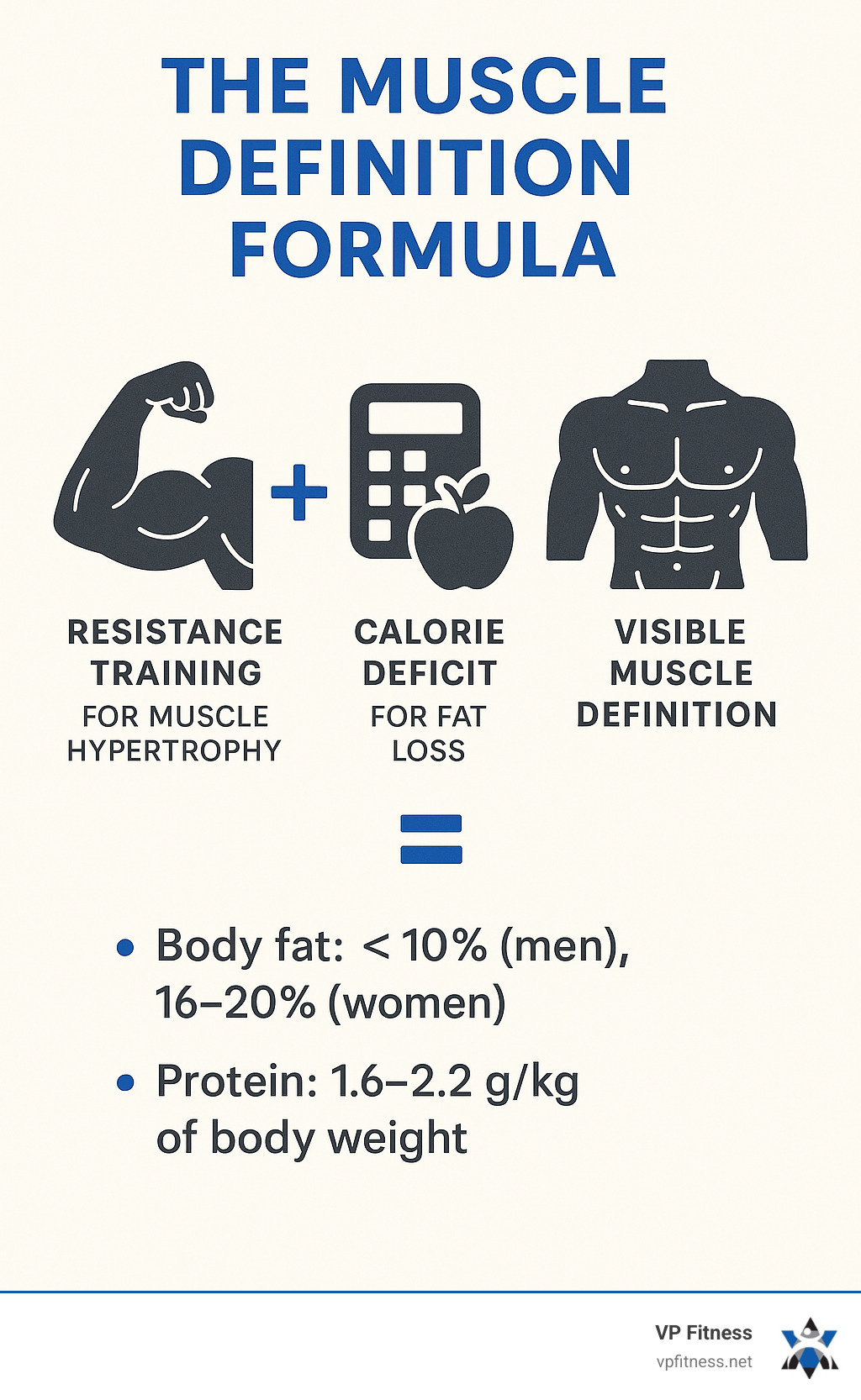
A muscle definition workout isn’t just about lifting heavy weights; it’s a smart combination of building lean muscle while reducing body fat to reveal the sculpted physique underneath. This requires both intensive training and a low body fat percentage.
Quick Answer: Essential Elements of an Effective Muscle Definition Workout:
- Progressive overload: Gradually increase weight, reps, or intensity.
- Compound exercises: Use squats, deadlifts, and bench presses for maximum muscle recruitment.
- Optimal rep ranges: Aim for 6-12 reps for muscle growth (hypertrophy).
- Strategic rest: Take 60-90 seconds between sets and 48-72 hours between muscle groups.
- Consistent frequency: Train 3-5 days per week.
- Proper nutrition: Consume high protein (1.6-2.2g per kg body weight) with a moderate calorie deficit.
Unlike building sheer size, muscle definition focuses on training techniques that promote strength and visible separation between muscle groups. The science is clear: mechanical damage and metabolic fatigue drive muscle growth, but your body fat percentage—ideally below 10% for men and 16-20% for women—determines how visible those muscles are.
I’m Joseph Depena, a fitness expert with over a decade of experience. I help clients achieve their physique goals through strategic muscle definition programs that combine evidence-based training with personalized nutrition.
The Science Behind a Defined Physique
To get a defined physique, you need to understand the science. It’s a two-part process: building muscle through muscle growth (hypertrophy) and reducing the subcutaneous fat that covers it. Both are essential for achieving that carved, athletic look.
Understanding Muscular Hypertrophy
Muscular hypertrophy is the scientific term for muscle growth. It occurs in two main ways relevant to your muscle definition workout:
- Myofibrillar hypertrophy: This is an increase in the size and number of muscle fibers (myofibrils). It builds dense, strong muscles and is key for a solid, defined appearance.
- Sarcoplasmic hypertrophy: This involves an increase in the fluid and energy stores within muscle cells. It contributes to muscle endurance and the “pump” you feel during workouts.
For maximum definition, you need both. Your Type II (fast-twitch) muscle fibers have the greatest growth potential, which is why heavy resistance training is so effective. This training causes mechanical damage (micro-tears in muscle fibers) and metabolic fatigue (the burn you feel from intense effort). Your body repairs this damage, making the muscles bigger and stronger. For a deeper dive, see The Mechanisms of Muscle Hypertrophy and Their Application to Resistance Training.
The Critical Role of Body Fat and Genetics
You can have well-developed muscles, but they won’t be visible if they’re covered by a layer of subcutaneous fat. The visibility of your muscles, including your visible abs, depends on your body fat percentage. Men typically need to be below 10% body fat, while women need to be around 16-20% to see clear definition.
Genetics play a significant role in your fat storage patterns and natural muscle-building potential. Some people have a genetic predisposition to store fat in certain areas, and rare conditions like myostatin-related hypertrophy highlight the power of our genes. However, genetics are not destiny. Consistent training and smart nutrition can dramatically improve anyone’s muscle definition. Understanding your body helps set realistic expectations.
Crafting Your Muscle Definition Workout: Key Training Principles
Now, let’s build your muscle definition workout. A solid plan is the difference between seeing results and spinning your wheels. The foundation rests on five core principles:
- Progressive overload: To prevent plateaus, you must gradually increase the weight, reps, or intensity to force your muscles to adapt. This can mean adding more weight, doing more reps, adding a set, or reducing rest time.
- Exercise selection: Choose movements that efficiently target multiple muscle groups.
- Optimal rep ranges: Stay in the sweet spot for muscle growth.
- Strategic rest periods: Recover enough to maintain intensity without losing metabolic stress.
- Consistent frequency: Regular workouts transform intentions into visible results.
Compound vs. Isolation Exercises for a Sculpted Look
Your muscle definition workout should include both compound and isolation exercises.
Compound exercises are your foundation. They work multiple muscle groups simultaneously, making them efficient for building strength, mass, and burning calories. Examples include squats, deadlifts, bench presses, and rows. These should form the core of your workouts.

Isolation exercises are for sculpting details. They target a single muscle group, helping to refine shape and improve symmetry. Think bicep curls, tricep extensions, and lateral raises.
A strategic combination is best: start with heavy compound lifts while you’re fresh, then use isolation exercises to target specific muscles.
Finding the Optimal Reps, Sets, and Rest
The reps, sets, and rest periods you use directly influence your results. Different rep ranges target different adaptations:
| Repetition Range | Primary Goal | Muscle Adaptation |
|---|---|---|
| Low Reps (1-5) | Strength & Power | Primarily myofibrillar hypertrophy, building dense, strong muscle. |
| Moderate Reps (6-12) | Hypertrophy (Growth) | The sweet spot for overall muscle size and strength. Essential for a muscle definition workout. |
| High Reps (13-20+) | Endurance & Definition | Primarily sarcoplasmic hypertrophy, leading to a “pumped” look and improved vascularity. |
For muscle definition, the 6-12 rep range is ideal. Focus on time under tension by controlling the weight, especially during the lowering (eccentric) phase of a lift (2-4 seconds). This is crucial for stimulating growth.
Aim for 60-90 seconds of rest between sets. This allows partial recovery, maintaining intensity while creating the metabolic stress needed for hypertrophy. Generally, lifting heavy weights in the 6-12 rep range is more effective for definition than using lighter weights for high reps.
Building Your Weekly Muscle Definition Workout Schedule
Consistency is the most critical factor for success. Aim for 3-5 training days per week to balance workout stimulus with recovery. Your ideal schedule depends on your experience and lifestyle.
Common workout splits include:
- Full-body workouts (3 days/week): Great for beginners or those with limited time. Train all major muscle groups each session (e.g., Mon/Wed/Fri).
- Split routines (4-6 days/week): Allow for more volume per muscle group. Popular options include upper/lower splits, push/pull/legs, or body-part splits.
Choose a schedule you can stick to. Rest days are mandatory for muscle growth, as this is when your body repairs and rebuilds tissue. Allow 48-72 hours of rest for a muscle group before training it again. The U.S. Department of Health and Human Services recommends strength training at least twice a week.
The best program is the one you’ll follow consistently. Start with a manageable plan and build from there.
Fueling the Fire: Nutrition and Recovery for Maximum Definition
Even the best muscle definition workout will fall flat without proper nutrition and recovery. Your workout is the stimulus, but food and rest are what build the muscle. Training, nutrition, and recovery are a three-legged stool; neglect one, and your progress will collapse.
Nutrition for Your Muscle Definition Workout
The saying “abs are made in the kitchen” is true. Your nutrition strategy must both build lean muscle and reduce body fat.

- Protein is essential for muscle repair. Aim for 1.6 to 2.2 grams of protein per kilogram of body weight daily. Focus on lean sources like chicken, fish, eggs, Greek yogurt, or plant-based options like beans, lentils, and tofu.
- Carbohydrates are your workout fuel. Choose complex carbs like oatmeal, sweet potatoes, and brown rice for sustained energy.
- Healthy fats support hormone production. Include sources like avocados, nuts, and olive oil, aiming for 20-30% of your daily calories.
To reveal definition, you need a calorie deficit. A common strategy is calorie cycling: periods of a small calorie surplus to build muscle, followed by a moderate deficit to lose fat. For simultaneous muscle gain and fat loss (body recomposition), a modest 10-20% calorie deficit with high protein intake is effective, especially for beginners.
Why Rest and Recovery Are Non-Negotiable
Muscles don’t grow in the gym; they grow during recovery. Training creates microscopic tears in muscle fibers, and your body repairs them stronger and larger during rest. This process takes 48 to 72 hours per muscle group.
Sleep is critical for muscle building. Aim for 7-9 hours of quality sleep per night. During sleep, your body releases growth hormone and repairs tissue. Poor sleep increases the stress hormone cortisol, which can lead to muscle loss and fat gain.
Be aware of overtraining. Signs include constant fatigue, declining performance, and loss of motivation. If you experience these, take extra rest.
Rest days don’t have to be sedentary. Active recovery, like light walking or stretching, can improve blood flow and speed up repair.
Do Supplements Help?
Supplements are not magic pills; they supplement a solid foundation of training, nutrition, and recovery. They can’t fix a poor diet or inconsistent workouts. However, a few can be beneficial:
- Whey protein powder: A convenient way to meet your daily protein targets, especially post-workout.
- Creatine: The most researched supplement for performance. It helps your muscles produce energy, leading to more strength and better growth. 3-5 grams daily is effective.
- BCAAs (Branched-Chain Amino Acids): Generally unnecessary if you eat enough protein from whole foods.
- Vitamin D: Worth considering if you have limited sun exposure, as it’s important for muscle function and overall health.
Always prioritize whole foods. Before taking supplements, consult a healthcare professional, especially if you have existing health conditions. Master the fundamentals first.
Frequently Asked Questions about Muscle Definition
Here are the answers to some of the most common questions.
How long does it take to get defined muscles?
There’s no magic timeline; it depends on several factors. While cellular changes happen within hours of a workout, visible changes typically take weeks to months.
Your timeline is influenced by:
- Your starting point: Having more body fat means it will take longer to reveal the muscle underneath.
- Consistency: Sticking to your muscle definition workout and nutrition plan is the single most important factor.
- Genetics: Your natural ability to build muscle and lose fat plays a role.
- Intensity: Challenging yourself with progressive overload will speed up results.
Patience is key. Trust the process and focus on consistency over quick fixes.
Can you build muscle and lose fat at the same time?
Yes! This process is called body recomposition. While challenging, it’s entirely possible, especially for certain groups:
- Beginners: Newcomers to resistance training can build muscle easily, even in a calorie deficit.
- Individuals with higher body fat: The body can use stored fat for energy while building muscle.
Even for experienced lifters, body recomposition is possible. The formula is a moderate calorie deficit, high protein intake (1.6-2.2g per kg of body weight), and a consistent, challenging muscle definition workout program.
How much cardio should I do for muscle definition?
Cardio is a tool to increase calorie expenditure and help create a deficit for fat loss, but you don’t need to live on the treadmill. The goal is to preserve muscle mass while reducing fat.
- Low-Intensity Steady-State (LISS): Activities like brisk walking or cycling burn calories without hindering recovery from strength training.
- High-Intensity Interval Training (HIIT): Effective for burning calories quickly but is very demanding. Too much HIIT can interfere with strength gains and lead to overtraining.
Some people achieve definition through diet alone, while others benefit from adding cardio. Use it strategically based on your goals and recovery capacity. A combination of strength training, proper nutrition, and smart cardio is the most effective approach.
Your Blueprint for a Defined Body
Achieving a defined look is a journey that combines smart training, precise nutrition, and diligent recovery. There are no shortcuts, but there is a proven path based on patience, consistency, and the right guidance.

Here is your blueprint for success:
- Master the Fundamentals: Build lean muscle while reducing body fat. This is the core of definition.
- Accept Progressive Overload: Continuously challenge your muscles by increasing weight, reps, or intensity. Track your workouts to ensure you’re progressing.
- Use a Hybrid Training Strategy: Blend compound movements for mass and strength with isolation exercises for sculpting details.
- Prioritize Nutrition: You can’t out-train a poor diet. Aim for 1.6-2.2g of protein per kg of body weight and use a calorie deficit to reveal muscle.
- Make Recovery Non-Negotiable: Get 7-9 hours of sleep, take rest days, and use active recovery. Muscle grows during rest, not during workouts.
- Be Patient and Consistent: Visible changes take weeks to months. Track your progress with photos and measurements, not just the scale.
Personalized fitness and nutrition plans are key to achieving your goals, as every journey is unique.
Whether you’re a beginner or hitting a plateau, personal training can provide the expertise and accountability you need. A professional, clean environment is designed to help you succeed.
Ready to build the defined physique you want? Start your fitness journey and let experienced trainers guide you.
The best muscle definition workout is the one you stick with. With the right approach and guidance, a sculpted physique is an achievable destination.