

Return to Sport: Navigating the Path from Injury to the Starting Line

Return to Sport: Navigating the Path from Injury to the Starting Line
Why Return to Sport Is More Than Just “Feeling Better”
Return to sport is the process of safely progressing an injured athlete from rest back to full competitive participation — and it’s far more complex than simply waiting until the pain goes away.
Here’s what you need to know at a glance:
| Stage | What It Means |
|---|---|
| Return to Participation | Moving again without pain; light, non-sport-specific activity |
| Return to Sport | Practicing sport-specific skills; not yet competing |
| Return to Performance | Competing at your pre-injury level |
Key facts:
- Each stage requires meeting specific physical and psychological criteria before moving forward
- Rushing the process significantly raises re-injury risk — for ACL injuries alone, re-injury rates are nearly 6x higher in the first two years
- Timelines vary widely based on injury type, age, and individual baseline fitness
- Medical clearance is required before returning to full-contact activity
The hard truth? Feeling good in everyday life does not mean you’re ready for sport. The demands of competition — explosive movements, fatigue, unpredictable contact — are completely different from walking up stairs or getting through a workday.
That gap between “I feel fine” and “I’m actually ready” is exactly where most re-injuries happen.
I’m Joseph DePena, a master trainer with over a decade of experience guiding athletes and active individuals through structured return to sport progressions. My work sits at the intersection of performance training and evidence-based recovery, and this guide reflects the principles I apply every day with real clients.
Relevant articles related to Return to sport:
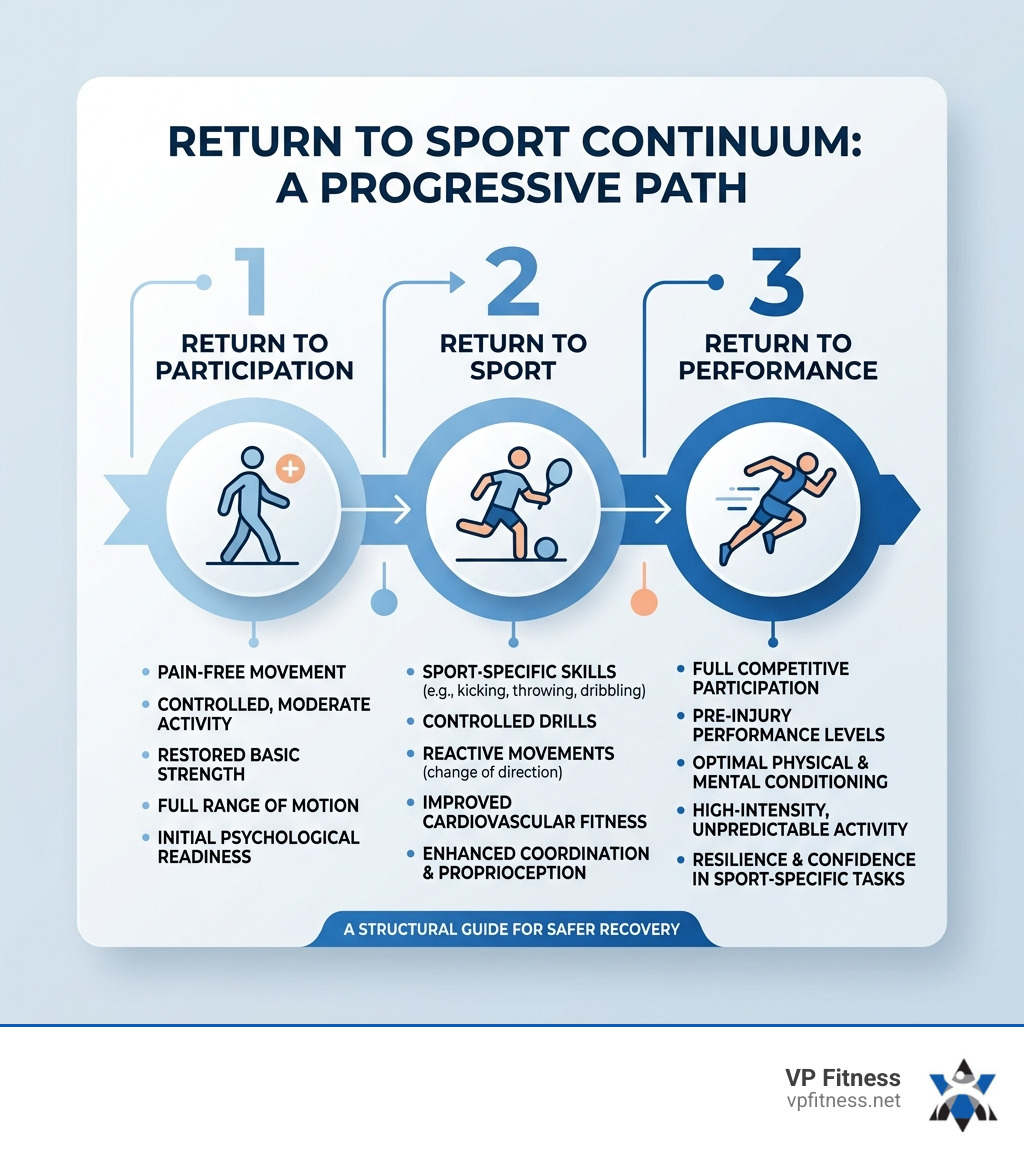
Understanding the Return to Sport Continuum
When we talk about getting back on the field, we often treat it like a light switch: you’re either “injured” or “cleared.” In reality, modern sports medicine views Return to sport as a dynamic continuum. It isn’t a single event, but a graduated transition where the athlete moves through overlapping phases of recovery and reconditioning.
According to the Panther Symposium ACL Injury Return to Sport Consensus Group, this journey is best viewed as a spectrum of participation. It begins the moment an injury occurs and doesn’t truly end until the athlete is performing at or above their pre-injury level. For those who have undergone surgery, maximizing your recovery with post-op PT is the first critical link in this chain.
Defining Return to Participation vs. Performance
To navigate this path, we must distinguish between the different milestones. Many athletes make the mistake of thinking that being “cleared to practice” means they are ready for a championship game.
- Return to Participation: The athlete is physically active (rehab, training, or modified practice) but is not yet “ready” for the specific sport. They may be performing drills but are restricted from contact or high-risk maneuvers.
- Return to Sport: The athlete has returned to their sport but is not yet performing at their previous level. Think of this as the “getting the rust off” phase. You’re in the game, but maybe your minutes are restricted or your explosive power isn’t quite 100% yet.
- Return to Performance: This is the gold standard. The athlete is back to their pre-injury level of play—or better. In professional circles, this is often defined by hitting specific performance metrics (like sprint speed or jump height) that match their baseline data.
The Science and Art of Clinical Judgment
Deciding when to move an athlete from one phase to the next is both a science and an art. The “science” involves objective data: strength ratios, range of motion, and biological healing timelines. The “art” involves clinical judgment—assessing the athlete’s confidence, their “game feel,” and the specific demands of their position.
We utilize the biopsychosocial model, which acknowledges that an injury isn’t just a torn ligament; it’s a biological event that happens to a person with a specific mindset in a specific social context (like a looming playoff season). We also use frameworks like the StARRT (Strategic Assessment of Risk and Risk Tolerance) model to balance the health of the tissue against the competitive pressures the athlete faces. The best decisions are made through shared decision-making between the athlete, the physician, and the performance coach.
Key Stages of a Safe Progression
A safe Return to sport progression is built on the principle of “progressive loading.” You wouldn’t try to bench press 300 pounds on your first day back in the gym; similarly, you shouldn’t try to sprint at full speed until your tissues have been conditioned to handle the stress. This is a core tenet of athletic physical therapy.
Building the Foundation: Mobility and Strength
The first priority is always the resolution of pain and swelling. Once the “fire” is out, we focus on restoring full, pain-free range of motion (ROM).
Next comes neuromuscular control. This is the brain-body connection. An injury often “shuts off” certain muscles or alters movement patterns. We use exercise physical therapy to wake those muscles back up and ensure that the athlete isn’t compensating with other joints. If your knee is hurt, but your hip isn’t firing correctly, you’re just begging for a second injury.
Mastering Sport-Specific Movements and Return to Sport Loading
As the foundation solidifies, we move into sport-specific reconditioning. This involves a shift from “general” gym movements to “specific” athletic tasks.
| Loading Type | Focus | Example Exercises |
|---|---|---|
| Linear Loading | Forward and backward movement | Jogging, straight-line sprints, lunges |
| Multidirectional | Lateral and rotational movement | Shuffles, T-drills, crossover steps |
| Reactive Loading | Unpredictable environment | Cutting on a coach’s signal, dodging a partner |
We also pay close attention to kinetic linking. In sports, power is rarely generated by one muscle; it flows from the ground, through the legs, into the core, and out through the arms. We ensure the entire “chain” is working together. Throughout this process, we monitor fatigue levels. Fatigue is a massive risk factor for re-injury, so we ensure the athlete can maintain perfect form even when they are tired.
Specialized Protocols: Concussions vs. Musculoskeletal Injuries
Not all injuries follow the same roadmap. While a muscle strain is a physical “hardware” issue, a concussion is more of a “software” issue. Each requires a distinct approach to finding the best physical therapy in Providence and beyond.
The 6-Step Return to Sport Protocol for Concussions
Concussions require a very strict, symptom-based progression based on international guidelines. Each step typically takes a minimum of 24 hours. If symptoms return at any point, the athlete must stop, rest, and drop back to the previous successful stage.
- Symptom-limited activity: Daily activities that do not provoke symptoms (like walking or light reading).
- Light aerobic exercise: 5-10 minutes of walking or stationary cycling. No resistance training.
- Sport-specific exercise: Running or skating drills. No head impact activities.
- Non-contact training drills: Harder training drills (e.g., passing drills). May start progressive resistance training.
- Full-contact practice: Following medical clearance, participate in normal training activities.
- Return to sport: Full participation in competitive play.
Statistics show that 80-90% of concussions resolve within 7-10 days, but the graduated return process usually takes 10-14 days to ensure safety.
ACL Recovery: Why Time and Criteria Matter
Anterior Cruciate Ligament (ACL) recovery is the “marathon” of Return to sport. The statistics are sobering: less than 50% of athletes regain their pre-injury performance level, and nearly 30% suffer a re-injury within the first two years.
Research indicates that delaying return to sport until 9 months after surgery can reduce re-injury risk by 51% for every month delayed up to that point. We don’t just look at the calendar, though; we look at criteria. An athlete shouldn’t be cleared until their injured limb has at least 90% of the strength and function of their healthy limb (known as the Limb Symmetry Index).
Objective Criteria and Psychological Readiness
How do we actually know if someone is ready? We stop guessing and start measuring. This is especially important for those dealing with long-term issues like back pain physical therapy, where “feeling better” can be deceptive.
Measuring Readiness with Objective Tests
We use a battery of tests to assess physical readiness:
- Hop Tests: Measuring the distance and quality of landing on one leg.
- Y-Balance Test: Assessing dynamic balance and core stability.
- LESS (Landing Error Scoring System): A biomechanical screen to identify high-risk landing patterns.
- Strength Ratios: Using dynamometers to ensure, for example, that the hamstrings are strong enough to support the ACL.
Addressing the Mental Barriers to Return to Sport
You can have the strongest knee in the world, but if you’re afraid to cut or jump, you aren’t ready to play. Kinesiophobia (fear of re-injury) is a major hurdle. We use tools like the ACL-RSI (Return to Sport after Injury) scale to quantify an athlete’s psychological readiness.
Confidence comes from “exposure.” We gradually reintroduce the athlete to the movements they fear in a controlled environment. Proper post-workout recovery also plays a role here—knowing your body can recover from a hard session builds the mental trust needed for competition.
The Role of a Multidisciplinary Team in Your Recovery
No one should navigate the Return to sport process alone. A multidisciplinary team ensures that every angle—medical, physical, and psychological—is covered.
The team usually includes:
- The Team Physician: Leads the medical clearance and protects the athlete from external pressures.
- Physical Therapist/Athletic Trainer: Manages the daily rehab and functional testing.
- Strength & Conditioning Coach: Bridges the gap between rehab and high-performance training.
- Nutritionist: Ensures the athlete has the fuel needed for tissue repair.
Shared Decision-Making and Risk Assessment
In the professional world, the final word often rests with the team physician, but the process is a shared decision. We look at “decision modifiers”—is this a pre-season scrimmage or the state championship? Is the athlete a professional with a career on the line or a high schooler with their whole life ahead of them? We use the StARRT framework to weigh these risks, ensuring the athlete’s long-term health is never sacrificed for a short-term win.
Frequently Asked Questions about Return to Sport
How long does it typically take to return to sports after an injury?
It depends entirely on the injury. A mild ankle sprain might take 1-2 weeks, while an ACL reconstruction typically requires 9-12 months. Concussions generally require a 10-14 day graduated protocol.
What are the risks of returning to play too early?
The primary risk is re-injury, which is often more severe than the initial one. Additionally, returning too early can lead to “compensatory injuries”—for example, hurting your hip because you are subconsciously protecting a weak ankle.
How do I know if my symptoms are a sign to stop?
A good rule of thumb is the “24-hour rule.” If you have a sharp increase in pain during activity, or if swelling and soreness persist for more than 24 hours after a session, you have likely pushed too hard and need to regress a step.
Conclusion
The road back to the starting line is rarely a straight line. It’s a journey that requires patience, discipline, and expert guidance. We specialize in bridging the gap between clinical rehab and elite performance. Our facility offers the individualized training and nutrition guidance you need to not just return to your sport, but to dominate it.
Whether you’re recovering from surgery or managing a nagging strain, we provide a professional, clean environment with the amenities you need to focus entirely on your goals. Start your recovery journey today and let us help you navigate the path from the sidelines back to the game.