

Sculpt Your Body with the Best Exercises for Definition

Sculpt Your Body with the Best Exercises for Definition
Why the Best Chest Exercises for Definition Actually Matter
The best chest exercise for definition isn’t just one movement — it’s a combination of exercises that hit all three regions of your chest from different angles.
Here’s a quick answer if you’re short on time:
| Exercise | Primary Target | Best For |
|---|---|---|
| Incline Dumbbell Press | Upper chest (clavicular head) | Upper chest definition |
| Barbell Bench Press | Mid chest (sternal head) | Overall size and shape |
| Cable Crossovers | Inner and lower chest | Muscle separation |
| Weighted Dips | Lower chest (abdominal head) | Lower pec line |
| Dumbbell Pullovers | Serratus and pec minor | Depth and stretch |
| Diamond Push-ups | Inner chest | Bodyweight definition |
A defined chest isn’t just about lifting heavy. It’s about targeting the right muscle fibers, at the right angles, with enough volume and consistency to create visible separation and shape.
Most people default to flat bench press and call it a day. That works for building mass — but definition requires more. You need exercises that hit the upper, middle, and lower portions of your pectoralis major, plus movements that train your chest across the midline, which is one of the muscle’s primary functions.
The result? A chest that looks sculpted, not just big.
I’m Joseph DePena, a master trainer with over a decade of experience helping clients build lean, defined physiques — including coaching them toward the best chest exercise for definition for their specific goals and body type. In the sections below, I’ll walk you through exactly what works, backed by both science and real-world training experience.
Important best chest exercise for definition terms:
The Science of Building a Defined Chest
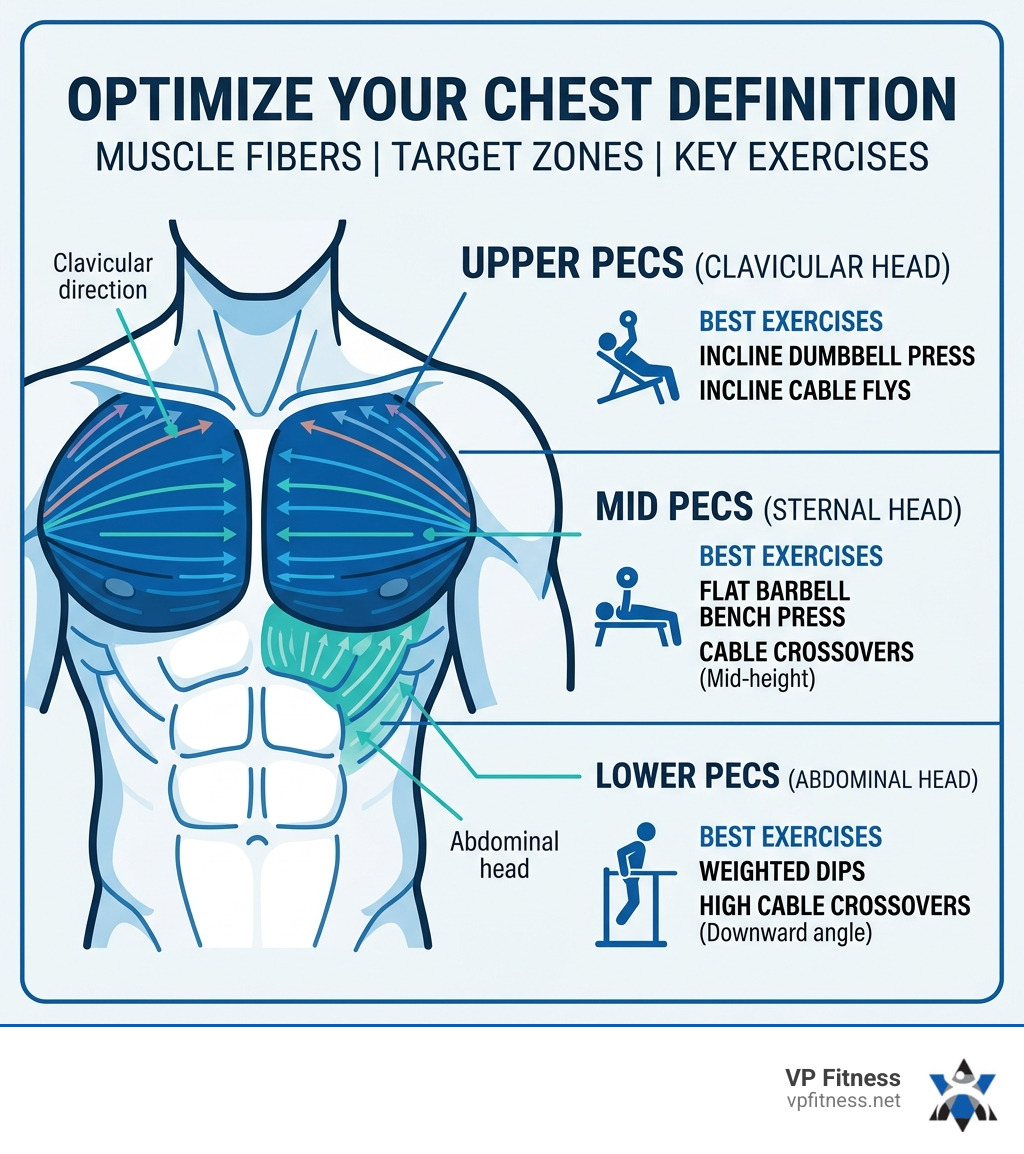
To achieve that “chiseled” look in April 2026, we have to look past the surface and understand the anatomy of the pectoralis major. This large, fan-shaped muscle is actually composed of three distinct regions: the clavicular head (upper chest), the sternocostal head (middle chest), and the abdominal head (lower chest).
True definition comes from achieving aesthetic symmetry across all three. If you only focus on flat pressing, you’ll likely end up with a “bottom-heavy” chest that lacks the “armor-plated” look provided by a strong upper pec.
Hypertrophy and Definition
Muscle definition is a product of two things: muscle size (hypertrophy) and low body fat. While we can’t “spot reduce” fat over the chest, we can influence how the muscle looks by focusing on three key factors:
- Mechanical Tension: Lifting heavy weights through a full range of motion.
- Metabolic Stress: The “pump” feeling from higher reps and short rest periods, which triggers growth signals.
- Mind-Muscle Connection: This is the most underrated aspect of definition. For the best chest exercise for definition, you must feel the muscle contracting and stretching, rather than just moving the weight from point A to point B.
Research suggests that the proper barbell bench press form is foundational for building the base of the sternal head, but isolation is required for fine-tuning. For a deeper dive into how to structure your overall plan, check out our more info about muscle definition workouts.
Compound vs. Isolation: The Definition Debate
| Feature | Compound Movements (e.g., Bench Press) | Isolation Exercises (e.g., Cable Fly) |
|---|---|---|
| Primary Goal | Mass and raw strength | Muscle separation and detail |
| Muscle Tension | High mechanical load | Constant tension throughout ROM |
| Definition Role | Builds the “foundation” | Carves the “inner” and “outer” lines |
| Fatigue Level | High central nervous system fatigue | High local muscular fatigue |
10 Best Chest Exercises for Definition
Achieving a high-definition physique requires a strategic approach to your exercise selection. We prioritize progressive overload—gradually increasing the weight, reps, or intensity—while ensuring we use a full range of motion to recruit as many muscle fibers as possible.
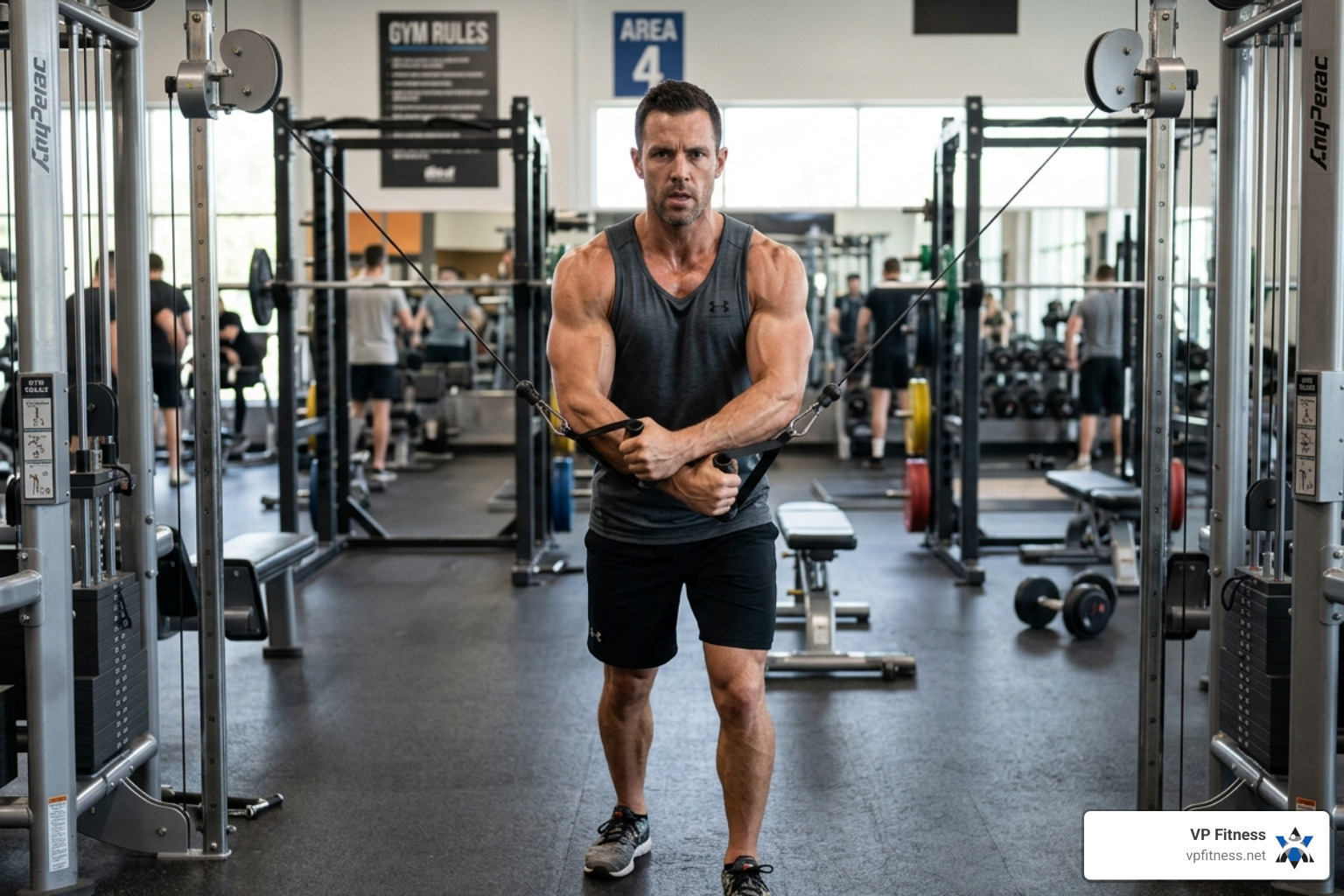
The following exercises are curated to provide the best chest exercise for definition by maximizing time under tension and peak contraction. According to research on upper chest activation, changing the angle of your press is the single most effective way to shift focus between the clavicular and sternal heads.
1. Incline Dumbbell Press for Upper Chest Definition
If we had to pick the absolute best chest exercise for definition in the upper region, this is it. By setting your bench to a 30-45 degree angle, you align the resistance with the fibers of the clavicular head.
Using dumbbells rather than a barbell allows for a greater range of motion at the bottom of the lift and forces each side to work independently, correcting unilateral imbalances. Focus on a slow eccentric (lowering) phase to maximize micro-tears in the upper fibers. For more ways to organize your week, see our more info about chest workout routines.
2. Cable Crossovers for Inner and Lower Chest Definition
Cables are superior to dumbbells for “etching” the inner chest because they provide constant tension. When you use dumbbells for a fly, the tension disappears at the top of the movement. With cables, the resistance pulls outward even when your hands meet.
By performing a horizontal adduction (bringing the arms across the midline), you target the sternocostal fibers. Crossing your hands at the end of the rep provides a peak contraction that is hard to replicate with any other movement. This is a staple in any best muscle exercises list.
3. Weighted Dips
Often called the “squat of the upper body,” dips are unrivaled for defining the lower pec line (the abdominal head). To make this a chest exercise rather than a tricep one, you must maintain a forward lean of about 30 degrees and flare your elbows slightly.
Proper scapular depression—keeping your shoulders down and away from your ears—is vital to prevent injury and keep the focus on the pecs.
4. Barbell Bench Press
The classic bench press remains the king of the sternal head. While often viewed as a “bulk” move, it provides the necessary foundation for definition. Without the density provided by heavy pressing, there isn’t enough muscle to “define” once body fat drops.
Focus on eccentric control—lower the bar for a 3-second count—to increase the time under tension. This is a core component of any best size definition workout guide.
5. Dumbbell Pullovers
This “old school” move is the secret to a 3D chest. It targets the pectoralis minor (which sits under the major) and the serratus anterior (the “finger-like” muscles on your ribs). By stretching the chest under load, you create a deeper ribcage appearance and better muscle separation.
6. Diamond Push-ups
Don’t underestimate bodyweight mastery. Diamond push-ups bring the hands together, forcing a massive contraction in the inner chest. These are perfect as a “finisher” to reach high-rep fatigue at the end of a workout. They also complement your core work; learn more about sculpt your core top abdominal muscle exercises to see how chest and core stability go hand-in-hand.
7. Decline Dumbbell Press
To specifically target the lower “sweep” of the chest, the decline press is statistically more effective than the flat bench. By lying on a 15-30 degree decline, you reduce the involvement of the anterior deltoids, allowing the lower pectorals to take the brunt of the load.
8. Machine Incline Press
While free weights are great for stability, machines allow you to train to absolute failure safely. The fixed path of a machine incline press lets you focus entirely on the mind-muscle connection in the upper chest without worrying about balancing the weight.
9. Plate Squeeze Press
This is a “secret weapon” for inner chest definition. By squeezing two light plates together while performing a chest press motion, you create intense isometric tension. This constant “squeezing” forces the inner fibers to fire throughout the entire range of motion.
10. Low-to-High Cable Flys
To fill in the gap right under your collarbone, low-to-high flys are essential. Starting with the cables at the bottom and pulling upward and inward mimics the exact fiber direction of the upper chest.
Optimizing Your Routine for Maximum Definition
Simply doing the exercises isn’t enough; you need a structured plan. For most of our clients, we recommend a training frequency of 1-2 times weekly for the chest. This allows for the 48-72 hours of recovery needed for muscle tissue to repair and grow more defined.
Rep Ranges and Rest
- For Strength & Density: 5-8 reps (Compound moves like Bench Press)
- For Hypertrophy & Definition: 8-12 reps (Dumbbell presses and Dips)
- For Detail & Metabolic Stress: 15-20 reps (Cables and Push-ups)
Rest intervals should be kept between 60-90 seconds for definition-focused workouts to keep the heart rate elevated and maximize metabolic stress.
Your chest doesn’t exist in a vacuum. To maintain a balanced, upright posture that makes your chest “pop,” you must also train your back and arms. See our guide on arm workout for size and definition to ensure your physique is balanced from every angle.
Frequently Asked Questions about Chest Definition
Can chest exercises get rid of “moobs”?
This is one of the most common questions we hear. The short answer is: you cannot “spot reduce” fat. If you have excess fat in the chest area (often called “moobs”), the best chest exercise for definition will build the muscle underneath the fat, but a caloric deficit and proper nutrition are required to reveal that muscle.
In some cases, this issue is hormonal (gynecomastia), but for most, it is simply a matter of lowering overall body fat percentage. Personalized nutrition plans are designed to help with exactly this.
How often should I train chest for definition?
For optimal results, aim for twice a week with at least two days of rest in between. For example, a “Push/Pull/Legs” split or an “Upper/Lower” split works wonders. Overtraining the chest can lead to shoulder impingement and plateaus. Recovery is when the “definition” actually happens, as the muscle fibers heal and thicken.
Should women perform chest exercises for definition?
Absolutely! We encourage all our female members to train chest. Women do not have the testosterone levels to “bulk up” like men from standard weightlifting. Instead, chest training improves posture, provides a “lift” to the breast tissue by strengthening the underlying muscle, and creates a balanced, athletic look.
Conclusion
Building a defined chest is a journey of consistency, progressive overload, and attention to detail. As we move through April 2026, the trends in fitness are shifting away from “mass at all costs” toward aesthetic symmetry and functional strength.
Whether you are a beginner or an advanced lifter, focusing on the best chest exercise for definition—like the incline dumbbell press and cable crossover—will ensure your hard work in the gym actually shows.
We pride ourselves on being a premier destination for the fitness community. Our professional, clean environment and individualized coaching are designed to help you navigate these routines safely and effectively. Are you ready to stop guessing and start growing?
Sculpt your body with a complete muscle definition workout and join us to take your training to the next level.