

Start Strong: Your How-To Guide for Beginning Pilates as a Senior

Start Strong: Your How-To Guide for Beginning Pilates as a Senior
Why So Many Seniors Are Searching for Beginner Pilates Near Them Right Now
If you’re looking for beginner pilates for seniors near me, here’s the short answer:
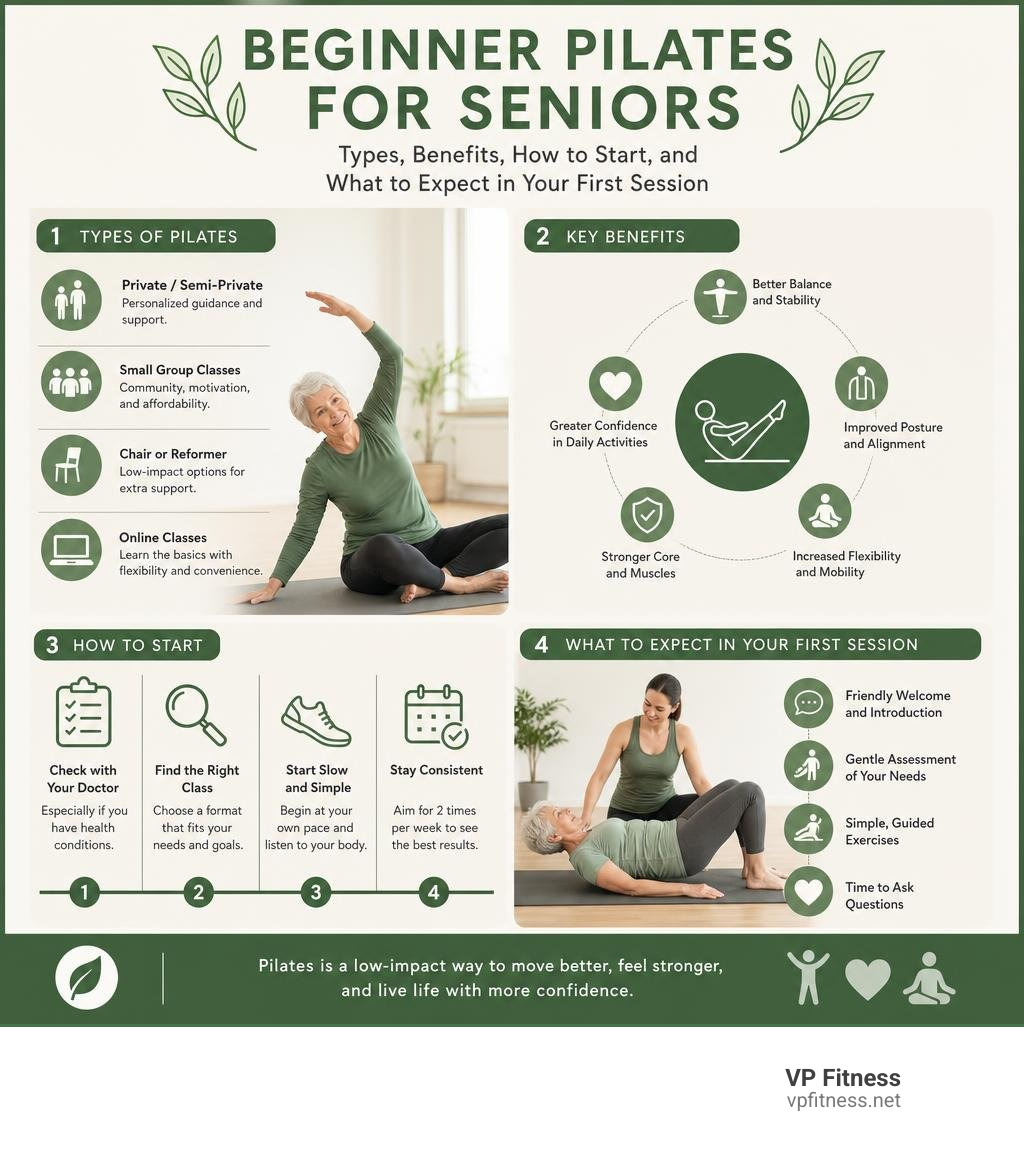
Start with one of these options:
- Private or semi-private session at a local studio — best if you have specific health concerns like arthritis, osteoporosis, or a joint replacement
- Small group beginner or senior-specific class — ideal if you want community and affordability together
- Chair or reformer Pilates class — best if getting up and down from the floor is difficult
- Online beginner senior Pilates class — a flexible option to learn the basics before joining in person
Look for studios that offer a free discovery session or low-cost intro pack before you commit.
Pilates has quietly become one of the most popular forms of exercise for older adults — and for good reason. It’s low-impact, adaptable, and designed to build the exact things that matter most as we age: balance, core strength, posture, and confidence in everyday movement.
The numbers back this up. Seniors who practice Pilates at least twice a week show a 23% improvement in balance and a 19% reduction in fall risk within just 12 weeks. And many people start noticing real changes in strength and flexibility within just 4 to 6 weeks.
But knowing what Pilates can do and knowing how to get started safely are two very different things. That’s what this guide is for.
I’m Joseph DePena, a master trainer with over a decade of experience helping people build sustainable fitness habits — including guiding older adults toward safe, effective movement practices like beginner pilates for seniors near me. This guide will walk you through everything you need to start strong, stay safe, and keep moving.
Quick beginner pilates for seniors near me terms:
What Beginner Pilates Is and Why It Works So Well for Older Adults
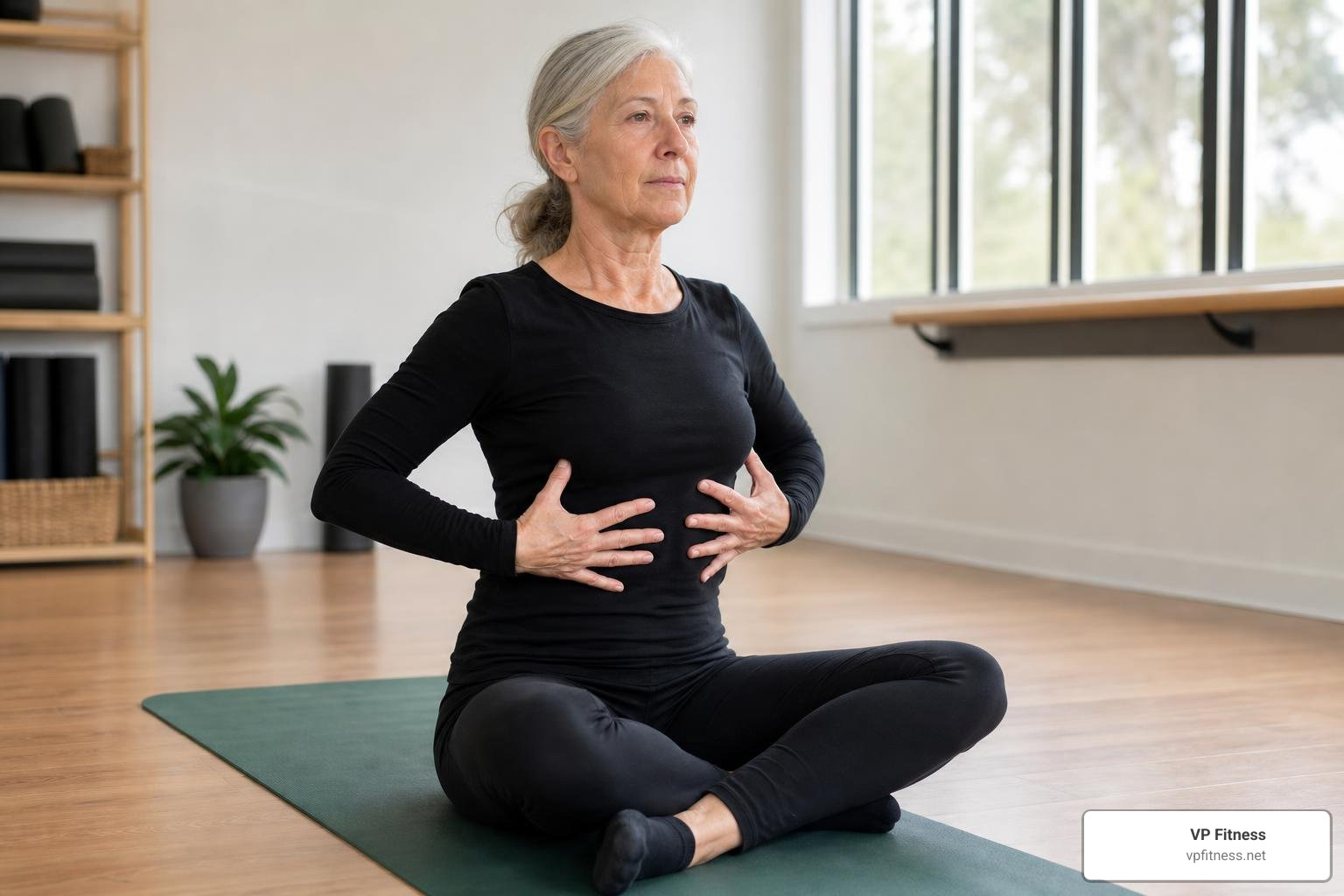
Beginner Pilates is a low-impact exercise method that teaches you how to move with better control, alignment, and awareness. Instead of rushing through big, sweaty movements, Pilates slows things down so your body can learn how to stabilize, strengthen, and move safely.
For seniors, that matters a lot.
Pilates focuses on:
- Core strength and breathing
- Posture and joint-friendly movement
- Balance and controlled flexibility
- Hip, back, and shoulder mobility
- Functional strength for everyday life
In plain English: Pilates helps your body become more reliable.
That means standing taller, moving with less stiffness, feeling steadier on your feet, and building strength without pounding your knees, hips, or back. No jumping. No sprinting.
In 2026, more older adults are choosing Pilates because it meets the body where it is today. Whether you are active, returning after years away from exercise, or managing a condition like arthritis, Pilates can usually be modified to fit your starting point.
What Makes Pilates Different From General Stretching or Exercise
Pilates is not just stretching. It is also not the same as a general fitness class where you follow along and hope for the best.
The biggest difference is control.
In Pilates, each movement is performed with attention to:
- How your spine is positioned
- How your pelvis and ribs move
- How your breath supports effort
- Whether your joints feel supported
- Whether both sides of your body are working evenly
A basic Pilates move may look simple from the outside, but inside your body, a lot is happening. Your deep core muscles are learning to support your spine. Your hips are learning to move without your lower back doing all the work.
That is why Pilates is often so useful for older adults. It trains the small stabilizing muscles that help with real-life movement, not just gym performance.
General stretching may improve flexibility. Walking may improve endurance. Strength training builds muscle. Pilates blends pieces of all three while adding posture, coordination, breath, and balance.
Key Benefits for Seniors: Balance, Strength, Flexibility, and Fall Prevention
The main benefits of Pilates for seniors are practical. This is not about doing fancy moves for social media. It is about moving better in everyday life.
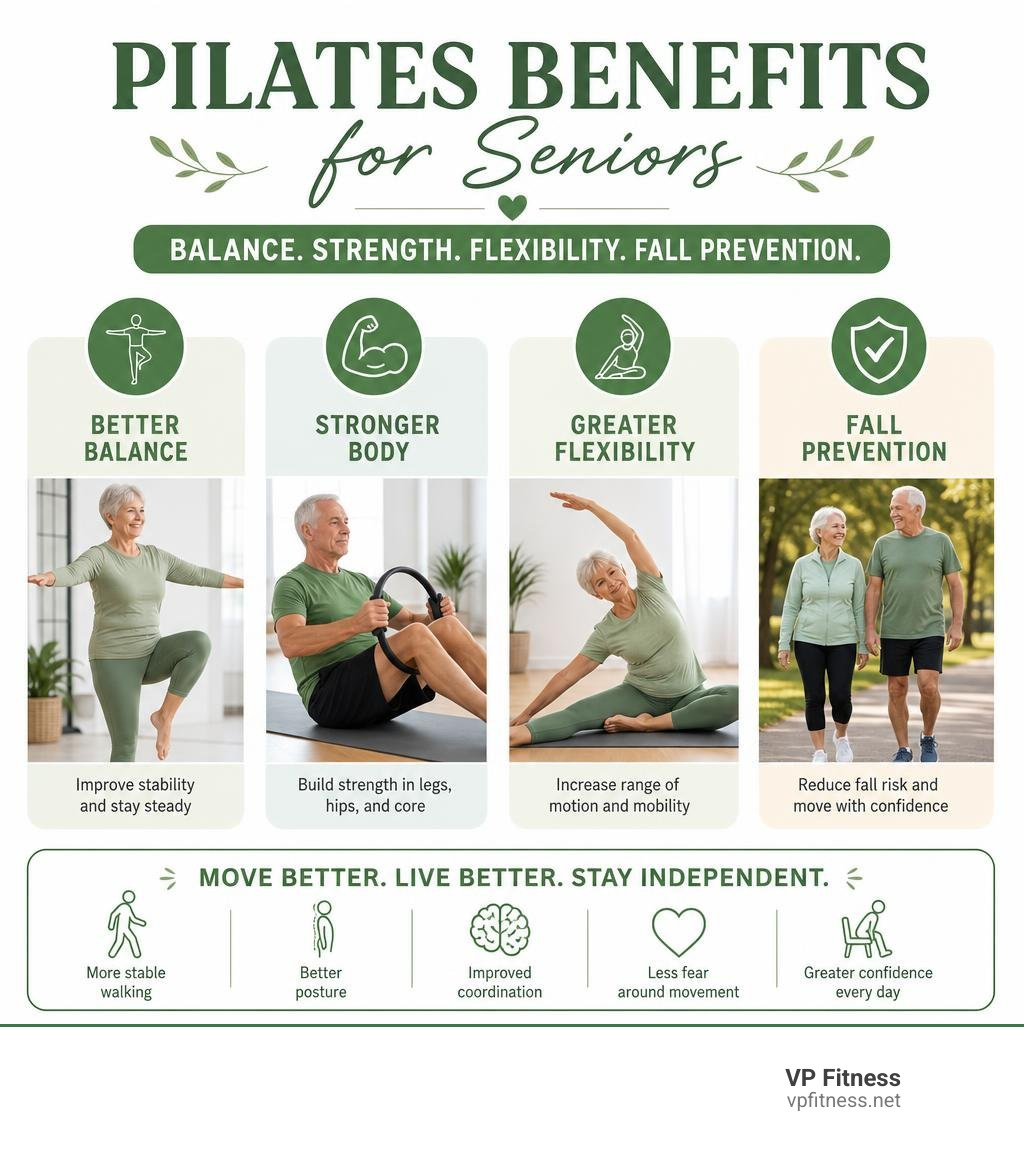
Key benefits include:
- Better balance and posture
- Stronger legs, hips, and core
- Improved flexibility and range of motion
- More stable walking and coordination
- Greater confidence getting up, turning, reaching, and stepping
Fall prevention is one of the biggest reasons seniors begin Pilates. According to CDC fall-prevention guidance, strength and balance training can reduce fall risk in adults over 65 by about 23%. Pilates fits into that category because it trains the muscles and awareness needed to stay steady.
Research-backed outcomes are encouraging:
- Seniors practicing Pilates at least twice weekly have shown a 23% improvement in balance within 12 weeks.
- Fall risk may decrease by about 19% over the same period.
- Many seniors notice better strength, flexibility, and balance within 4 to 6 weeks when practicing 2 to 3 times per week.
- Regular Pilates can improve muscle strength, walking ability, and aerobic power in older adults by up to 30%.
One of the hidden benefits is confidence. When you trust your body more, you move more. When you move more, you stay stronger. That is the positive cycle we want.
How Pilates Supports Everyday Activities and Independence
The best exercise programs for seniors should make daily life easier. Pilates does that by training functional movement.
Pilates can help with:
- Standing up from a chair
- Climbing stairs
- Carrying groceries
- Reaching into cabinets
- Walking longer without fatigue
- Turning safely
- Getting in and out of a car
A stronger core supports your spine. Stronger hips support your knees. Better ankle control supports your balance. Better posture supports your breathing and walking.
If you are just beginning exercise in general, you may also find our guide to exercise for beginners helpful.
How to Find beginner pilates for seniors near me Without Choosing the Wrong Class
Searching for beginner pilates for seniors near me can bring up many options, but not every class is right for an older beginner.
The right class should feel supportive, clear, and safe. The wrong class may move too fast, assume too much, or fail to offer modifications.
Look for a starting point that includes:
- Beginner-friendly instruction and senior-aware coaching
- Small class sizes or private/semi-private options
- Clear demonstrations and questions about injuries/medical history
- Accessible equipment and a clean, professional facility
- Easy parking or entry and a calm pace
- A culture where modifications are normal
The best fitness plan starts with the person in front of you. That means your goals, health history, mobility, confidence level, and comfort all matter.
Here is a simple comparison of common Pilates options for seniors:
| Pilates Type | Best For | Things to Consider |
|---|---|---|
| Mat Pilates | Seniors comfortable getting on the floor, beginners learning basics | May need cushions, props, or help getting up |
| Reformer Pilates | Supported strength, guided range of motion, joint-friendly resistance | Best with trained supervision, especially at first |
| Chair Pilates | Limited mobility, balance concerns, no-floor workouts | Great entry point but may offer less resistance |
| Wall Pilates | Home practice, posture, supported balance | Best when exercises are simple and controlled |
For an idea of how these are structured, you can view an example senior mat Pilates class format.
What to Look For in beginner pilates for seniors near me
When comparing options, do not just look for the closest class. Look for the class that is most appropriate for your body.
A senior-friendly beginner Pilates option should include:
- Certified or well-trained instructors with experience modifying exercises
- An intake form or health questionnaire asking about arthritis, osteoporosis, joint replacements, back pain, balance, and heart conditions
- Smaller groups or individual attention
- Clear beginner labels and patient pacing
- Props such as chairs, cushions, bands, balls, or light weights
- Non-slip surfaces and a welcoming environment
If you are local to Providence, you can also read more about pilates classes providence and how to think through your options.
A good instructor should never make you feel embarrassed for needing a modification. Modifications are a sign of smart training that keeps people moving and keeps the drama low.
Questions to Ask Before Booking beginner pilates for seniors near me
Before booking your first session, ask a few direct questions to avoid walking into a class that is too advanced.
Ask:
- Is this class appropriate for someone completely new to Pilates?
- Do you work with older adults or seniors?
- Can exercises be modified for arthritis or osteoporosis?
- What should I do if I have a hip, knee, or shoulder replacement?
- Do I need medical clearance before starting?
- Is there a private orientation or assessment available?
- How many people are usually in the class?
- Will I need to get down on the floor?
- Are chairs, props, or elevated equipment available?
- What is the cancellation policy and is there a trial class?
If the answers are vague, rushed, or dismissive, keep looking. Your body is not a guessing game.
In-Person, Online, Private, or Group: Which Starting Option Fits Best?
There is no single best way to start Pilates. The best choice depends on your body, goals, budget, and comfort level.
Private sessions are best if you have medical conditions, recent surgery, significant pain, balance concerns, or anxiety about starting. You get full attention and a plan built around you.
Semi-private sessions offer a middle ground. You get more attention than a large group class, often at a lower cost than one-on-one coaching.
Small group classes are great for motivation, routine, and community. They are often more affordable and can be very effective when the class is beginner-friendly.
Online Pilates can be useful if you want to learn the language of Pilates at home, but it has limits. No one can correct your form through a prerecorded video. If you have health concerns, start in person when possible.
For budget-conscious planning, see our guide to affordable pilates classes near me.
Choosing the Best Type of Pilates for Your Body
The best Pilates style for you depends on mobility, balance, joint comfort, confidence, and whether you prefer home or in-person practice.

Mat Pilates for Seniors
Mat Pilates is done on the floor using your body weight and sometimes props. It is often one of the most affordable and widely available ways to begin.
Mat Pilates can help seniors build:
- Core strength and hip mobility
- Spinal awareness and shoulder control
- Flexibility and breathing coordination
However, mat Pilates may not be ideal if getting down to the floor is difficult. If you have knee pain, hip stiffness, dizziness, or balance issues, floor transitions can be more challenging than the exercises themselves.
Helpful modifications include:
- Using a thicker mat or placing cushions under the head or knees
- Using a chair for support or skipping rolling exercises
- Moving slowly between positions and practicing near a wall or stable surface
Mat Pilates is a good fit if you can get up and down safely and want to learn foundational movement at a gentle pace.
Reformer Pilates for Seniors
Reformer Pilates uses a machine with a sliding carriage, straps, pulleys, and springs. It may look intimidating at first, but for many seniors, it can actually feel more supported than mat work.
The spring resistance can assist movement or add challenge depending on the setup. This makes reformer Pilates useful for building strength without the same joint strain that may come from free weights or high-impact exercise.
Benefits of reformer Pilates for seniors include:
- Supported movement and adjustable resistance
- Guided range of motion with less impact on joints
- Strength training for hips, legs, arms, and core
- Balance and coordination practice
- Easier transitions than floor-based exercise in some cases
Some research and expert observations suggest spring-based resistance can reduce joint strain compared with traditional free weights, especially when exercises are coached well. Reformer Pilates is often a strong choice for seniors who want low-impact strength training with close supervision.
Chair and Wall Pilates for Limited Mobility
Chair and wall Pilates are excellent options if you do not want to get on the floor.
Chair Pilates can include:
- Seated breathing and core activation
- Leg extensions and heel raises
- Arm movements and gentle twists
- Posture drills and sit-to-stand practice
Wall Pilates can include:
- Wall posture alignment and supported squats
- Standing balance drills and wall push-ups
- Gentle calf raises and shoulder mobility
- Controlled hip movements
These options are especially helpful for seniors with limited mobility, balance concerns, or fear of falling. A chair is not a downgrade; it is a highly effective tool.
How Often Seniors Should Practice Pilates to See Results
Most seniors do well with Pilates 2 to 3 times per week. That frequency allows enough practice to build strength and coordination while still leaving time for recovery.
A simple beginner schedule could look like:
- Week 1 to 2: 1 to 2 gentle sessions per week
- Week 3 to 6: 2 sessions per week
- Week 7 and beyond: 2 to 3 sessions per week, depending on recovery
Many seniors notice improvements in 4 to 6 weeks, especially in posture, flexibility, and confidence. More measurable balance and fall-risk improvements are often seen around 12 weeks with consistent practice.
Once weekly can still help, especially for maintenance or if you are also walking, strength training, or doing physical therapy. But if your goal is noticeable progress, 2 to 3 times weekly is usually better.
Safety, Modifications, and Medical Precautions for Senior Beginners
Pilates is generally safe for seniors when it is taught properly and modified for the individual. The keyword is modified.
Before starting, speak with your healthcare provider if you have:
- Osteoporosis or recent surgery
- Hip, knee, or shoulder replacement
- Heart conditions or uncontrolled blood pressure
- Dizziness, fainting episodes, or severe balance problems
- Significant back, neck, or unexplained pain
- Neurological conditions
A safe program should value the connection between fitness, physical therapy, and smart progression. If your body has a medical history, your exercise plan should respect it.
Is Pilates Safe for Seniors With Arthritis?
Yes, Pilates can be safe and helpful for many seniors with arthritis, but it must be gentle and joint-aware.
For arthritis, the goal is to move joints through a comfortable range without forcing them. Movement can help reduce stiffness, improve circulation, and maintain strength around the joints.
Helpful arthritis modifications include:
- Smaller ranges of motion and slower transitions
- Extra warm-up time and avoiding painful joint positions
- Using props for support and taking rest breaks
- Choosing chair or reformer options
- Avoiding long weight-bearing positions on painful hands or knees
During an arthritis flare-up, the session should be easier. The rule is simple: effort is okay; joint pain is not.
Is Pilates Safe for Osteoporosis?
Pilates can be safe for many people with osteoporosis, but certain traditional Pilates movements may not be appropriate.
With osteoporosis, spine safety is especially important. Many people need to avoid or heavily modify exercises involving:
- Loaded forward bending
- Rolling like a ball, roll-ups, and roll-overs
- Deep spinal twisting or fast flexion movements
- Combined bending and twisting
Safer emphasis often includes:
- Tall posture and hip hinging instead of rounding the spine
- Gentle back extension and core stability
- Hip strength and balance training
- Controlled resistance
If you have osteoporosis or low bone density, work with an instructor who understands osteoporosis modifications. A private session is strongly recommended before joining a group class.
Pilates After Hip, Knee, or Shoulder Replacement
Many seniors return to exercise after joint replacement, but timing and clearance matter.
Before beginning Pilates after a joint replacement:
- Get clearance from your surgeon or physical therapist.
- Ask about range-of-motion restrictions.
- Tell your instructor exactly what surgery you had and when.
- Avoid forced positions and move slowly during transitions.
- Watch for swelling, sharp pain, or instability.
Reformer and chair-based exercises may be helpful because they can provide support and reduce impact. A joint replacement is not a reason to avoid movement forever; it is a reason to start carefully and progress intelligently.
What to Do If You Feel Pain, Dizziness, or Instability
Stop immediately if something feels wrong. Do not “push through” symptoms.
Stop Pilates and tell your instructor if you feel:
- Sharp pain or chest pain/pressure
- Dizziness or shortness of breath
- Sudden weakness, numbness, or tingling
- Joint instability or loss of balance
- Nausea or a sudden headache
- Pain that gets worse with each repetition
What to do:
- Stop the exercise.
- Sit or lie in a safe neutral position.
- Breathe slowly and drink water if appropriate.
- Tell the instructor what happened.
- Follow up with a healthcare provider if symptoms continue.
Muscle effort is normal. Mild soreness the next day can be normal. Sharp pain, dizziness, or instability is not the goal.
What to Expect in Your First Beginner Pilates Session
Your first Pilates session should not feel like a test. It should feel like an introduction.
A good beginner session may include:
- Intake form and health history discussion
- Goals conversation and posture check
- Mobility screening and breathing practice
- Gentle warm-up and basic core activation
- Simple hip and shoulder movements
- Balance drills and cooldown
- Instructor feedback
You should leave feeling informed, not overwhelmed.
Before Class: What to Wear and Bring
Wear comfortable clothing that lets you move. It does not need to be fancy. If you can sit, reach, bend slightly, and breathe comfortably in it, you are on the right track.
Bring:
- Water and a towel
- Grip socks, if required
- A list of medications, injuries, or surgeries
- Any doctor or physical therapist restrictions
- Glasses or hearing aids if you need them for instruction
- A light layer in case the room is cool
Try to arrive early so you can ask questions without feeling rushed. Avoid eating a heavy meal right before class.
During Class: Common Beginner Exercises and Cues
Beginner Pilates exercises are usually simple, controlled, and focused on awareness.
You may practice:
- Breathing into the ribs and pelvic tilts
- Heel slides and marching
- Seated leg extensions and shoulder openers
- Clamshells and supported bridges
- Wall push-ups and seated posture drills
- Gentle balance work and hip mobility movements
Common cues include:
- “Move slowly.”
- “Keep breathing.”
- “Lengthen through the spine.”
- “Relax your shoulders.”
- “Use a smaller range.”
- “Stop if there is pain.”
The slower pace is not because Pilates is easy. It is because control is the point.
After Class: How to Track Progress
Progress in Pilates can be subtle at first. Pay attention to daily life changes, not just how you feel during class.
Track:
- Can you stand up from a chair more easily?
- Do stairs feel steadier?
- Is your posture better?
- Are you walking with more confidence?
- Do you feel less stiff in the morning?
- Is your balance improving?
- Are you more aware of how you move?
- Is your back less tired at the end of the day?
Some muscle soreness is normal, especially if you are using muscles that have been “on vacation” for a while. But soreness should be manageable and should improve within a day or two.
If you want broader support for staying active as you age, explore our active aging programs.
Frequently Asked Questions About Beginner Pilates for Seniors
Can I Start Pilates at 70 or Older?
Yes. You can start Pilates at 70, 80, or beyond, as long as the program is appropriate for your health and mobility.
Age is not the main issue. The real questions are:
- What is your current fitness level?
- Do you have medical restrictions?
- Can you get up and down from the floor safely?
- Do you need chair or reformer support?
- Would a private session help you start with confidence?
Many seniors begin with no Pilates experience at all. The key is to start slowly, choose beginner-friendly instruction, and focus on consistency rather than intensity.
What If I Can’t Get on and off the Floor?
You can still do Pilates.
Floor work is not required for every Pilates program. Good alternatives include:
- Chair Pilates
- Wall Pilates
- Reformer Pilates
- Seated core work
- Standing balance exercises
- Supported mobility drills
If floor transitions are difficult, tell the instructor before class. You should not have to struggle your way down to a mat just to prove a point. The goal is better movement, not dramatic entrances and exits.
Is Pilates Better Than Weight Training, Yoga, or Tai Chi for Seniors?
Pilates is not automatically better than weight training, yoga, or tai chi. It depends on your goals.
Each method has strengths:
- Pilates: core control, posture, balance, mobility, joint-friendly strength
- Weight training: muscle mass, bone strength, power, metabolism
- Yoga: flexibility, breathing, relaxation, mobility
- Tai chi: balance, coordination, calm movement, fall prevention
For many seniors, the best routine combines several methods. Pilates can be a strong foundation because it teaches body awareness and control, which can make other exercises safer and more effective.
A complete plan often includes strength, mobility, balance, cardiovascular health, nutrition, and recovery. Pilates can be one important piece of that plan.
Conclusion
If you have been searching for beginner pilates for seniors near me, the best place to start is with a safe, supportive, beginner-friendly option that respects your body as it is today.
Pilates can help seniors build balance, strength, flexibility, posture, and confidence. It can support everyday activities like walking, climbing stairs, carrying groceries, and getting up from a chair. Most importantly, it can help you stay active and independent longer.
Start with the right format:
- Private or semi-private if you have health concerns
- Small group if you want community and structure
- Chair or wall Pilates if floor work is difficult
- Reformer Pilates if you want supported resistance
- Online practice only if it is safe for your body and you understand the basics
A well-rounded fitness facility can help members build personalized fitness plans in a clean, professional environment with group classes, individualized training, physical therapy support, nutrition guidance, convenient parking, and post-workout recovery options.
Start safely. Build gradually. Celebrate small improvements. And remember: the goal is not to move like someone else. The goal is to move better as you.
Ready to take the next step? Explore fitness classes for active aging or learn more about a Providence fitness center focused on health and wellness.