

The Ultimate Showdown: High-Intensity Interval Training vs. Strength Workouts

Strength training vs high intensity cardio: Ultimate 2
Understanding the Ultimate Fitness Showdown
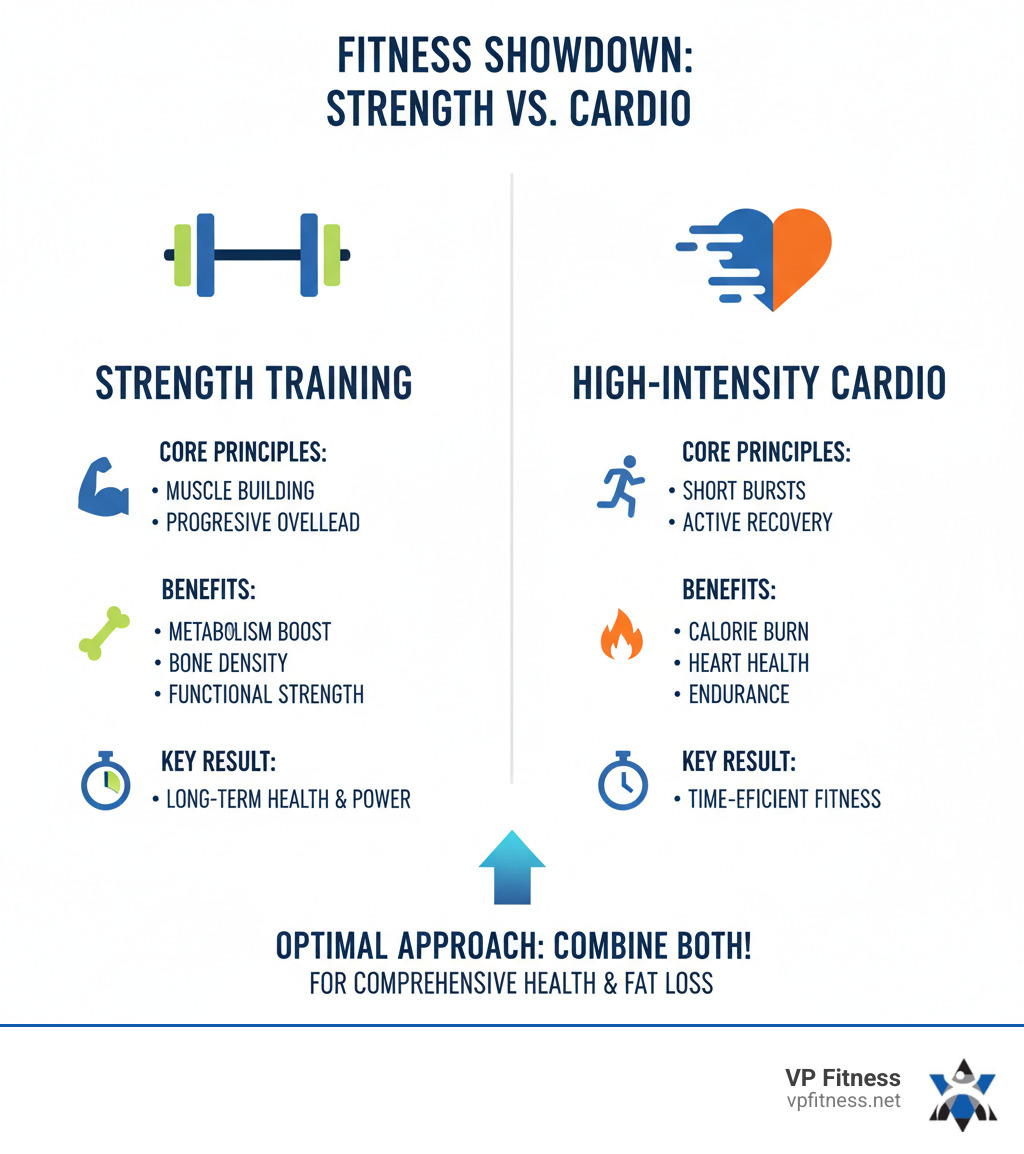
When weighing strength training vs high intensity cardio, many wonder which is superior for fitness goals. The truth is, they offer different yet complementary benefits:
- Strength Training: Builds muscle, boosts metabolism long-term, improves bone density, and improves functional fitness.
- High-Intensity Cardio (HIIT): Burns calories quickly, improves heart health, increases metabolic rate during and after workouts, and is time-efficient.
- Best Approach: Combining both is generally recommended for comprehensive fitness, optimal fat loss, and overall health.
The debate is common: is cardio or strength training superior? Both are powerful tools for changing your body and health, but they work differently. Strength training uses resistance (weights, bands, or bodyweight) to build muscle. HIIT involves short, intense bursts of exercise followed by brief rest periods. Each method offers unique advantages. In this guide, we’ll break down what each workout offers and show you how they work together for the best results, helping you understand the science behind these popular fitness choices.
As a fitness professional with a passion for helping clients improve their well-being and expertise in powerlifting, I’ve explored the most effective strategies for strength training vs high intensity cardio to achieve significant milestones.
The Case for Strength Training: Building a Resilient Body
Strength training is the foundation of physical fitness, building a strong, resilient body with benefits that go beyond aesthetics. It involves using resistance—from weights, bands, or your own body—to challenge your muscles, causing them to adapt by getting stronger and bigger.

A key advantage of strength training is its effect on your metabolism. By building and maintaining muscle mass, your body becomes a more efficient calorie-burning machine, even at rest. Your resting metabolism gets a boost because muscle requires more energy to maintain than fat. After a workout, your body continues to burn extra calories for days as it repairs and rebuilds muscle. This makes strength training essential for long-term weight management, as it helps you build a body that naturally maintains a healthy weight. Scientific research on strength training backs up these metabolic benefits.
Enhancing Bone Density and Joint Health
Strength training also strengthens your bones and joints. Weight-bearing exercises like squats and deadlifts put positive stress on your skeleton, causing bones to become denser and stronger. This increased bone density is crucial for osteoporosis prevention and reducing fracture risk as you age. Stronger muscles also provide better support for your joints, leading to improved balance and stability. This support significantly reduces the risk of common injuries, arthritis, and strains from everyday movements. The overall benefit is a significant injury reduction.
Functional Fitness for Everyday Life
Strength training improves functional fitness, preparing your body for everyday challenges. It makes daily tasks become easier, from carrying groceries to climbing stairs. With improved coordination, you’ll have better balance and reaction time. A strong core, a key focus of functional fitness, provides better posture, reduces back pain, and stabilizes your spine. This core strength is the powerhouse connecting your upper and lower body, making all movements more efficient and powerful. The real magic of strength training is how it changes the way you move through life, making activities that once felt exhausting feel manageable.
When considering strength training vs high intensity cardio, strength training builds the foundation your body needs for long-term health, resilience, and an active lifestyle at any age.
The Power of High-Intensity Cardio: Maximum Results in Minimal Time
High-intensity cardio, or HIIT, is about igniting your engine and pushing its limits. Its main appeal is time efficiency; you can get an incredible workout in just 20-30 minutes, making it perfect for busy schedules.

HIIT burns a significant number of calories during the workout, but the benefits continue afterward. This is due to the afterburn effect, or EPOC (excess post-exercise oxygen consumption), where your body continues burning calories at an liftd rate for hours as it recovers. Pushing through the challenging intervals of a HIIT session also builds mental toughness. The focus and determination required can translate into greater resilience in other areas of your life.
Boosting Cardiovascular Health and Performance
While strength training vs high intensity cardio might seem like opposing forces, HIIT brings its own unique set of health benefits that complement what strength work provides. HIIT is exceptional at strengthening your heart and lungs, improving blood circulation throughout your body, and significantly reducing your risk of heart disease.
One of the most impressive benefits? HIIT specifically targets visceral fat—that stubborn, dangerous fat that wraps around your internal organs and increases your risk of serious health conditions. Research on HIIT and visceral fat reduction shows just how effective these short, intense workouts can be at tackling this problem area.
HIIT also works wonders for your blood sugar levels and insulin sensitivity. Studies show it can help lower blood sugar and improve insulin sensitivity, making it particularly valuable for anyone concerned about type 2 diabetes or metabolic health.
Perhaps best of all, HIIT improves both your aerobic and anaerobic capacity. This means you’ll have more endurance for long activities like hiking or cycling, while also developing explosive power for quick, intense movements. You become a more well-rounded athlete, capable of excelling across different types of physical challenges.
Strength Training vs High Intensity Cardio: The Head-to-Head Breakdown
Let’s put strength training vs high intensity cardio head-to-head. While both are fantastic, they achieve results differently, and understanding these differences is key to building an effective workout plan.
To give you a clear picture, here’s a quick comparison of their core features:
| Feature | Strength Training | High-Intensity Cardio (HIIT) |
|---|---|---|
| Calorie Burn | Lower during workout, higher post-workout (EPOC), higher resting metabolism due to muscle mass | Higher during workout, significant post-workout (EPOC) |
| Time Commitment | Typically 45-90 minutes per session | Often 20-30 minutes per session |
| Muscle Growth | Primary focus, highly effective for building and preserving muscle mass | Builds lean muscle, especially if strength elements are included |
| Fat Loss | Promotes fat loss while preserving muscle; boosts long-term metabolism | Highly efficient for calorie and fat burning during and after workout; targets visceral fat |
| Skill Level Req. | Varies (from beginner bodyweight to advanced lifting), focus on form | Moderate to advanced (requires good base fitness and form) |
| Primary Goal | Muscle strength, size, bone density, functional fitness | Cardiovascular health, endurance, metabolic boost, time efficiency |
For body composition and weight management strategies, their combined power is best. Strength training builds and preserves metabolically active muscle, which burns more calories at rest. HIIT is a calorie-burning powerhouse, torching fat during and after your session. Together, they create a synergy that helps you shed fat while sculpting a more defined physique.
Which is Better for Fat Loss: A Look at the Nuances of strength training vs high intensity cardio
A common question is which is better for fat loss. The answer is nuanced. HIIT is highly efficient, burning many calories during the workout and continuing for hours afterward due to the afterburn effect (EPOC), making it great for visceral fat reduction. However, strength training plays a different but vital role. In a calorie deficit, strength training helps you preserve muscle mass, which is often lost along with fat. Losing muscle slows your metabolic rate. By preserving and building muscle, strength training provides a sustained, long-term metabolic advantage, even if HIIT burns more calories in a single session.
Can HIIT Count as Strength Training?
Can HIIT count as strength training? Yes, it can include strength elements. By adding exercises like push-ups, squats, or kettlebell swings to your intervals, you create a hybrid workout, often called High-Intensity Resistance Training (HIRT). HIRT combines cardio intensity with muscle-building resistance, using bodyweight or weights in HIIT. It’s excellent for building lean muscle and improving endurance efficiently. However, for maximal strength or significant muscle growth (hypertrophy), traditional strength training with heavier loads is more effective. For general fitness and time-efficient body composition improvement, integrating strength into HIIT is a powerful strategy.
Creating the Perfect Blend: How to Combine Strength and HIIT
To achieve optimal results, it’s best to combine the powers of strength training vs high intensity cardio into a balanced routine. This synergistic approach builds comprehensive fitness, tackling both muscular strength and heart health simultaneously. A varied routine also helps prevent plateaus and reduces the risk of overuse injuries by constantly challenging your body in new ways.
The American College of Sports Medicine guidelines suggest at least 150 minutes of moderate-intensity cardio weekly, alongside two strength-building days. This is a fantastic blueprint for a sustainable and effective fitness path.
Sample Weekly Workout Schedule
Here’s a sample 5-day workout plan that incorporates both strength and HIIT, with built-in recovery.
-
Monday: Full Body Strength. Focus on compound movements like squats, deadlifts, overhead presses, rows, and push-ups. Aim for 3-4 sets of 8-12 reps to build foundational strength.
-
Tuesday: HIIT Session (Cardio Focus). This session involves short, intense cardio bursts. Try sprint intervals, jumping jacks, or burpees. Work for 30-45 seconds, rest for 15-30 seconds, and repeat for 20-30 minutes.
-
Wednesday: Full Body Strength. Focus on different compound movements or variations like lunges, bench press, pull-ups (or lat pulldowns), triceps dips, and bicep curls. Aim for 3-4 sets of 8-12 reps.
-
Thursday: Active Recovery / Low-Intensity Cardio. Gentle movement aids recovery. A 30-45 minute brisk walk, bike ride, yoga session, or stretching is ideal.
-
Friday: HIIT Session (Hybrid Strength/Cardio Focus). This hybrid HIIT session incorporates strength. Create a circuit with exercises like jump squats, push-ups, kettlebell swings, and mountain climbers. Work for 45 seconds, rest for 15, and repeat for 20-25 minutes.
-
Saturday & Sunday: Rest. Rest is crucial for recovery, muscle growth, and injury prevention. Don’t skip it!
Rest and recovery are just as important as the workouts themselves. They allow your muscles to repair and grow stronger, preventing burnout and injury. Active recovery days, like a leisurely walk or gentle stretching, can also aid this process.
Getting Started: A Guide for Beginners on strength training vs high intensity cardio
If you’re just starting, high-intensity workouts can feel overwhelming. It’s best to build a solid foundation first, as HIIT requires a baseline level of fitness to perform safely. Start with bodyweight strength exercises like squats, lunges, planks, and push-ups to learn proper form and build strength. When you’re ready for HIIT, start slow and modify. Use longer rest periods, shorter work intervals, or lower-impact versions of exercises (e.g., fast squats instead of jump squats). Proper form is always crucial to prevent injury and target the right muscles.
Frequently Asked Questions about Combining Workouts
These common questions about combining strength training vs high intensity cardio can help you build a routine that truly fits.
What is the recommended weekly balance between strength training and HIIT?
For most people, three to four days of strength training and two to three days of HIIT each week is a great balance. This allows for muscle building and cardiovascular improvement, with at least one full rest day.
However, your perfect balance depends on your goals. For building muscle, you might increase strength days and do HIIT twice a week. For fat loss or endurance, you might lean more toward HIIT.
The real secret is to listen to your body. Some weeks you’ll feel energetic, while others may require extra rest. Adjusting your routine based on how you feel is smart training.
Which should I do first, cardio or strength training?
The answer depends on your primary goal for the day due to the “interference effect,” where doing one exercise type can affect performance in the other. Prioritize your main goal: if you’re lifting heavy, do strength training first while you’re fresh. If your focus is endurance, do HIIT first.
Ideally, do them on separate days to allow for full energy and recovery for each. If you must do them on the same day, try to space them out by several hours. If doing them back-to-back, perform the exercise that aligns with your main goal first. For example, if strength is the focus, a light cardio session afterward is best.
What are the potential risks of doing too much HIIT?
While powerful, too much HIIT can lead to overtraining. Signs include persistent fatigue, decreased performance, lingering muscle soreness, trouble sleeping, or getting sick more often. These are signs your body needs a break.
HIIT is stressful on the body, so recovery is essential. We recommend a maximum of two to three HIIT sessions per week. This allows your body to recover, adapt, and get stronger.
Overtraining doesn’t lead to better results; it increases your risk of injury, especially if form slips due to exhaustion. Smart, consistent training is more effective for long-term health than excessive volume that leads to burnout or injury.
Conclusion: The Verdict Is In—You Need Both
The final verdict on strength training vs high intensity cardio is clear: it’s not a competition, but a partnership. For optimal results, you need both. Strength training builds your foundation of strong muscles, dense bones, and functional movement. High-intensity cardio fires up your engine, strengthening your heart and building endurance. Together, they are an unstoppable team for long-term health.
Combining these approaches creates a synergistic effect, leading to comprehensive fitness. You build muscle while improving cardiovascular health, and burn fat while preserving muscle for optimal body composition. This balanced approach has profound long-term health implications, reducing your risk of chronic diseases like heart disease, diabetes, and osteoporosis. You’re investing in a future with more energy, strength, and vitality.
This approach also keeps your journey sustainable and enjoyable. Varying workouts prevents plateaus, reduces overuse injury risk, and keeps you motivated by preventing boredom.
The power of this combination is evident when applied correctly. Personalized training that honors your unique goals and fitness level is key. Expert coaches can create customized plans that blend strength training and HIIT in the right proportions for you. Whether you’re a beginner or an experienced athlete, professional guidance can make your fitness journey easier and more enjoyable.
Ready to experience the benefits of a balanced routine? The next step is creating a plan that works for your life and goals.