

The Best Physical Therapy Exercises to Kick Back Pain for Good

The Best Physical Therapy Exercises to Kick Back Pain for Good
Why Physical Therapy Back Pain Treatment Is the Smartest First Step
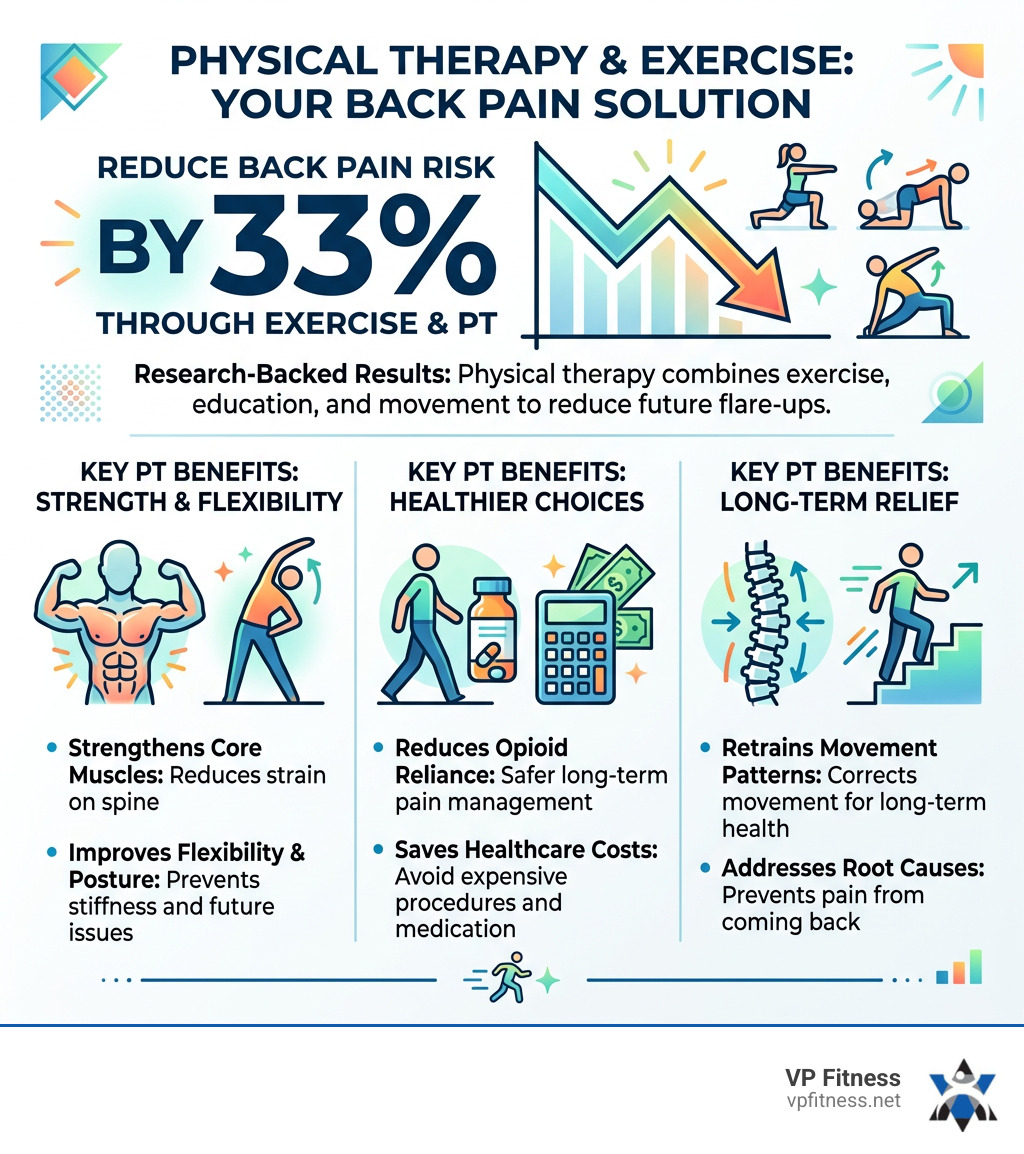
Physical therapy back pain treatment is one of the most effective, evidence-backed ways to reduce pain, restore movement, and avoid surgery or medication dependence. Here’s a quick breakdown of what it can do for you:
| What PT Does | How It Helps |
|---|---|
| Strengthens core and back muscles | Reduces strain on the spine |
| Improves flexibility and posture | Prevents future flare-ups |
| Retrains movement patterns | Addresses root causes, not just symptoms |
| Reduces reliance on opioids | Safer long-term pain management |
| Saves money | Up to $4,160 in avoided healthcare costs |
Back pain is not a rare problem. Right now, roughly 30% of people in the United States are dealing with it. Globally, low back pain accounted for 57.6 million years lived with disability in 2016 alone — and that number has grown by more than 50% since 1990.
The good news? You don’t have to live with it.
Research is clear: staying active beats bed rest every time. Exercise on its own can reduce your risk of low back pain by 33%. And when you combine exercise with education, that risk drops further. Physical therapy brings both together in a structured, personalized way.
With years of experience helping clients overcome pain and build resilient, functional bodies, experts focus on managing physical therapy back pain alongside fitness goals. Let’s walk through the exercises and strategies that actually work.
Common Causes and When to Seek Physical Therapy Back Pain Relief
Understanding why your back hurts is the first step toward fixing it. In a professional clinical setting, a wide range of issues are addressed, but most fall into a few specific categories. The spine is a complex structure of vertebrae, discs, nerves, and muscles. When one part isn’t moving right, the whole system feels it.
Common culprits include:
- Herniated or Bulging Discs: Discs act as cushions between your vertebrae. If they bulge or leak, they can press on nearby nerves, causing sharp pain or numbness.
- Spinal Stenosis: This involves the narrowing of the spaces within your spine, which can put pressure on the nerves. It’s often age-related and can make walking or standing for long periods difficult.
- Muscle Spasms and Strains: Sudden movements or heavy lifting can cause the muscles supporting the spine to seize up.
- Degenerative Changes and Arthritis: Wear and tear over time can lead to stiffness and inflammation in the spinal joints.
- Sciatica: This is specifically pain that radiates along the sciatic nerve, which runs from your lower back down through your hips and legs.
Scientific research, such as the Lancet low back pain series30725-6), highlights that low back pain is a major global challenge, but it is often a “benign” condition—meaning that while it hurts, there is usually no permanent structural damage.
When to Seek Immediate Help (Red Flags)
While most back pain is manageable through physical therapy back pain protocols, there are “red flags” that require immediate medical attention. We always advise our clients to see a doctor immediately if they experience:
- Loss of bowel or bladder control.
- “Saddle anesthesia” (numbness in the groin or inner thighs).
- Sudden, progressive weakness in the legs.
- Pain following a major trauma, like a fall or accident.
Identifying Your Specific Pain Category
A licensed physical therapist doesn’t just give you a random list of stretches. They categorize your pain to find the right solution. For example, if your pain is acute (recent and sharp), the focus is on calming the system down. If it’s chronic (lasting more than 3 months), the focus shifts to retraining the nervous system.
Therapists often use “Repeated Motion” testing. If bending backward makes your leg pain disappear, that’s a “directional preference” that guides your entire exercise plan. Others may need “Stabilization,” which focuses on the deep muscles of the core that have “turned off” due to pain.
How Physical Therapy for Back Pain Works
Many people think physical therapy is just “supervised exercise.” In reality, it is a multidisciplinary approach to health. When you start back pain physical therapy, you aren’t just working on muscles; you’re working on your brain.
Manual Therapy and Mobilization Physical therapists use hands-on techniques to move joints and soft tissues. Unlike the high-velocity “cracks” you might associate with other professions, PTs often use mobilization—slower, gentler movements designed to improve the range of motion in a stiff spine. This is particularly helpful for those dealing with osteoarthritis or general spinal stiffness.
Pain Science and the Brain One of the most aspects of modern therapy is “Pain Science.” Research shows that MRI results don’t always correlate with pain. Some people have terrible-looking MRIs but zero pain, while others have “perfect” spines and excruciating discomfort. This is because pain is a signal produced by the brain based on perceived danger.
Physical therapy uses graded activity to show your brain that movement is safe. By slowly increasing your activity level, we “rewire” the nervous system to stop sending danger signals for normal movements like bending over or lifting a grocery bag.
The Role of Patient Education and Home Programs
The 167 hours a week you spend outside the gym or clinic matter more than the one hour you spend with us. Evidence-based guidelines emphasize that education is a first-line treatment. We teach you:
- Activity Modification: How to keep moving without flaring up your symptoms.
- Ergonomic Alignment: How to set up your desk or car seat to support your spine.
- Self-Management: Giving you the tools (like a specific stretch) to stop a flare-up in its tracks.
Top Exercises for Physical Therapy Back Pain
When it comes to physical therapy back pain exercises, “one size fits all” is a myth. However, there are several gold-standard movements that help the majority of people by improving stability and mobility.
The “Big Three” for Stability
- Bird-Dog: On all fours, extend the opposite arm and leg while keeping your back flat. This retrains the core to stabilize the spine during limb movement.
- The Bridge: Lying on your back, lift your hips toward the ceiling. This activates the glutes, which are the primary supporters of the lower back.
- Cat-Cow: Moving between an arched and rounded back while on all fours to improve segmental mobility of the vertebrae.
Specific Exercises for Physical Therapy Back Pain Conditions
Depending on your diagnosis, your “medicine” (exercise) will change. For instance, what helps a disc bulge might actually irritate spinal stenosis.
| Condition | Recommended Movement | Why? |
|---|---|---|
| Herniated Disc | Extension (Press-ups) | Helps “centralize” pain away from the legs. |
| Spinal Stenosis | Flexion (Knee-to-Chest) | Opens up the spinal canal to relieve nerve pressure. |
| Muscle Spasms | Gentle Mobility & Foam Rolling | Relaxes the “guarding” response of the muscles. |
| Weak Core | Pelvic Tilts & Dead Bugs | Builds deep abdominal strength to protect the spine. |
If you want to dive deeper into building a resilient back, check out our back strength training complete guide.
The McKenzie Method
Many of our exercise physical therapy protocols involve the McKenzie Method. This involves finding a “directional preference.” If you find that sitting (flexion) makes your leg pain worse, but standing up and leaning back (extension) makes it feel better, we focus on extension-based exercises to move the pressure off the nerve.
The Benefits of Choosing Therapy Over Surgery or Medication
In the past, the standard advice for back pain was “take two aspirin and stay in bed.” We now know that is the worst thing you can do. Prolonged bed rest causes muscles to weaken and joints to stiffen, which actually increases disability.
The Cost-Effectiveness of PT Choosing physical therapy as your first point of care isn’t just better for your body; it’s better for your wallet. Studies have shown that patients who choose PT first for acute back pain save an average of $4,160 in healthcare costs. They avoid expensive imaging (like MRIs that might not even explain the pain), injections, and unnecessary surgeries.
Avoiding the Opioid Trap Medications like opioids only mask the pain signal; they don’t fix the underlying movement dysfunction. Worse, they lead to tolerance and dependency. Physical therapy addresses the root cause—whether it’s a weak core, stiff joints, or poor lifting mechanics.
Is Physical Therapy Back Pain Treatment Better Than Surgery?
For the vast majority of people, the answer is yes. Surgery is often permanent and comes with significant risks. Research on LBP prevention shows that conservative care—exercise, education, and manual therapy—is just as effective as surgery for many conditions like stenosis or disc herniation, without the downtime.
Even if surgery is eventually required, “pre-habilitation” (doing PT before surgery) significantly improves recovery times and reduces post-operative pain. For more on high-level recovery, see our athletic physical therapy guide.
Frequently Asked Questions about Physical Therapy Back Pain
Should I stay in bed if my back hurts?
Absolutely not. While you might need to avoid heavy lifting for 24 hours during a severe flare-up, bed rest longer than a day is counterproductive. Gentle movement—like walking or the mobility exercises we’ve discussed—keeps blood flowing to the area and prevents your muscles from “guarding” and tightening further.
How long does it take for physical therapy to work?
Many people feel a significant difference in their pain levels within the first 2 to 4 weeks. However, the goal of physical therapy back pain treatment isn’t just to stop the pain; it’s to prevent it from coming back. This usually requires a 6- to 12-week commitment to build the necessary strength and change old movement habits. Consistency with your home exercise program is the biggest predictor of success.
Can I do these exercises if I have a herniated disc?
Yes, but you must choose the right ones. If you have a disc issue, forward bending (flexion) often pushes the disc material further against the nerve. You will likely find relief with extension exercises, like “press-ups” (lying on your stomach and pushing your chest up while keeping your hips down). This “centralizes” the pain, moving it from your leg back into your lower back, which is a sign of healing.
Conclusion
Back pain can feel like an invisible weight, but it doesn’t have to be your “new normal.” Whether you are dealing with a recent injury or a chronic ache that has lingered for years, physical therapy back pain strategies offer a path back to the things you love.
Movement is medicine. Combining the clinical expertise of physical therapy with a motivating environment helps move patients from “rehab” to “performance,” ensuring that once back pain is gone, it stays gone.
Don’t let another day of stiffness hold you back. Whether you’re looking for a personalized recovery plan or want to bulletproof your body against future injury, help is available.
Ready to take the first step toward a pain-free life? Start your journey with personal training and let us help you build a back that can handle anything life throws at it.