

The Ultimate Guide to an Efficient Full-Body Workout

The Ultimate Guide to an Efficient Full-Body Workout
Why a Full-Body Workout Routine Delivers Real Results
A workout whole body routine trains every major muscle group — legs, back, chest, shoulders, and core — in a single session. It is one of the most efficient ways to build strength, burn fat, and stay consistent, especially if you have a busy schedule.
Here is what you need to know at a glance:
- What it is: A workout that hits all major muscle groups in one session, typically 3 days per week
- Best exercises: Squats, deadlifts, bench press, rows, overhead press, and pull-ups
- Who it’s for: Beginners, busy professionals, and anyone with limited training days
- How long: 45 to 60 minutes per session is the sweet spot
- How often: 2 to 4 times per week, with at least one rest day between sessions
- Can you build muscle? Yes — a 2021 study confirmed full-body and split routines are equally effective when weekly training volume is matched
Most people overthink their training. They assume they need to spend five or six days in the gym hitting one body part at a time. But the research — and decades of real-world results — tells a different story.
Legends like Arnold Schwarzenegger built their foundational muscle mass using full-body training. Modern science backs up what they already knew: hitting each muscle group multiple times per week creates a stronger growth signal than isolating it once.
The key is not complexity. It is consistency, compound movements, and progressive overload.
I’m Joseph DePena, a master trainer with over a decade of experience designing workout whole body programs that get real results for real people. In this guide, I’ll walk you through everything you need to know — from exercise selection to sample routines for every fitness level.
What is a Full-Body Workout vs. a Split Routine?
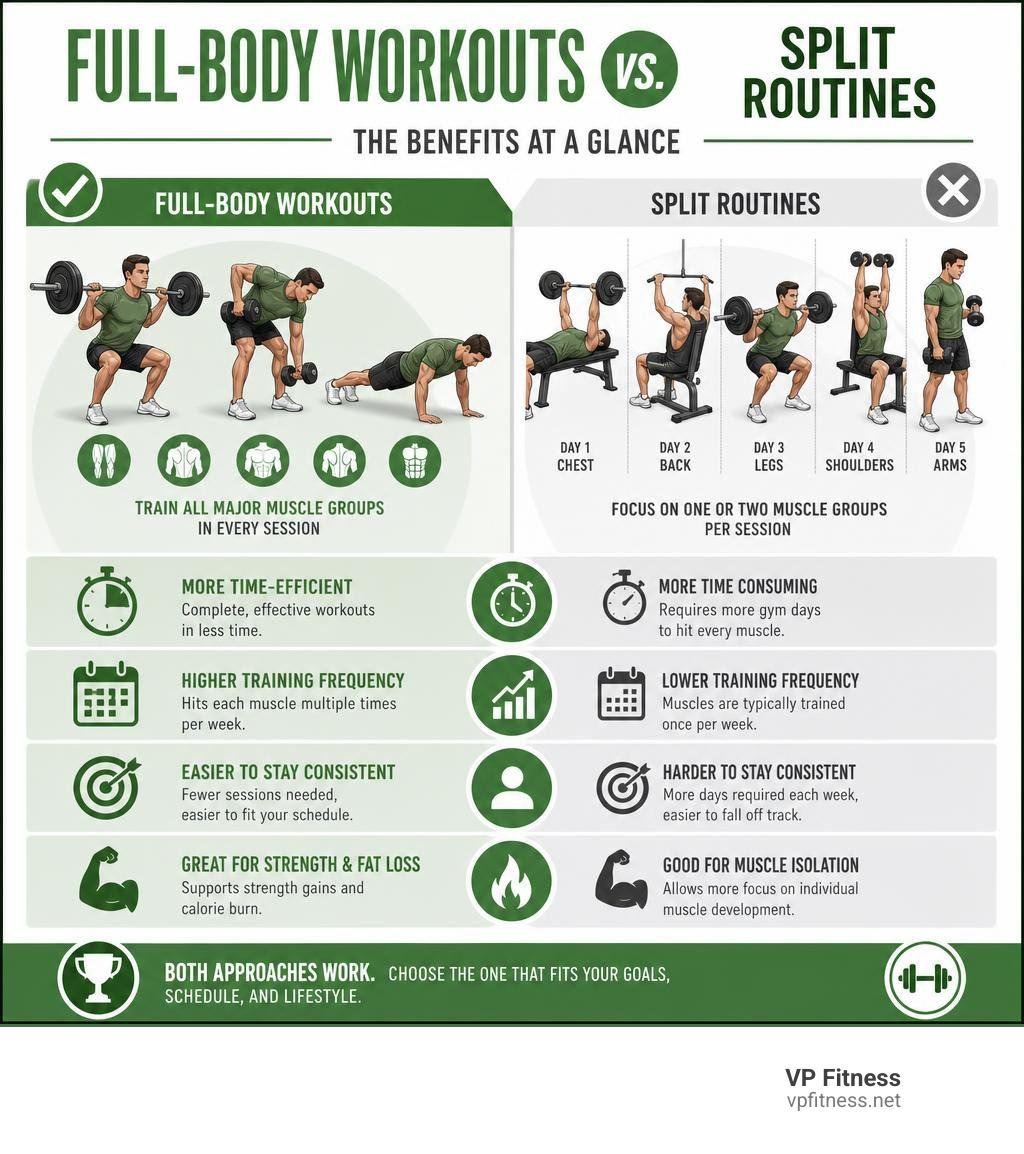
When we talk about structuring a training program, we generally look at two primary methodologies: full-body workouts and split routines. Understanding the differences between these two is crucial to choosing the path that best aligns with your lifestyle and goals.
A full-body workout targets all your major muscle groups in a single session. Instead of spending an entire hour exhausting your chest or your legs, we distribute that work across your entire frame. You might perform one squat variation, one horizontal push, one vertical pull, and a core exercise all in the same visit.
Conversely, a split routine divides your training by body parts or movement patterns across different days of the week. Common examples include the “bro split” (training chest on Monday, back on Tuesday, legs on Wednesday, etc.) or the popular Push-Pull-Legs (PPL) split. These routines require you to visit the gym four to six times a week to ensure every muscle group gets adequate attention.

The primary differentiator here is training frequency versus daily volume. With a split routine, you blast a single muscle group with high volume once a week, requiring up to seven days of recovery before you train it again. With a workout whole body routine, we stimulate each muscle group with lower daily volume but at a much higher frequency—typically three times per week.
This frequent stimulation keeps your muscle protein synthesis elevated more consistently throughout the week. Furthermore, full-body training acts as an excellent insurance policy for busy people. If you are on a PPL split and you miss “leg day” due to a late meeting, your legs won’t get trained for another week. If you miss a full-body session, you simply pick up where you left off during your next visit without throwing your entire weekly schedule out of balance.
Learn more about starting out with a beginner’s guide to full body routine to understand how to transition your body into this highly effective training style.
Key Benefits of a Workout Whole Body Routine
Why should you choose to train your entire body in one go? The benefits extend far beyond simply saving time.
First and foremost is time efficiency. In today’s world, committing to five or six gym sessions a week is a recipe for burnout. A three-day full-body program allows you to achieve incredible results in just three hours of total training time per week.
Second, a workout whole body routine is a powerhouse for fat loss and cardiovascular health. When you perform compound movements that recruit multiple large muscle groups simultaneously, your heart rate spikes to deliver oxygenated blood across your entire body. This massive energy demand results in a higher immediate caloric burn during the session compared to isolated body-part splits.
Additionally, full-body training triggers a significant EPOC (Excess Post-exercise Oxygen Consumption) effect. This metabolic boost keeps your body burning calories at an elevated rate for hours after you leave the gym. While an elliptical workout can burn between 300 to 600 calories per hour depending on intensity, combining resistance-based full-body movements with brief metabolic conditioning provides a superior, long-lasting metabolic stimulus.
Third, full-body training accelerates neurological learning and skill development. Exercises like the barbell squat and deadlift are highly technical skills. By practicing these movement patterns three times a week rather than once, your nervous system adapts much faster, leading to rapid strength gains—especially for beginners.
| Feature | Full-Body Workout | Split Routine |
|---|---|---|
| Weekly Frequency per Muscle | High (2-4 times) | Low (1-2 times) |
| Caloric Burn per Session | High (utilizes multiple large muscle groups) | Moderate (focuses on smaller isolated areas) |
| Schedule Flexibility | High (missed sessions are easily absorbed) | Low (missing a day disrupts the cycle) |
| Ideal for | Beginners, busy professionals, general health | Advanced bodybuilders, high-volume specialists |
| Recovery window | 48 hours of complete rest between sessions | 72+ hours for targeted muscle groups |
This balanced approach to fitness is why low-impact, whole-body disciplines have exploded in popularity. For instance, in 2023, almost 12 million people in the United States engaged in Pilates training—the highest number of annual participants since 2010. People are realizing that holistic, multi-joint movement is the key to feeling and looking our best. The Physical Activity Guidelines for Americans recommend getting at least 150 minutes of moderate-intensity exercise or 75 minutes of high-intensity exercise per week to prevent disease and boost overall health. A structured full-body program easily satisfies these requirements while building functional strength.
The Best Compound Exercises for a Workout Whole Body Program
To make a full-body routine work, you must abandon single-joint isolation exercises as your primary focus. You cannot build an efficient routine out of wrist curls and leg extensions. Instead, we base our programs on compound, multi-joint exercises that recruit maximum muscle mass.
Here are the “Big Six” movements that should form the foundation of your program:
- The Squat (King of Lower Body): Whether it is a barbell back squat or a beginner-friendly goblet squat, squatting targets your quadriceps, glutes, and core. To protect your joints, ensure your knees track over your toes and your back remains straight throughout the movement.
- The Deadlift (The Ultimate Pull): This movement targets your entire posterior chain—your hamstrings, glutes, spinal erectors, and upper back. A great cue to engage your lats before lifting is to imagine squeezing an orange in each armpit to pull the slack out of the bar.
- The Bench Press (Horizontal Push): Excellent for building the chest, shoulders, and triceps. To protect your shoulders, keep your shoulder blades squeezed together on the bench and tuck your elbows to a 45- to 60-degree angle from your torso.
- The Overhead Press (Vertical Push): This exercise builds strong shoulders and a stable core. Squeeze your glutes tight and brace your abs like you are about to take a punch before pressing the weight overhead to prevent your lower back from arching excessively.
- The Barbell Row (Horizontal Pull): Essential for a strong, balanced back. Focus on pulling with your back muscles rather than your arms, driving your elbows toward the ceiling.
- The Pull-Up (Vertical Pull): The ultimate test of upper-body pull strength. If you cannot perform a standard pull-up yet, we recommend starting with inverted rows or using resistance bands for assistance.
Discover how to master a full body exercise routine to learn how to combine these heavy movements safely without experiencing systemic exhaustion.
How to Structure and Progress Your Full-Body Training
The secret to long-term success with a workout whole body program is not finding a “magic” exercise; it is the systematic application of progressive overload. Your muscles will only grow and strengthen if they are forced to adapt to a stimulus that is greater than what they have previously experienced.
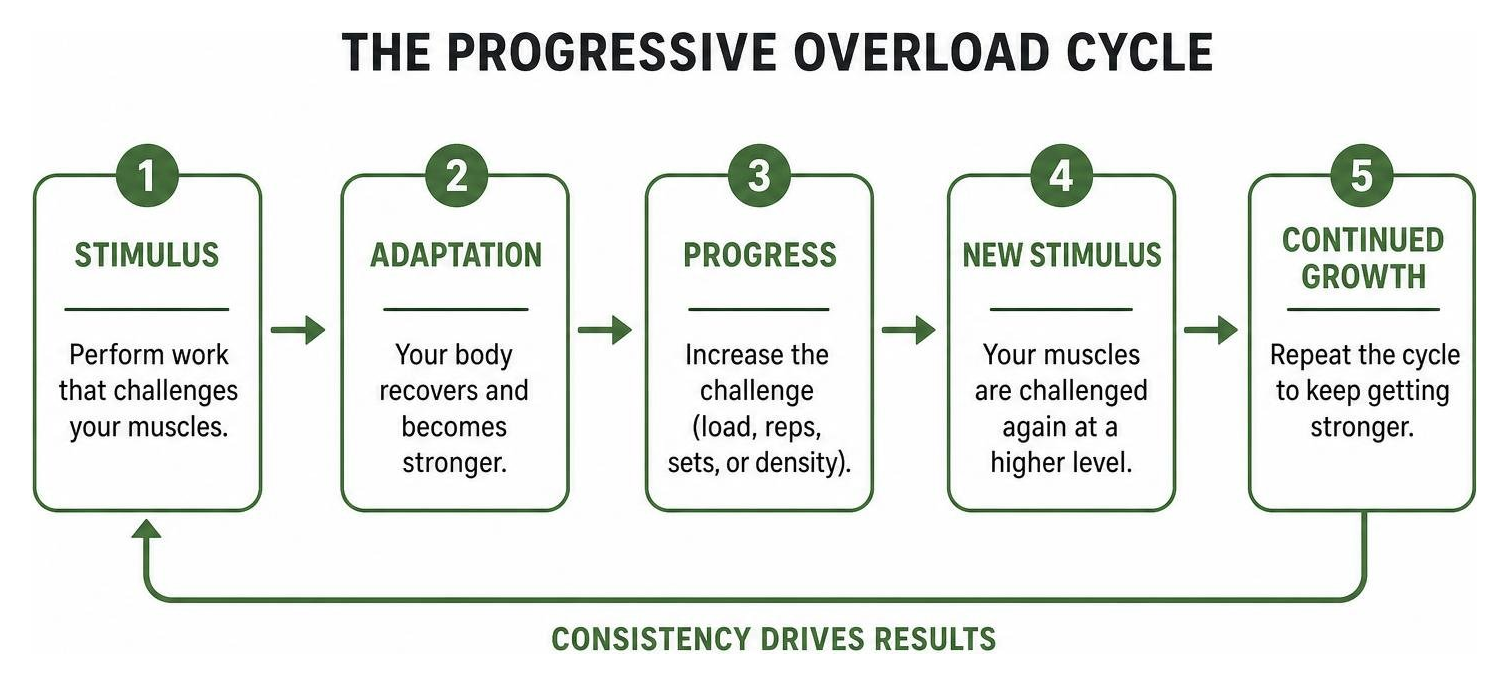
You can apply progressive overload in several simple ways:
- Increase the resistance: Add 5 pounds to the barbell or select heavier dumbbells.
- Increase the volume: Perform an extra rep per set, or add a third set to an exercise.
- Improve your density: Reduce your rest intervals slightly (e.g., cutting rest from 90 seconds to 75 seconds) while keeping the weight and reps the same.
- Improve your form: Focus on a slower, more controlled eccentric (lowering) phase.
For safety and longevity, we must manage our training volume and fatigue. Because we are training the entire body three times a week, we keep the daily volume per muscle group relatively low (typically 3 to 4 working sets per exercise).
We also recommend using ramped sets to manage fatigue on heavy compound lifts. Instead of jumping straight to your heaviest “working weight” for five sets, build up gradually. For example, if your target working weight for squats is 200 pounds, your sets might look like this:
- Set 1: 120 lbs (60% of working weight)
- Set 2: 160 lbs (80% of working weight)
- Sets 3-5: 200 lbs (100% of working weight)
This primes your nervous system and lubricates your joints without causing premature muscular exhaustion. To keep your workouts fresh and prevent plateaus, you can also utilize daily undulating periodization—varying your rep ranges and intensities on different days of the week (e.g., a “Heavy” day of 6-8 reps, a “Medium” day of 10-12 reps, and a “Light/Power” day).
Read about the 4-Week Full-Body Workout Program for Balanced Fitness Gains to see how these progression schemes are structured over a monthly training block.
Sample Full-Body Workout Routines for Every Level
To help you get started, we have designed three distinct full-body routines tailored to different fitness levels. Whether you are stepping into a gym for the first time or looking to break through a strength plateau, there is a template here for you.
Explore the science-backed PERFECT Full Body Workout Routine for a deeper look at how to customize your movements based on your unique joint anatomy and structural needs.
Beginner Workout Whole Body Routine
This routine is designed for those who are new to strength training or returning after a long break. It focuses on foundational movement patterns using body weight, resistance machines, and dumbbells to build baseline joint stability and movement confidence safely.
Perform this routine 2 to 3 days per week on non-consecutive days (e.g., Monday and Thursday). Rest for 30 to 60 seconds between sets.
- Goblet Squats: 3 sets of 10-12 reps. Tip: Hold a dumbbell vertically at your chest. Keep your torso upright and push your knees out.
- Knee Pushups: 3 sets of 8-12 reps. Tip: Keep your body in a straight line from your head to your knees; do not let your lower back sag.
- Dumbbell Rows: 3 sets of 10-12 reps. Tip: Support your chest on an incline bench to isolate your back muscles and prevent momentum.
- Stationary Lunges: 3 sets of 10 reps per leg. Tip: Take a wide step back and lower your hips straight down until your back knee almost touches the floor.
- Glute Bridges: 3 sets of 12-15 reps. Tip: Lie on your back with knees bent and feet flat. Drive through your heels and squeeze your glutes hard at the top.
Find out how to transform your body with a full body workout routine to learn more about the physical adaptations you can expect during your first six weeks of consistent beginner training.
Intermediate and Advanced Full-Body Routines
Once you have mastered the basics and can no longer easily progress your weights week-to-week, it is time to transition to a more advanced, barbell-centric routine. This program splits your training into alternating “Workout A” and “Workout B” sessions, performed three days a week (e.g., Monday, Wednesday, Friday).
Workout A (Heavy Push / Light Pull)
- Barbell Back Squats: 3 sets of 6-8 reps. (Rest 2 minutes between sets)
- Dumbbell Bench Press: 3 sets of 8-10 reps. (Rest 90 seconds)
- Seated Cable Rows: 3 sets of 10-12 reps. (Rest 90 seconds)
- Romanian Deadlifts (RDLs): 3 sets of 10-12 reps. (Rest 90 seconds) Tip: Keep your back flat and hinge at the hips, keeping the dumbbells close to your legs to protect your lower back.
- Lateral Raise Superset: 3 sets of 12-15 reps. (Rest 60 seconds)
Workout B (Heavy Pull / Light Push)
- Conventional Deadlifts: 3 sets of 5 reps. (Rest 2-3 minutes)
- Overhead Barbell Press: 3 sets of 6-8 reps. (Rest 2 minutes)
- Pull-Ups or Lat Pulldowns: 3 sets of 8-10 reps. (Rest 90 seconds)
- Bulgarian Split Squats: 3 sets of 8-10 reps per leg. (Rest 90 seconds)
- Hollow Body Hold: 3 sets of 30-second holds. (Rest 60 seconds)
Check out the high-intensity 8×8 full body workout if you are an advanced lifter looking to shock your system with a high-volume, metabolic hypertrophy program.
Warm-Up, Cool-Down, and Recovery Strategies
An outstanding workout is only as good as your ability to recover from it. Because a workout whole body routine places a high demand on your central nervous system and multiple joint structures, proper preparation and post-workout care are non-negotiable.
The Warm-Up (5-10 Minutes)
Never walk cold to a barbell. A proper warm-up increases your core temperature, dilates blood vessels, and prepares your joints for heavy loads. We recommend a two-phase warm-up:
- General Warm-Up: 3 to 5 minutes of light cardio (like a brisk walk or easy rowing) to get your blood flowing.
- Dynamic Mobility: Focus on movements that mimic your upcoming lifts. Perform 5 to 10 repetitions of T-spine rotations, toe-touch squats, and arm circles to mobilize your shoulders and hips.
The Cool-Down (5 Minutes)
After your final working set, spend five minutes bringing your heart rate back down to baseline. Perform light static stretching targeting your hip flexors, hamstrings, chest, and lats. Hold each stretch for 15 to 30 seconds while focusing on deep, slow breathing to transition your nervous system into a parasympathetic, recovery-focused state.

The Building Blocks of Recovery
Muscles do not grow in the gym; they grow while you rest. When you lift weights, you create microscopic tears in your muscle fibers. These fibers repair and grow stronger exclusively during rest periods and deep sleep.
- Sleep: Aim for 7 to 9 hours of high-quality sleep per night. During deep sleep, your body experiences a major surge of growth hormone, which is vital for tissue repair.
- Nutrition: To support muscle building, ensure you are eating a balanced diet with adequate protein. We recommend consuming 0.7 to 1 gram of protein per pound of body weight daily, distributed across meals containing 25 to 40 grams of high-quality protein.
- Active Recovery: On your rest days, keep moving but keep the intensity low. Light walking, swimming, or active mobility work will promote blood flow to sore muscles and alleviate the dreaded DOMS (delayed onset muscle soreness) without taxingly stalling your recovery.
See how a 25-minute full-body workout can expose hidden muscle weaknesses to understand why identifying and addressing physical imbalances through proper mobility work is essential for long-term progress.
Frequently Asked Questions about Full-Body Workouts
Can you do a full-body workout every day?
No. While you can train your entire body multiple times a week, you should not do it on consecutive days. Your muscle fibers require at least 48 hours to fully recover and repair from an intense session. Training the same muscle groups daily prevents this repair process, leading to chronic fatigue, plateaus, and an increased risk of overuse injuries. Aim for 2 to 4 non-consecutive days per week (e.g., Monday, Wednesday, Friday).
How long should a full-body workout session last?
An optimal full-body session should last between 45 and 75 minutes. This timeframe allows you to complete a thorough warm-up, execute your primary compound lifts with adequate rest periods (usually 2 minutes for heavy lifts), perform your accessory work, and complete a brief cool-down. If your workouts are stretching past 90 minutes, you are likely performing too much volume or resting too long between sets, which can lead to excessive cortisol release and diminished returns.
Can you build significant muscle with a full-body routine?
Absolutely. There is a common myth that you must use a split routine to build serious muscle size (hypertrophy). However, peer-reviewed research consistently shows that as long as your weekly training volume is matched, full-body and split routines produce identical muscle growth. By hitting each muscle group three times a week rather than once, you provide a more frequent growth stimulus. Combine this consistent stimulus with a slight caloric surplus (200-300 calories above maintenance) and sufficient protein intake, and you will build significant, balanced muscle mass.
Conclusion
We believe that fitness should enhance your life, not consume it. A structured workout whole body routine is the ultimate tool for achieving maximum physical results in minimum time. By focusing on fundamental compound movements, applying progressive overload, and prioritizing recovery, you can build a strong, athletic, and resilient physique that serves you in daily life.
Finding the right approach means cutting through the noise to discover what works for your unique body. A balanced plan that combines personalized progression with proper recovery ensures your training is both highly effective and completely pain-free.
Ready to stop guessing and start growing? Achieve your fitness goals with a customized full body workout designed to build your strongest self, together.