

Three Days to Gains: The Best Intermediate 3-Day Workout Split

Three Days to Gains: The Best Intermediate 3-Day Workout Split
Why a 3-Day Workout Split Is the Smart Choice for Intermediate Lifters
A 3 day split workout for intermediate lifters is one of the most effective ways to build muscle and strength without spending every free hour in the gym. If you want the short version, here’s what you need to know:
The best 3-day splits for intermediate lifters:
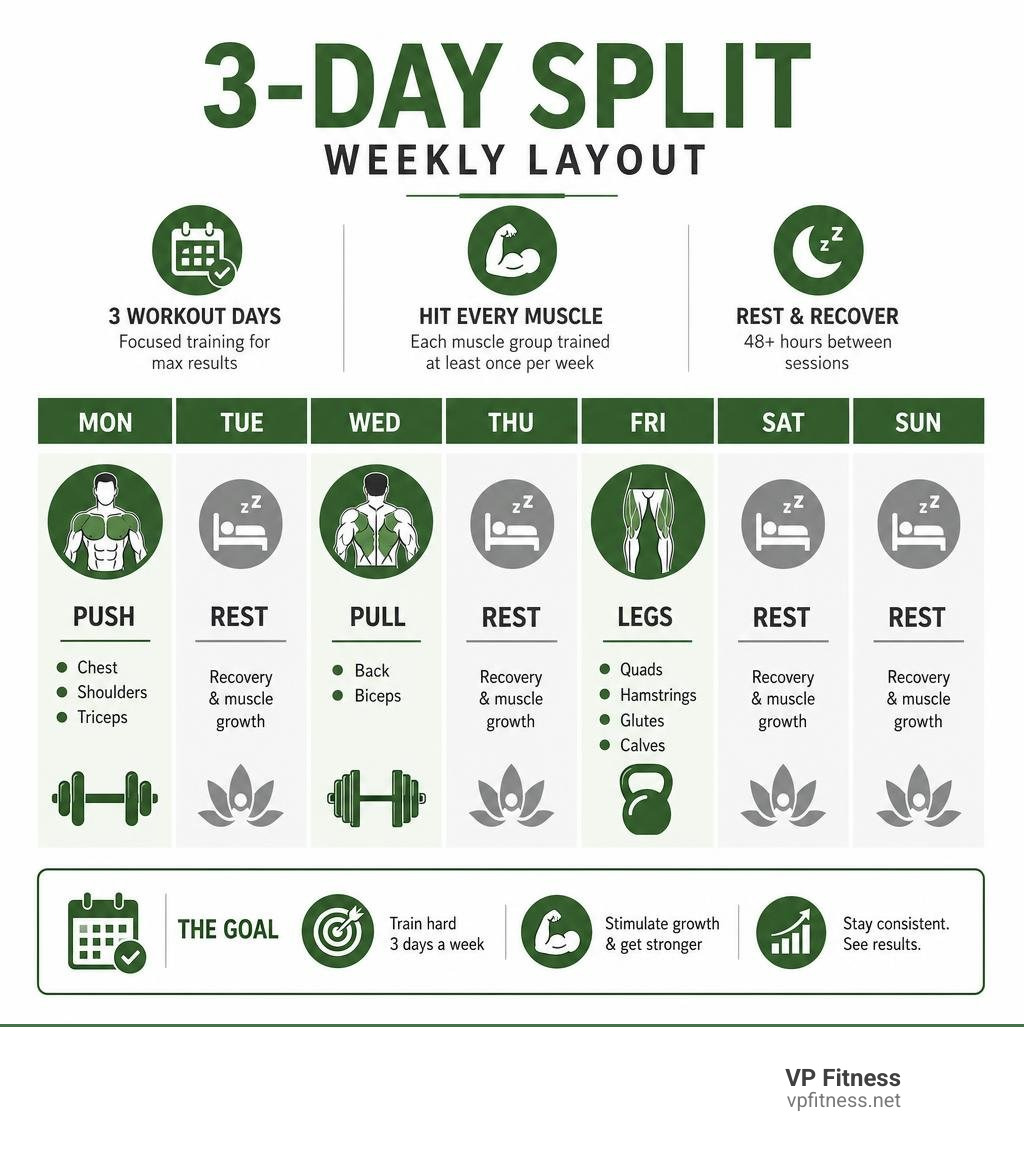
- Push/Pull/Legs (PPL) – Chest, shoulders, triceps / Back, biceps / Legs. Best for hypertrophy focus.
- Full Body 3x – All major muscle groups each session. Best for strength and frequency.
- Upper/Lower/Full Body – A hybrid approach. Good for lifters transitioning between programs.
What makes a 3-day split work for intermediates:
- Trains each muscle group at least once, often twice, per week
- Allows 48+ hours of recovery between sessions
- Fits into a busy schedule with 45-75 minutes per session
- Delivers real hypertrophy and strength gains when volume and progressive overload are dialed in
You’ve moved past the beginner stage. Linear progress is slowing down. You need more structure, not just more effort. That’s exactly the gap a well-designed 3-day split fills.
Research consistently shows that training each major muscle group approximately twice per week produces significantly greater hypertrophy than once-weekly training — even when total weekly volume is the same. And a 3-day split, done right, achieves that frequency without burning you out.
The other reality? 58% of people cite lack of time as the top reason they don’t exercise consistently. Three focused sessions per week solve that problem directly.
I’m Joseph DePena, founder of VP Fitness and a master trainer with over a decade of experience designing 3 day split workouts for intermediate lifters who want real, measurable results. In this guide, I’ll walk you through exactly how to structure your training, choose the right split for your goals, and make every session count.
Basic 3 day split workout for intermediate vocab:
What is a 3-Day Workout Split and Who is it For?
A 3-day workout split is a training structure where we divide our weekly lifting volume across three distinct sessions, usually separated by a day of rest (for example, Monday, Wednesday, and Friday). This setup allows us to train with high intensity during our active sessions while giving our bodies a full 48 to 72 hours of recovery between workouts.
As we transition into 2026, the modern standard of fitness has shifted away from the old-school mentality of “more is always better.” We now understand that muscle tissue doesn’t grow while we are working out; it grows when we are resting, eating, and recovering. A 3-day split strikes the perfect balance between giving our muscles enough of a stimulus to grow and allowing them the downtime they need to repair.
This format is exceptionally versatile, but it is particularly valuable for intermediate lifters. An intermediate is typically someone who has been lifting consistently for one to five years. At this stage, the easy “newbie gains” have dried up, and a simple, unorganized routine will no longer yield results.
If you want to dive deeper into how to optimize your limited gym time, check out our guide with more info on how to get fit with only three days in the gym.
Why a 3 Day Split Workout for Intermediate Trainees Works
To understand why a 3 day split workout for intermediate athletes is so effective, we have to look at the biology of muscle growth. When we lift weights, we trigger a biological process known as Muscle Protein Synthesis (MPS). For beginners, MPS can remain elevated for up to 72 hours after a workout. However, for intermediate lifters, this window shrinks. Our bodies adapt, and MPS usually drops back to baseline within 36 to 48 hours after a training session.
If we only train a muscle group once a week (as in a traditional “bro split”), we miss out on valuable growth windows. By utilizing a 3-day split—especially a full-body or a rotating upper/lower variation—we can stimulate MPS multiple times per week. This matches the findings in scientific research on 3-day splits, which highlights that higher-frequency training is superior for building mass when weekly training volume is equated.
For an intermediate lifter, volume management is the key to breaking plateaus. We need enough total working sets per week to force adaptation, but not so much that we exceed our maximum recoverable volume (MRV). A structured 3-day split allows us to hit a sweet spot of 15 to 24 total working sets per muscle group per week, spread across our sessions. This creates the ideal environment for true muscle growth. If you want to understand the science of this process further, you can read about the meaning of hypertrophy.
Popular 3-Day Split Variations Compared
Not all 3-day splits are created equal. The right split for us depends entirely on our goals, recovery capabilities, and training history. Let’s look at how the three most popular variations stack up against one another.
| Split Type | Weekly Frequency per Muscle Group | Best For | Pros | Cons |
|---|---|---|---|---|
| Full Body | 3x per week | Strength, fat loss, and general fitness | High frequency, highly time-efficient, great for calorie burn | Sessions can be incredibly fatiguing toward the end |
| Upper / Lower (Rotating) | ~1.5x per week | Balanced strength & hypertrophy | Excellent recovery balance, allows more focus per muscle group | Requires a rotating schedule that changes week-to-week |
| Push / Pull / Legs (PPL) | 1x per week (in a 3-day format) | Pure hypertrophy and symmetry | Maximum focus on specific muscle groups, great pump | Lower frequency per muscle group compared to other 3-day options |
Each of these structures has its place. For instance, if our primary goal is to build raw strength on compound lifts, a full-body split is incredibly tough to beat because it gives us three opportunities per week to practice our primary movement patterns. On the other hand, if we want to focus on shaping specific muscles, a PPL split allows us to accumulate more targeted volume in a single session.
If you find yourself wondering if you need more training days to reach your goals, it’s worth taking a moment to learn about the 4-day split to see if a slightly higher frequency fits your lifestyle.
Choosing Your 3 Day Split Workout for Intermediate Goals
Choosing the right split isn’t just about what looks best on paper; it’s about what we can consistently execute. Consistency is the single most important factor in any training routine. If we choose a program that doesn’t fit our weekly schedule, we won’t stick to it, and our progress will stall.
- If your goal is pure muscle growth (hypertrophy): A Push/Pull/Legs (PPL) or a rotating Upper/Lower split is highly effective. These splits allow us to target individual muscle groups with multiple exercises per session, creating the metabolic stress and muscle damage required for growth.
- If your goal is building maximum strength: A Full Body split is our top recommendation. Training compound movements like squats, presses, and pulls three times a week builds incredible neurological efficiency, helping us lift heavier weights over time.
- If your schedule is highly unpredictable: Go with a Full Body split. If we miss a session on a PPL split, we might go more than a week without training our legs or chest. If we miss a session on a Full Body split, we still hit every muscle group twice that week.
To help you make the most informed decision possible, we recommend you explore the ultimate workout split routine guide to find the perfect framework for your body.
Designing the Ultimate 3 Day Split Workout for Intermediate Lifters

When we design an intermediate program, we must prioritize compound movements. These are multi-joint exercises—like squats, deadlifts, overhead presses, and rows—that recruit a massive amount of muscle mass simultaneously. They give us the biggest bang for our buck and form the foundation of our physical strength.
However, as intermediates, we also need to incorporate targeted isolation exercises. These single-joint movements (like bicep curls, lateral raises, and leg extensions) allow us to bring up lagging body parts and accumulate volume without putting excessive stress on our central nervous system.
To help you get started, we have mapped out a highly effective, tried-and-tested 3-day PPL split below. If you want to compare this with other muscle-building templates, you can discover the 3-day muscle building routine that we recommend to our personal training clients.
Day 1: Push Focus (Chest, Shoulders, and Triceps)
Our push day focuses on the anterior (front) side of our upper body. We start with heavy compound presses and move toward lighter isolation movements as the session progresses.
- Barbell Bench Press: 3 sets x 6-8 reps (Rest: 2-3 minutes). Focus on control. To ensure your safety and maximize chest engagement, make sure to master proper bench press form.
- Overhead Dumbbell Press: 3 sets x 8-10 reps (Rest: 2 minutes). Excellent for building strong, stable shoulders.
- Incline Dumbbell Flyes: 3 sets x 10-12 reps (Rest: 90 seconds). Focus on stretching the chest at the bottom.
- Dumbbell Lateral Raises: 4 sets x 12-15 reps (Rest: 60 seconds). Great for building that wide, “V-taper” shoulder look.
- Tricep Overhead Extensions (Cable or Dumbbell): 3 sets x 10-12 reps (Rest: 60 seconds). Keep your elbows tucked close to your head.
- Tricep Rope Pushdowns: 3 sets x 12-15 reps (Rest: 60 seconds). Squeeze your triceps hard at the bottom of each rep.
Day 2: Pull Focus (Back, Biceps, and Posterior Chain)
Our pull day is dedicated to the posterior chain (the back of our body) and our pulling muscles. This session balances out our chest pressing with plenty of rowing and vertical pulling.
- Conventional Deadlift: 3 sets x 5 reps (Rest: 3 minutes). The ultimate test of total-body strength. To protect your lower back, take a moment to read our deadlift technique tips.
- Wide-Grip Pull-Ups: 3 sets x Max Reps (or weighted if you are advanced) (Rest: 2 minutes). If you are struggling with pull-ups, check out our guide and learn the ultimate chin-up progression.
- One-Arm Dumbbell Rows: 3 sets x 8-10 reps per side (Rest: 90 seconds). Pull with your elbows, not your hands, to fully engage your lats.
- Face Pulls: 3 sets x 15 reps (Rest: 60 seconds). Crucial for shoulder health and upper back posture.
- EZ-Bar Bicep Curls: 3 sets x 8-10 reps (Rest: 75 seconds). Control the lowering phase of the movement.
- Hammer Curls: 3 sets x 10-12 reps (Rest: 60 seconds). Builds the forearms and the outer bicep.
Day 3: Legs and Core Focus
Never skip leg day! Our lower body contains the largest muscle groups in our body. Training them hard triggers a massive systemic response that benefits our entire physique.
- Barbell Back Squat: 3 sets x 6-8 reps (Rest: 3 minutes). The king of lower-body exercises. Be sure to master proper squat form to protect your knees and lower back.
- Romanian Deadlifts (RDLs): 3 sets x 8-10 reps (Rest: 2 minutes). Excellent for targeting the hamstrings and glutes. Focus on pushing your hips back.
- Bulgarian Split Squats: 3 sets x 10-12 reps per leg (Rest: 90 seconds). A fantastic unilateral movement to fix muscle imbalances.
- Standing Calf Raises: 4 sets x 15 reps (Rest: 60 seconds). Hold the stretch at the bottom and the contraction at the top.
- Hanging Leg Raises: 3 sets x 12-15 reps (Rest: 60 seconds). Keep the movement slow and controlled; avoid swinging.
- Planks: 3 sets x 60-second hold (Rest: 60 seconds). Focus on squeezing your glutes and drawing your belly button in.
The Science of Hypertrophy and Progressive Overload
To continue making progress as an intermediate, we must understand the primary driver of muscle growth: progressive overload. This is the gradual increase of stress placed upon our body during exercise over time. If we lift the exact same weights for the exact same reps every week, our body has no reason to adapt or grow.
There are several ways to apply progressive overload:
- Increasing the weight (load): Adding 5 pounds to the bar.
- Increasing the repetitions: Doing 10 reps instead of 8 with the same weight.
- Increasing the volume: Adding an extra set to an exercise.
- Improving technique: Performing the lift with better control and a full range of motion.
For intermediates, we highly recommend the Double Progression Method. Under this system, we work within a target rep range (for example, 8 to 12 reps). We keep the weight the same until we can perform the top of the rep range (12 reps) for all of our scheduled sets with perfect form. Only then do we increase the weight for our next workout, which will naturally drop our reps back down to the bottom of the range (8 reps). From there, we work our way back up.
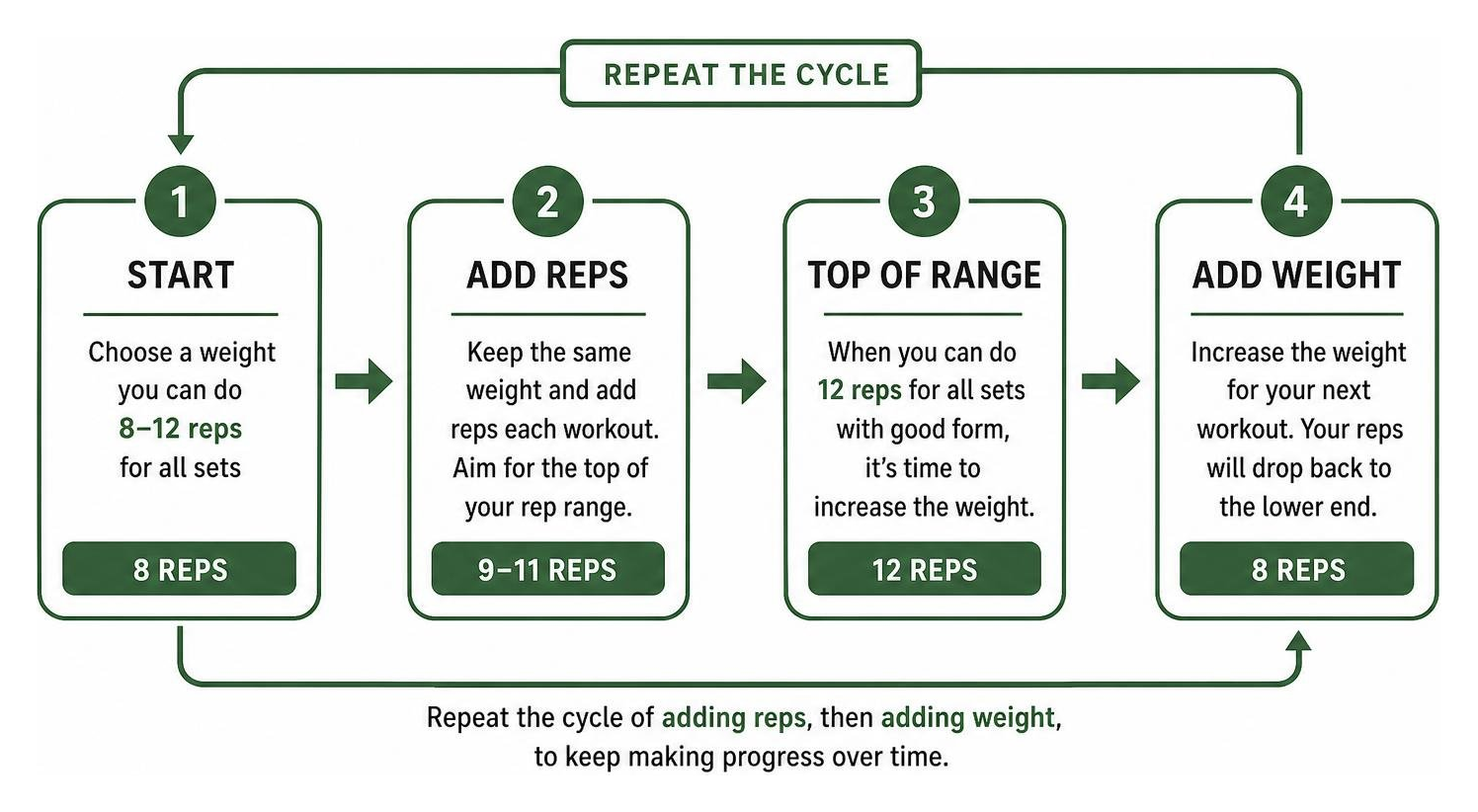
By systematically applying this method, we generate consistent mechanical tension—the most important mechanism for muscle growth. If you want a structured plan to implement these principles, you can learn how to build muscle and read about the science of muscle hypertrophy.
Maximizing Recovery, Nutrition, and Cardio Integration
What we do outside of the gym is just as important as what we do inside of it. Our training sessions act as the blueprint, but our recovery, nutrition, and sleep are the actual construction workers that build the muscle.
First, let’s talk about nutrition. To support muscle growth, we must consume enough protein to repair the muscle tissue we break down in the gym. We recommend aiming for 1.6 to 2.2 grams of protein per kilogram of body weight (or roughly 0.8 to 1 gram per pound of body weight) daily. On our training days, we want to prioritize complex carbohydrates (like oats, rice, and sweet potatoes) to fuel our workouts, while keeping our protein intake consistently high on rest days.
Second, never underestimate the power of sleep. Research shows that poor sleep quality is directly associated with decreased muscle strength and slower recovery. Aim for 7 to 9 hours of high-quality sleep every night.
Finally, we can easily integrate cardio into a 3-day split without hurting our lifting progress. We recommend performing 2 to 3 sessions of Low-Intensity Steady State (LISS) cardio—such as brisk walking, cycling, or using an elliptical—for 20 to 30 minutes on our rest days. This promotes blood flow, aids active recovery, and supports our cardiovascular health without putting extra stress on our joints.
To learn more about optimizing your off days, you can read why the 3-day split is the king of consistency.
Frequently Asked Questions about 3-Day Splits
Can you build muscle training only 3 days a week?
Yes, absolutely! Many lifters believe they need to train five or six days a week to build a great physique, but this is a myth. Muscle growth is driven by total weekly training volume and intensity, not by how many days we walk through the gym doors.
As long as we are hitting our target volume (typically 10 to 20 working sets per muscle group per week) and taking our sets close to mechanical failure, three days is more than enough. In fact, many busy lifters make better progress on a 3-day split because the extra rest days allow them to train with much higher energy and focus during their active sessions. For further proof, you can look at the scientific research on 3-day gym routines.
How should I incorporate cardio into a 3-day split?
The best way to incorporate cardio into a 3-day split is to perform it on your non-lifting days (such as Tuesdays, Thursdays, or Saturdays) or immediately after your strength training sessions.
Avoid doing high-intensity interval training (HIIT) right before your lifting sessions, as this will drain your glycogen stores and limit the amount of weight you can lift. Stick to low-intensity steady-state (LISS) cardio, which supports your aerobic base, burns extra calories, and speeds up recovery by flushing lactic acid out of your muscles.
When should I transition from a 3-day split to a 4-day split?
You should consider transitioning to a 4-day split when your progress has completely stalled for several weeks, despite having your nutrition, sleep, and progressive overload dialed in.
As we become more advanced, our bodies require more volume to trigger new muscle growth. Eventually, cramming all of that volume into three sessions can make our workouts too long and exhausting. Moving to a 4-day split allows us to spread that extra volume across another day, keeping our sessions sharp and effective. If you feel like you have reached that point, you can explore 5-day splits to see if a higher-frequency routine is right for you.
Conclusion
A 3 day split workout for intermediate lifters is a highly effective, sustainable, and scientifically proven way to build a strong, healthy body. It respects your busy schedule while giving your muscles the exact stimulus and recovery time they need to grow.
We believe that fitness should enhance your life, not consume it. We specialize in creating highly personalized training and nutrition plans tailored to your unique biology, lifestyle, and goals. Whether you are looking to break through an intermediate lifting plateau or simply want to train in a clean, professional, and supportive environment, we are here to help you every step of the way.
Are you ready to take your training to the next level? Unlock your potential with our ultimate guide to workout splits and let us help you build the physique you deserve.