

Unlock Your Gains: A Complete 3-Day Muscle Building Routine

Unlock Your Gains: A Complete 3-Day Muscle Building Routine
Why a 3-Day Workout Routine for Mass Actually Works
A 3 day workout routine for mass is one of the most effective and time-efficient ways to build muscle — especially if your schedule doesn’t allow for daily gym sessions.
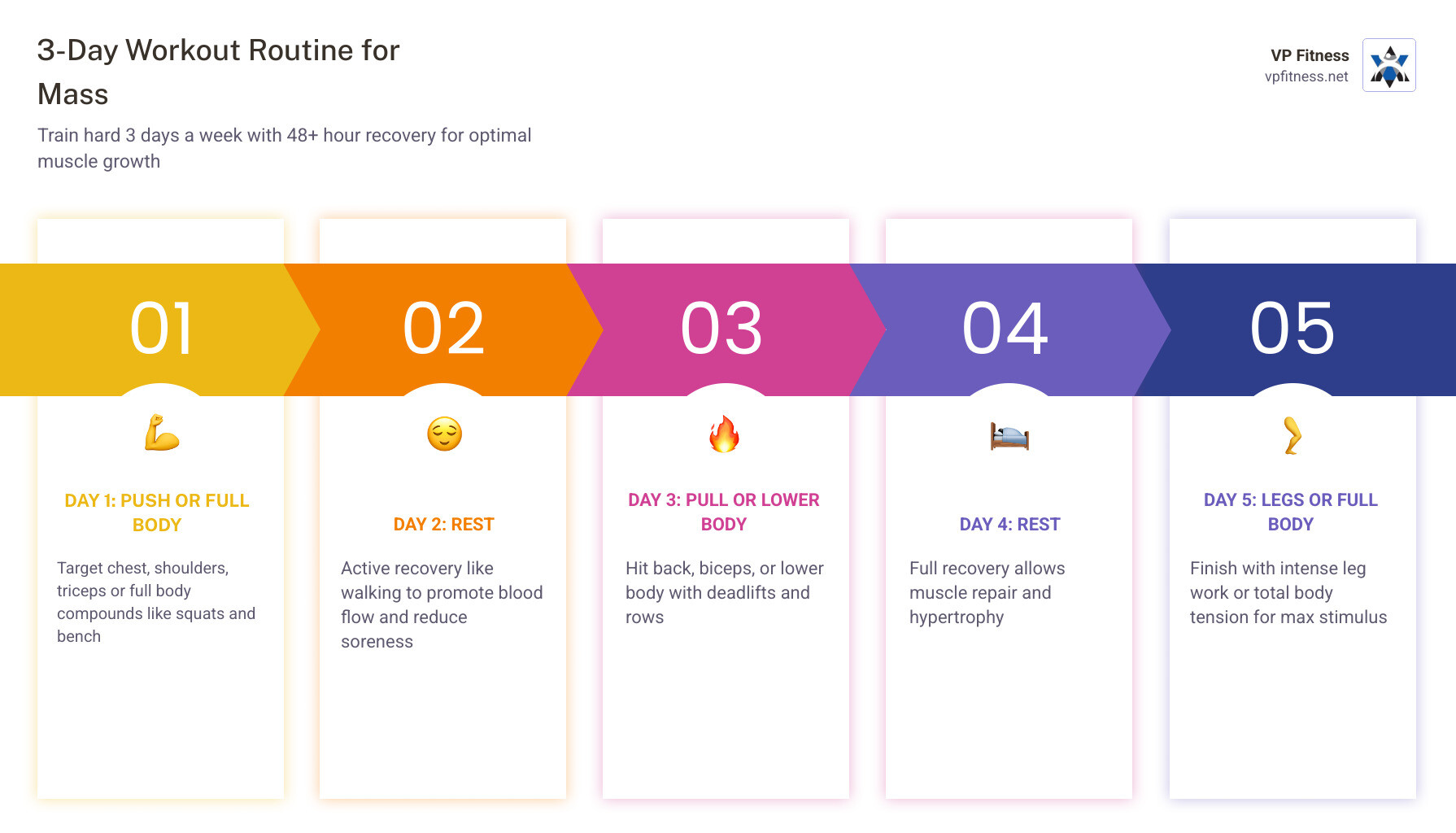
Here’s a quick snapshot of how it works:
| Day | Training Focus | Rest |
|---|---|---|
| Monday | Workout 1 (e.g., Push or Full Body) | – |
| Tuesday | Rest | Active recovery |
| Wednesday | Workout 2 (e.g., Pull or Lower Body) | – |
| Thursday | Rest | Active recovery |
| Friday | Workout 3 (e.g., Legs or Full Body) | – |
| Saturday | Rest | Recovery |
| Sunday | Rest | Recovery |
The core idea is simple: train hard three days a week, give your muscles time to recover and grow, and repeat consistently. Research supports that beginners and intermediate lifters can achieve significant hypertrophy with just three weekly sessions — as long as training intensity and nutrition are dialed in.
Three days per week gives you:
- Enough stimulus to trigger muscle growth
- 48+ hours of recovery between sessions
- Time to stay consistent without burning out
Whether you’re a busy professional juggling work and life, or someone just getting started with weight training, three days is a realistic, sustainable commitment that delivers real results.
I’m Joseph DePena, founder of VP Fitness and a master trainer with over a decade of experience designing effective 3 day workout routines for mass for clients at every fitness level. In the sections below, I’ll walk you through everything you need to build your best routine — from split selection and exercise programming to nutrition and recovery.
3 day workout routine for mass word list:
What is a 3 Day Workout Routine for Mass?
At its heart, a 3-day split is a training schedule where we hit the gym three times per week. But for those of us in Providence looking to pack on serious size, it’s not just about showing up; it’s about how we organize those sessions. The goal is to provide enough direct training for major muscles while allowing the body the necessary downtime to actually build the tissue.
You see, muscle doesn’t grow while we are lifting heavy weights; it grows while we are resting. When we lift, we create microscopic tears in the muscle fibers. During recovery, our bodies repair these tears, making the fibers thicker and stronger. This process is known as Building Blocks: Understanding Muscle Hypertrophy.
The beauty of a 3-day routine is the built-in recovery. By training on non-consecutive days (like Monday, Wednesday, and Friday), we give our Central Nervous System (CNS) a breather. If the CNS is fried, your strength will tank, and your mass gains will stall. We focus primarily on compound movements—exercises like squats, deadlifts, and presses that use multiple joints and muscle groups. These are the “heavy hitters” that trigger a massive anabolic hormone response, including testosterone and growth hormone.
While isolation exercises (like bicep curls or calf raises) have their place for fine-tuning, the foundation of a 3 day workout routine for mass must be built on big lifts. Research on training frequency and strength gains suggests that for many, training a muscle group 2-3 times per week is the “sweet spot.” In a 3-day full-body split, we hit every muscle three times a week. In a Push/Pull/Legs split, we hit them once or twice depending on how the weeks rotate. Both are scientifically proven to move the needle.
Popular 3-Day Split Variations for Hypertrophy
Choosing the right split is like choosing the right suit—it needs to fit your lifestyle and your goals. We often see people getting overwhelmed by the options, but for building mass, three specific variations stand out.
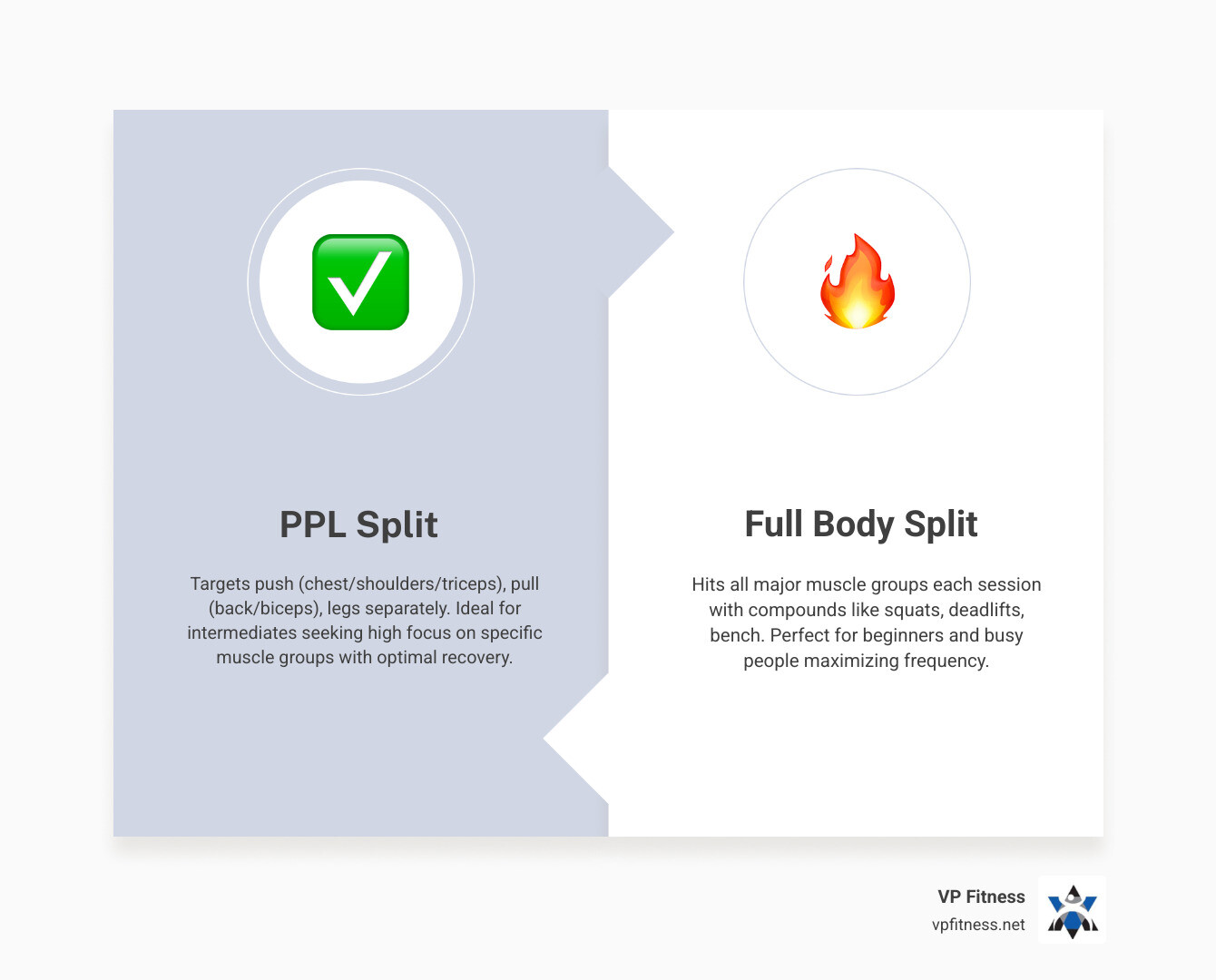
| Split Type | Best For | Main Advantage |
|---|---|---|
| Push/Pull/Legs (PPL) | Intermediates | High focus on specific muscle groups |
| Full Body | Beginners/Busy People | Maximum frequency for major lifts |
| Upper/Lower/Full | Hybrid Seekers | Balanced volume and recovery |
Each of these follows a specific Workout Split Routine logic. The “Bro Split” (training one muscle group once a week) is popular in old-school bodybuilding circles, but for most natural lifters, it doesn’t provide enough frequency. Instead, we look toward movement patterns and muscle synergy to maximize our time. If you want a deeper dive, check out our Workout Splits: Ultimate Guide.
The Push/Pull/Legs 3 Day Workout Routine for Mass
The PPL split is a classic for a reason. It groups muscles that naturally work together.
- Push Day: Targets the chest, shoulders, and triceps. All these muscles are involved in “pushing” weight away from your body.
- Pull Day: Focuses on the back and biceps. These are your “pulling” muscles.
- Leg Day: Dedicated to the quads, hamstrings, glutes, and calves.
By grouping synergistic muscles, we avoid “overlapping” fatigue. For example, if you train chest on Monday and shoulders on Tuesday, your shoulders might already be tired from the chest presses. PPL solves this by hitting them all in one go. If you’re looking for a structured path, our Your 12-Week PPL Blueprint: Build Muscle & Boost Strength is a great place to start. This PPL Split Workout Plan allows for incredible leg day intensity because you aren’t worried about saving energy for upper body movements.
Full-Body 3 Day Workout Routine for Mass
For those who want to master the “big three” (squat, bench, deadlift), the full-body split is king. In this version, we perform Best Muscle Exercises every single session.
A typical session might include:
- Squats (Legs/Core)
- Bench Press (Chest/Shoulders/Tris)
- Rows (Back/Bis)
- Overhead Press (Shoulders)
This approach creates significant metabolic stress and total body tension. Because you are hitting every muscle group three times a week, your body stays in a constant state of protein synthesis. It’s an efficient way to learn How to Build Muscle because you get so much practice with the technical compound lifts.
Structuring Your Mass-Building Schedule and Volume
To turn a 3 day workout routine for mass into actual muscle, we have to look at the numbers. Volume (sets x reps x weight) is the primary driver of hypertrophy.
Research recommends a training volume of roughly 8-15 sets per week for large muscle groups (like the back and quads) for optimal growth. In a 3-day split, we distribute this volume across our sessions.
- Rep Ranges: For mass, we generally stay in the 6-12 rep range. This is the “hypertrophy zone” that balances heavy mechanical tension with metabolic stress.
- Rest Intervals: Don’t rush! For big compound lifts, rest 2-3 minutes. This allows your ATP stores to recover so you can lift heavy on the next set. For isolation moves, 60-90 seconds is usually plenty.
- Time Under Tension (TUT): Instead of just throwing the weights around, focus on a controlled eccentric (lowering) phase. A 2-0-2 tempo (2 seconds down, 0 rest, 2 seconds up) is a solid standard.
We also can’t ignore the importance of the kitchen. Scientific research on optimal protein intake for growth suggests consuming 1.6 to 2.2 grams of protein per kilogram of body weight (about 0.7 to 1 gram per pound). Without this, your Workout for Hypertrophy is just making you tired, not bigger.
Progressive Overload and Avoiding Plateaus
The most common mistake we see in Providence gyms is people lifting the same weights for months and wondering why they don’t look different. To grow, you must provide a “shock” to the system. This is called progressive overload.
You can progress by:
- Increasing the weight on the bar
- Doing more reps with the same weight
- Improving your form/technique
- Decreasing rest time (though weight and reps are better for mass)
Research on repetition progression for muscular adaptations shows that both increasing load and increasing reps are effective for growth. We recommend a “Rep Goal” system. If your goal is 3 sets of 10, and you hit 10 reps on all three sets with perfect form, it’s time to bump the weight up by 5 pounds next week. This ensures you Gain Muscle Quickly by never letting your body get too comfortable.
Don’t forget the Mind-Muscle Connection. Don’t just move the weight from point A to point B; feel the target muscle contracting. And every 6-8 weeks, take a deload week where you reduce your intensity by 20-30% to let your joints and CNS fully recover.
Nutrition and Supplements for Maximum Growth
You can’t build a house without bricks, and you can’t build a physique without a calorie surplus. To gain mass, you need to eat more calories than you burn. A slight surplus of 250-500 calories above your maintenance level is usually enough to gain muscle without putting on excessive body fat. This is the foundation of any Nutrition for Muscle plan.
While whole foods should be 90% of your diet, supplements can provide that extra 10% edge.
- Creatine Monohydrate: This is the most researched supplement in history. Research on creatine and ATP production shows it helps your body produce energy faster during high-intensity lifting. Aim for 3-5 grams daily.
- Whey Protein: A convenient way to hit your protein targets, especially post-workout when your muscles are primed for nutrients.
- Pre-Workout: Can help with focus and blood flow (the “pump”), but use it sparingly so you don’t become dependent on caffeine.
Check out our Best Muscle Supplements Guide for a full breakdown. Also, keep your hydration in check! If you’re taking creatine, we recommend men aim for up to 3.7 liters of water daily and women 2.7 liters. Muscles are mostly water; a dehydrated muscle is a weak muscle.
Frequently Asked Questions about 3-Day Splits
Is 3 days a week enough for muscle growth?
Absolutely. Especially for beginners or those returning after a break, the body is highly responsive to new stimuli. This “newbie gain” phase allows for rapid progress even with moderate frequency. For intermediate lifters, a 3-day split works because it allows you to train with much higher intensity since you know you have a full rest day coming up. It’s all about maximizing Lean Muscle Mass through quality over quantity.
Should I do cardio on a 3-day split?
We generally recommend “Active Recovery” on your off days. A 20-30 minute walk or light cycling is great for heart health and blood flow, which actually helps clear out metabolic waste and speeds up recovery. However, avoid intense HIIT sessions right before a heavy leg day, as it can interfere with your strength. If your goal is a Muscle Definition Workout, a little Low-Intensity Steady State (LISS) cardio is a great tool.
How long should I follow this routine?
Consistency is the secret sauce. We recommend sticking to a specific 3 day workout routine for mass for at least 8 to 12 weeks. This gives your body time to adapt and allows you to accurately track your strength progression. After 12 weeks, you might choose to swap some exercises or increase the volume. Always pair your training with a consistent Muscle Gain Diet to see the best changes in body composition.
Conclusion
Building a powerful, muscular physique doesn’t require living in the gym six days a week. By following a structured 3 day workout routine for mass, prioritizing heavy compound lifts, and fueling your body with the right nutrition, you can achieve incredible results while still having a life outside the weight room.
At VP Fitness in Providence, we pride ourselves on providing a professional, clean environment where you can focus on your goals. Whether you need individualized training or just a smoothie bar to refuel after a brutal leg session, we’re here to help you unlock your gains.
Ready to take the next step? Check out our Workout Split Routine: Ultimate Guide or come visit us in person to see how our personalized coaching can fast-track your progress.