

Why the 3 Day Weight Split is the King of Consistency

Why the 3 Day Weight Split is the King of Consistency
Why the 3 Day Weight Lifting Split is the King of Consistency
A 3 day weight lifting split is a training schedule where you work out three times per week, hitting all major muscle groups across those sessions while using the remaining days for recovery.
Here’s what you need to know at a glance:
| Question | Quick Answer |
|---|---|
| What is it? | A weekly workout plan with 3 structured lifting sessions |
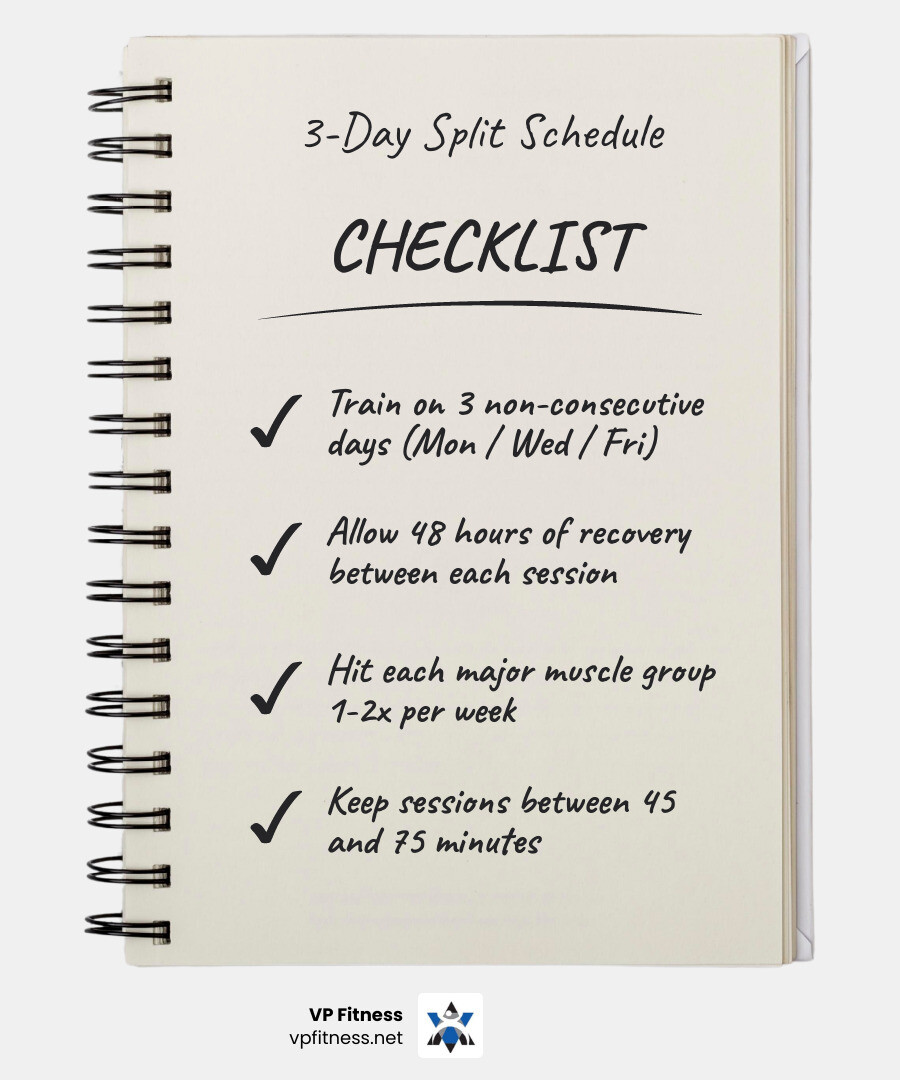
| Best schedule | Monday / Wednesday / Friday (or any 3 non-consecutive days) |
| Who is it for? | Beginners, intermediates, and busy professionals |
| Can you build muscle? | Yes — with proper volume and progressive overload |
| How long per session? | 45 to 75 minutes |
| Main benefit | Balances training stimulus with full recovery |
Most people think more gym days automatically means better results. It doesn’t.
Research shows that training each major muscle group twice per week produces greater muscle growth than once per week — even when total weekly volume is the same. A well-designed 3-day split does exactly that, without running your body into the ground.
For busy professionals especially, the 3-day split is a game-changer. You get a real training stimulus, real recovery time, and a schedule you can actually stick to week after week. That last part — consistency — is where most programs succeed or fail.
The best program is the one you actually follow. And three days a week is something most people can genuinely commit to for the long haul.
I’m Joseph DePena, founder of VP Fitness and a master trainer with over a decade of experience building personalized 3 day weight lifting split programs for clients at every fitness level. In this guide, I’ll walk you through everything you need to structure your training, maximize your results, and make the 3-day split work for your life.
3 day weight lifting split word list:
- 12 week push pull legs program
- 4 day split hitting each muscle twice
- 5 day split hitting each muscle twice
What is a 3 Day Weight Lifting Split?
A 3-day split is simply a way to organize resistance training into three lifting sessions per week. Instead of lifting every day, we spread your weekly work across three focused workouts and leave room for recovery, work, family, and life.
If you are new to training structure, our Workout Split Routine Ultimate Guide breaks down how splits work in general.
What makes a 3 day weight lifting split effective is not magic. It is good programming.
A strong 3-day plan does three things well:
- It gives each major muscle group enough weekly volume.
- It lets you train hard without piling on junk volume.
- It provides at least one rest day between sessions in most cases.
That recovery piece matters. Your muscles, joints, and nervous system need time to adapt after hard training. We do not get stronger during the workout itself. We get stronger after the workout, when recovery is handled well.
Another important point: when weekly volume is matched, a 3-day full-body split can produce strength and muscle gains similar to a 4-day split. In plain English, more days is not automatically more progress.
3 Day Weight Lifting Split vs. Bro Splits
A classic bro split usually trains one body part per day: chest Monday, back Tuesday, shoulders Wednesday, and so on. That can work, but for many natural lifters it often means each muscle gets trained hard only once per week.
That is a problem.
Muscle protein synthesis rises after training, but it does not stay elevated forever. For most lifters, stimulating a muscle more than once weekly is often a better way to grow. That is one reason training each major muscle group twice per week tends to outperform once-per-week training when total weekly work is equal.
You can learn more about that growth process in Building Blocks: Understanding Muscle Hypertrophy.
Compared with bro splits, a 3 day weight lifting split usually offers:
- Better training frequency for most muscles
- More practice on key lifts like squats, rows, and presses
- Less pressure to destroy one body part in a marathon session
- Better recovery for busy or stressed lifters
For a deeper outside perspective on frequency and split design, see Scientific research on training frequency.
The short version: chasing soreness is not the same as chasing progress. Your chest does not need its own national holiday to grow.
Who Should Use a 3-Day Split?
A 3-day split works especially well for:
- Beginners who need practice with basic movement patterns
- Intermediate lifters who want a sustainable muscle-building plan
- Busy professionals who cannot realistically train 5 or 6 days every week
- People returning after a layoff
- Recovery-focused athletes balancing lifting with sports, work, or stress
Beginners often make excellent progress on three days per week because the training stimulus is still new. They do not need huge amounts of volume to gain strength and muscle.
Intermediate lifters also do well because three weekly sessions allow enough intensity while still protecting recovery. And for adults with real schedules, this is often the sweet spot between ambition and reality.
If your goal is practical, sustainable progress, our article Full Body Gains: Maximize Muscle in Just 3 Days a Week is a great next read.
Popular Variations of the 3 Day Weight Lifting Split
Not all 3-day splits look the same. The best version depends on your experience level, goals, and available equipment.
Here is a simple comparison:
| Split Type | Best For | Main Benefit | Possible Drawback |
|---|---|---|---|
| Full Body x3 | Beginners, fat loss, busy schedules | High frequency and lots of lift practice | Sessions can feel demanding |
| Push/Pull/Legs | Intermediate lifters, hypertrophy | Clear structure and good muscle grouping | Each muscle may get direct work only once weekly |
| Upper/Lower/Full | Advanced beginners, intermediates | Great balance of frequency and recovery | Slightly more planning required |
If you want more detail on movement-based training, see our PPL Split Workout Plan. For another sample structure, this external guide on a 3 Day Gym Workout Routine (The Ultimate Guide w/ Free PDF) – The Fitness Phantom offers useful examples.
Across all versions, we like to anchor workouts around compound lifts:
- Squat or squat variation
- Hinge or deadlift variation
- Horizontal press
- Vertical press
- Horizontal pull
- Vertical pull
Then we add isolation work where needed for arms, shoulders, calves, core, or lagging muscle groups.
The Full Body Approach for Beginners
For most beginners, full body is the best place to start.
Why? Because it teaches the big movement patterns faster. When you squat, press, row, and hinge multiple times per week, you build skill, confidence, and coordination. More practice usually means better technique and steadier progress.
A basic full-body week might look like this:
- Day 1: Squat, bench press, row, leg curl, curls
- Day 2: Deadlift, overhead press, pulldown, split squat, triceps
- Day 3: Leg press, incline dumbbell press, cable row, hip hinge, core
That structure keeps all major muscle groups involved several times each week. It also helps with symmetry. When every session includes some lower-body work, it becomes harder to “accidentally” skip leg day for six months. Funny how that happens.
For more on muscle-building basics, visit How to Build Muscle. You can also review a simple beginner example here: 3-Day Split: Beginner – JEFIT.
A good beginner setup usually includes:
- 4 to 6 exercises per workout
- 2 to 4 sets per exercise
- 6 to 12 reps for most movements
- 45 to 75 minutes total per session
Push/Pull/Legs for Intermediate Gains
Push/Pull/Legs, or PPL, organizes training by movement pattern:
- Push: chest, shoulders, triceps
- Pull: back, rear delts, biceps
- Legs: quads, hamstrings, glutes, calves
This is a clean, intuitive system. It teaches how muscles work together and makes exercise selection straightforward.
We often use a 3-day PPL format for intermediate lifters who want more focus per session and enjoy a bodybuilding feel without living in the gym. It works especially well when we prioritize compound lifts first, then add accessory work.
A sample week might look like:
- Push: bench press, incline dumbbell press, overhead press, lateral raise, triceps pressdown
- Pull: pull-up or pulldown, barbell row, seated cable row, rear delt fly, curls
- Legs: squat, Romanian deadlift, leg press, calf raise, abs
For a VP Fitness take on this style, see Unlock Your Gains: A Complete 3-Day Muscle Building Routine.
One limitation: direct frequency for each muscle group may be lower than full body unless you program overlap carefully. That is why many lifters do well with a hybrid option such as upper/lower/full body, which blends structure with better frequency. This outside resource on StrengthLog’s 3-Day Bodybuilding Split is a useful example of that approach.
Maximizing Results: Progressive Overload and Recovery
If the split is the schedule, progressive overload is the engine.
Progressive overload means asking your body to do slightly more over time. That can mean:
- Adding weight
- Adding reps
- Adding sets
- Improving technique
- Using the same weight with less effort
- Reducing rest slightly on accessory work
The easiest method for most people is double progression:
- Pick a rep range, like 6 to 10.
- Use the same weight until you hit the top of the range on all sets.
- Increase the load slightly next workout.
Example:
- Week 1 bench press: 3 x 6 at 135
- Week 2: 3 x 8 at 135
- Week 3: 3 x 10 at 135
- Week 4: move to 140 and start again at 6 to 8 reps
This works beautifully in a 3 day weight lifting split because recovery is built in.

General set and rep guidelines:
- Strength focus: 3 to 6 reps, 2 to 4 minutes rest
- Hypertrophy focus: 6 to 12 reps, 60 to 120 seconds rest
- Isolation work: 10 to 15 reps, 45 to 90 seconds rest
We usually recommend keeping compound lifts 1 to 2 reps shy of failure most of the time. Going all-out on every set sounds hardcore, but in practice it often just trashes recovery and makes next week worse.
How long should you stay on one plan? Usually 8 to 12 weeks is a strong minimum. Many lifters see noticeable strength changes by 10 weeks, and visible physique changes typically follow with consistent nutrition. Deload weeks every 6 to 8 weeks can help if fatigue is climbing. That usually means reducing load or total volume by about 20 to 30% for one week.
If you are curious when a higher-frequency option makes sense, compare this approach with our 4-Day Split: Hitting Each Muscle Twice. For another minimalist progression philosophy, see 3 Day Weight Lifting Program Routine & Key Lifts For Maximum Gains.
Nutrition and Supplementation for a 3 Day Weight Lifting Split
Training is only part of the picture. If we want muscle growth, nutrition has to support it.
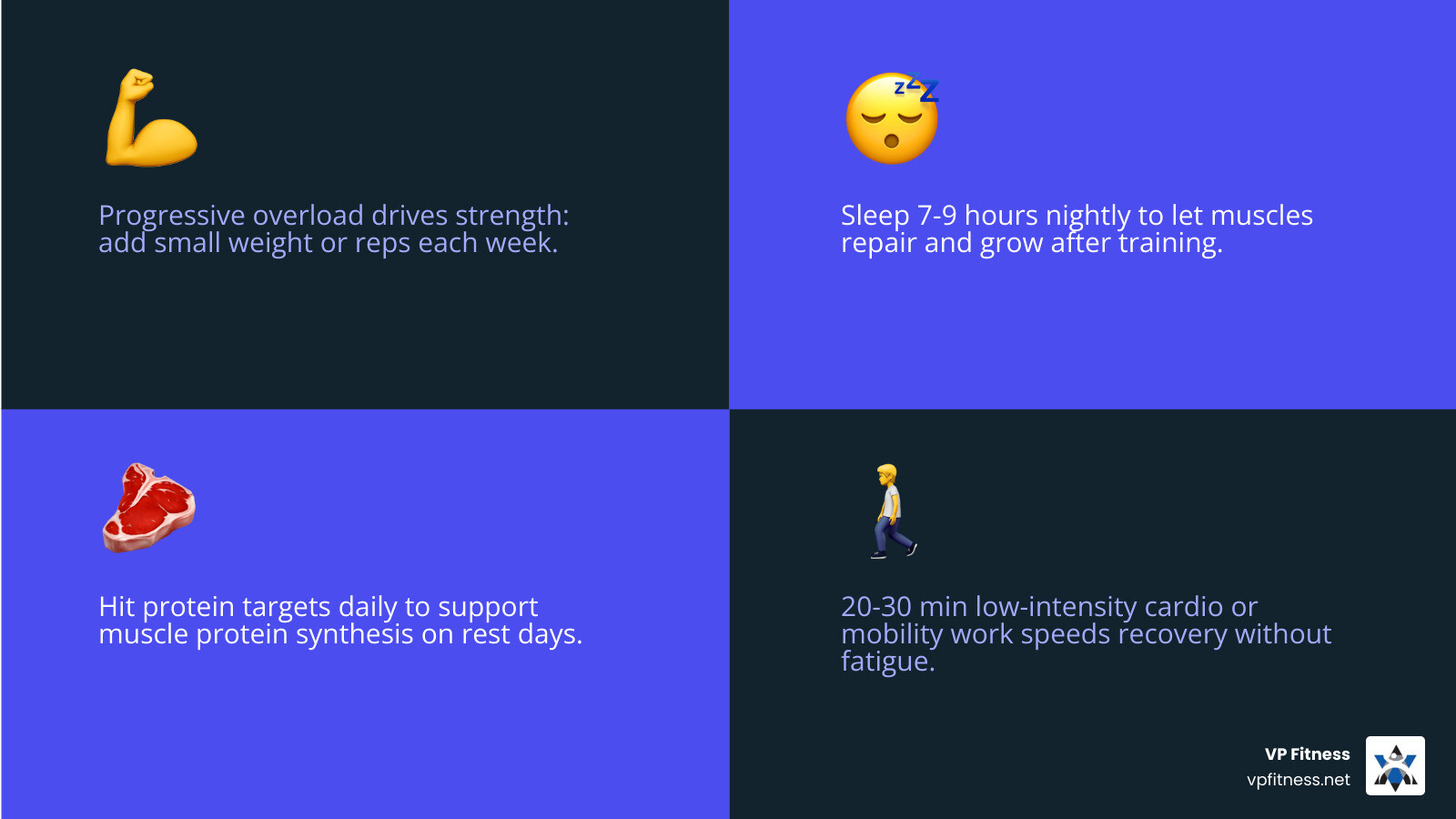
Protein is the first priority. Research consistently supports roughly 1.6 to 2.2 grams of protein per kilogram of body weight for muscle building. That is a practical sweet spot for most lifters.
Then we match calories to the goal:
- Muscle gain: slight calorie surplus, often 250 to 500 calories above maintenance
- Fat loss: small calorie deficit, often around 250 to 500 calories below maintenance
- Recomp or maintenance: hold calories near maintenance while training hard
Hydration matters too, especially if you are using creatine or training hard in long sessions.
As for supplements, keep it simple:
- Creatine monohydrate: 3 to 5 grams daily
- Protein powder: useful if whole-food protein is low
- Pre-workout: optional, not required
- Caffeine: effective, but do not use it as a substitute for sleep
If you are comparing weekly training structures, our 5-Day Split: Hitting Muscle Twice Guide helps show how nutrition demands can change as training frequency rises. For another sample high-effort 3-day routine, see Bulldozer Training 3 Day Workout Split – Muscle & Strength.
At VP Fitness in Providence, we put a big emphasis on individualized nutrition guidance because no two bodies, schedules, or appetites are exactly alike.
The Role of Active Recovery and Cardio
Rest days are not wasted days. They are where adaptation happens.
Active recovery can include:
- 20 to 30 minutes of walking
- Easy cycling
- Mobility work
- Light stretching
- Foam rolling
- Easy core work
Low-intensity steady-state cardio is usually the best fit alongside a 3-day lifting routine. It supports heart health, helps manage body composition, and usually does not beat up recovery the way too much HIIT can.
For a deeper comparison, read Strength Training vs High Intensity Cardio.
And please do not overlook sleep. If your training is great but your sleep is a mess, progress often stalls. Aim for 7 to 9 hours when possible. That is not glamorous advice, but neither is being tired, sore, and wondering why your squat has not moved in a month.
For a practical training-and-recovery perspective, this video on The Perfect 3 Day Full Body Workout Split For Strength and Athleticism is worth watching.
Frequently Asked Questions about 3-Day Splits
Is 3 days a week enough to build muscle?
Yes. For most beginners and intermediate lifters, three days per week is absolutely enough to build muscle.
The key is weekly volume and progression, not just how many days you show up. If you train hard, recover well, and hit enough productive sets across the week, you can make excellent progress on three sessions.
In fact, a 3-day split is often more effective than a 5-day split people cannot consistently follow. More days only help if they improve total productive training, not if they create fatigue, missed workouts, and guilt.
This external overview, 3 Day Split Workout – Complete Guide (2026) – Hevy app, also highlights that consistency is the real multiplier.
Can I do a 3-day split at home with minimal equipment?
Yes again.
A home-friendly 3 day weight lifting split can work well with:
- Adjustable dumbbells
- Resistance bands
- An adjustable bench
- A pull-up bar
- Bodyweight variations
Adjustable dumbbells are especially useful because they save space, cost less than a full rack, and make supersets easier.
Home exercise swaps can include:
- Goblet squat instead of barbell squat
- Dumbbell Romanian deadlift instead of barbell deadlift
- Push-ups or dumbbell floor press instead of bench press
- One-arm dumbbell row instead of cable row
- Band pulldown or pull-up instead of lat pulldown
- Bulgarian split squat instead of leg press
No, your garage does not need to look like a superhero movie set to be effective.
How long should each session last in a 3-day split?
Most sessions should land in the 45 to 75 minute range.
That is enough time for:
- A 5 to 10 minute warm-up
- 4 to 6 main exercises
- Appropriate rest between sets
- A short cooldown if needed
If your workouts regularly creep past 90 minutes, one of a few things is probably happening:
- Too much volume
- Too many exercises
- Too much scrolling between sets
- Too much socializing
- Rest periods are drifting
Keep the structure tight. Use a timer if needed. For most goals, efficient workouts beat endless workouts.
A smart warm-up should include:
- 3 to 5 minutes of light movement
- Dynamic mobility for the joints you will train
- 2 to 4 ramp-up sets before your first heavy compound lift
Conclusion
The 3 day weight lifting split earns its crown because it is realistic, effective, and repeatable.
It gives us enough volume to build muscle, enough frequency to practice the basics, and enough recovery to come back stronger each session. That is why it works so well for beginners, intermediate lifters, and busy adults trying to balance fitness with everything else on their calendar.
If you want a plan you can actually sustain, this is one of the best options available.
At VP Fitness, we build personalized training and nutrition strategies around real lives, real schedules, and real recovery needs. If you want help choosing the right split, refining your exercise selection, or building a program around your goals, explore our Comprehensive Fitness Programs and our full Workout Splits Ultimate Guide.
The best split is not the fanciest one. It is the one you can follow next week, next month, and next year.
And that is exactly why the 3-day split is king.